


Where to Buy Merv 8 Filters
In the landscape of industrial and commercial air and fluid management, the search for specific filtration ratings often begins with the Minimum Efficiency Reporting Value (MERV). For many facility managers, engineers, and procurement specialists, determining where to buy MERV 8 filters involves more than simply finding a retail supplier; it requires a deep understanding of how these ratings translate to operational efficiency, equipment longevity, and process purity. While MERV 8 is a standard frequently associated with HVAC systems, its equivalent performance levels are often required in more demanding industrial settings where standard disposable filters are insufficient.
This guide explores the procurement landscape for MERV 8-rated filtration solutions, the technical distinctions between commercial and industrial-grade components, and why precision-engineered Filter Discs & Packs are often the superior choice for high-stakes industrial environments.
Understanding MERV 8 Filtration Standards in Industrial Contexts
The MERV scale, developed by ASHRAE, ranges from 1 to 16, with higher numbers indicating a greater ability to capture smaller particles. A MERV 8 filter is designed to capture at least 70% to 85% of particles in the 3.0 to 10.0-micron range. In a standard commercial setting, this includes dust, lint, pollen, and dust mites.
However, in an industrial context—such as chemical processing, food and beverage production, or hydraulic machinery—the "MERV 8" requirement often serves as a baseline for particle retention. Engineers must look beyond the rating and consider the environment. Standard MERV 8 filters are typically made of pleated synthetic fibers or fiberglass housed in cardboard frames. These are ill-suited for high-temperature, high-pressure, or chemically aggressive environments. In these scenarios, the search for where to buy MERV 8 filters shifts toward manufacturers of stainless steel wire mesh components that can provide equivalent or superior filtration accuracy while maintaining structural integrity.
Commercial vs. Industrial Procurement: Where to Buy Merv 8 Filters
When determining the best source for filtration components, the first step is identifying the application's severity.
1. Big-Box Retailers and General HVAC Suppliers
For standard office buildings, retail spaces, or residential-style HVAC units, big-box retailers and general online marketplaces are the most common sources. These suppliers offer mass-produced, disposable filters. While cost-effective for general air handling, they lack the customization and durability required for industrial process filtration.
2. Specialized Industrial Distributors
Industrial distributors carry a wider range of filtration media, including high-capacity pleats and bag filters. They are a viable option for facilities that require standard sizes but need higher dust-holding capacities than what is available at retail.
3. OEM Manufacturers and Custom Fabricators
For engineers designing proprietary machinery or operating in specialized sectors like pharmaceutical or chemical manufacturing, the best place to buy is directly from an OEM manufacturer like Kaifil. When a process requires the particle retention of a MERV 8 filter but involves high-viscosity fluids or corrosive gases, custom-fabricated stainless steel Filter Discs & Packs provide a permanent, cleanable, and highly precise solution that disposable filters cannot match.
Key Evaluation Criteria for Industrial Filtration Components
Before finalizing a purchase, technical professionals must evaluate several critical factors to ensure the chosen filter meets the demands of the application. Simply matching a MERV rating is rarely enough in a B2B environment.
Filtration Accuracy and Micron Rating
While MERV 8 focuses on the 3-10 micron range, industrial processes may require tighter tolerances. Stainless steel wire mesh can be woven to precise micron ratings, ensuring that the filter pack removes specific contaminants without causing unnecessary pressure drops.
Material Compatibility
Industrial environments often involve exposure to solvents, acids, or high temperatures. A standard MERV 8 filter with a cardboard frame and synthetic media will fail almost instantly in such conditions. Procurement teams should prioritize 304 or 316L stainless steel for its corrosion resistance and thermal stability.
Pressure Drop (Delta P)
Every filter introduces resistance to flow. An inefficiently designed filter will cause a significant pressure drop, forcing pumps or fans to work harder and increasing energy costs. Industrial-grade metal filters are engineered to optimize the open area of the mesh, providing the required filtration efficiency with minimal resistance.
Structural Strength
In hydraulic systems or high-pressure gas lines, the filter media must withstand significant mechanical stress. Multi-layered Filter Discs & Packs are often sintered or spot-welded together to provide a robust structure that prevents media migration and resists deformation under pressure.
The Role of Stainless Steel Filter Discs & Packs in High-Performance Systems
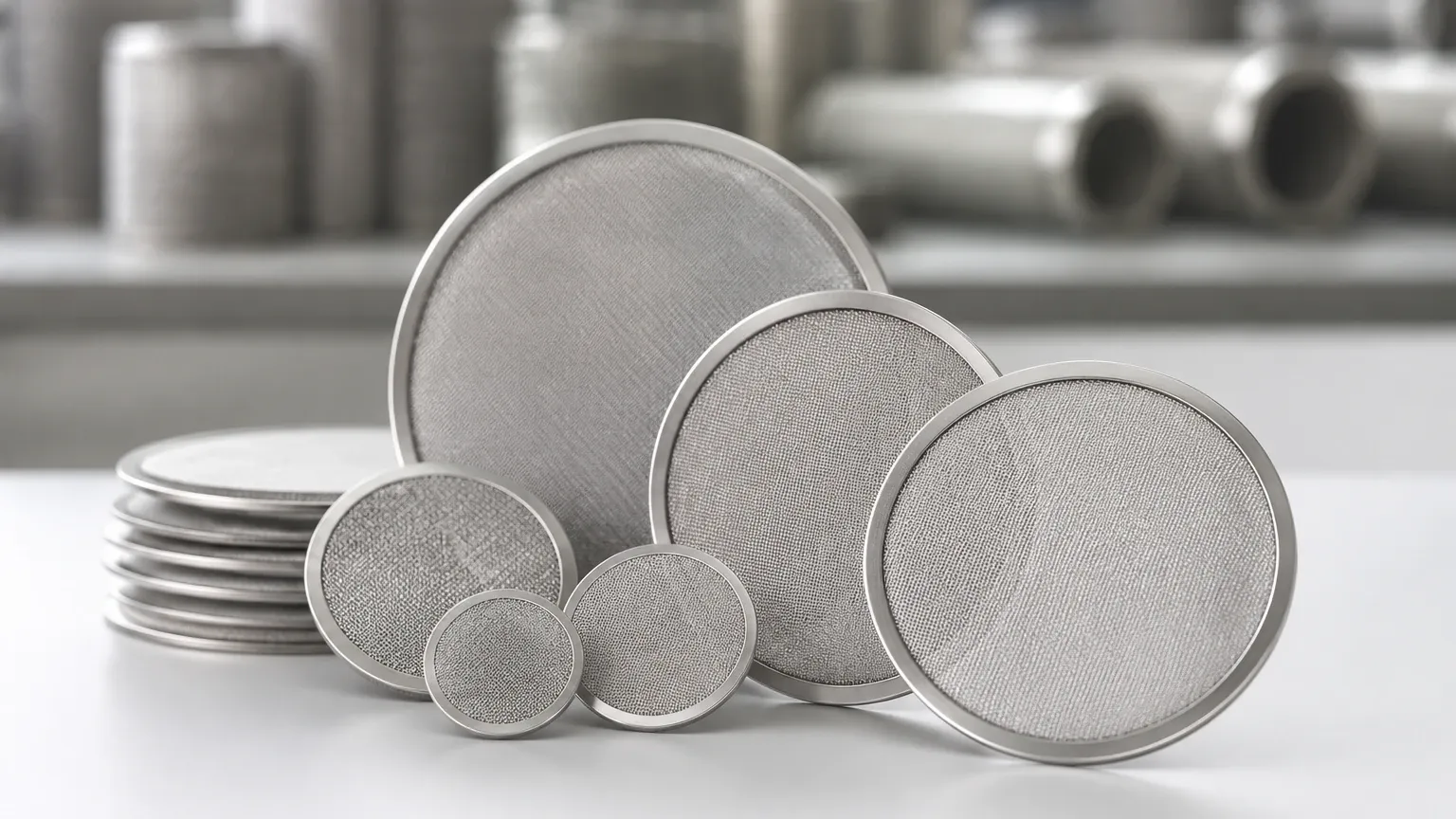
In many advanced industrial applications, the concept of a "disposable" MERV 8 filter is replaced by the use of precision metal filtration. Stainless steel filter discs and packs are essential components in plastic extrusion, fiber production, and fine chemical filtration.
Unlike pleated paper filters, these metal components offer several distinct advantages:
* Reusability: Stainless steel filters can be cleaned via ultrasonic baths or chemical cleaning and returned to service. This significantly reduces the long-term waste and procurement frequency associated with disposable filters.
* Precision Layering: A filter pack can consist of multiple layers of different mesh counts. For example, a coarse outer mesh can act as a support layer, while a fine inner mesh provides the actual MERV-equivalent filtration. This "graded density" approach improves dirt-holding capacity.
* High Temperature Tolerance: Where synthetic MERV 8 filters might melt or degrade above 200°F, stainless steel components can operate effectively at temperatures exceeding 800°F, depending on the alloy and assembly method.
For those evaluating where to buy MERV 8 filters for heavy-duty machinery, transitioning to metal Filter Discs & Packs is often the most technically sound decision.
Customization and OEM Solutions for Precision Filtration
One of the primary challenges in industrial procurement is finding a filter that fits non-standard housing or meets unique flow requirements. Standard commercial suppliers offer fixed dimensions (e.g., 20x20x1). In contrast, custom manufacturers provide engineering support to develop bespoke solutions.
Engineering Support
When working with a professional manufacturer, engineers can specify the exact diameter, thickness, and weave type required. This is particularly important for "packs" where multiple layers of wire cloth are combined to achieve a specific filtration result.
Edge Finishing and Assembly
Industrial filter discs can be supplied with various edge treatments, including aluminum or stainless steel rims, or they can be spot-welded to ensure the layers remain perfectly aligned during installation and operation. This level of detail prevents bypass—a common failure point in lower-quality filters where unfiltered air or fluid leaks around the edges of the media.
Total Cost of Ownership and Replacement Cycles
When deciding where to buy MERV 8 filters, it is a mistake to look only at the initial purchase price. The Total Cost of Ownership (TCO) includes the cost of the unit, the labor required for replacement, the cost of downtime during changeovers, and disposal fees.
1. Disposable Filters: Low upfront cost, but high frequency of replacement. Over a five-year period, the cumulative cost of purchasing, shipping, and disposing of hundreds of filters can be substantial.
2. Permanent Metal Filters: Higher initial investment, but significantly longer service life. Because they are cleanable, the replacement cycle is measured in years rather than weeks or months. Furthermore, the durability of stainless steel reduces the risk of catastrophic filter failure, which could lead to expensive downstream equipment damage.
For purchasing teams, the goal should be to find a supplier that offers a balance of high-quality materials and manufacturing expertise to maximize the ROI of the filtration system.
Conclusion: Making an Informed Procurement Decision
Finding where to buy MERV 8 filters is a process of matching the filtration requirement to the operational environment. For general building maintenance, commercial suppliers are adequate. However, for industrial processes where reliability, precision, and durability are paramount, the search should lead to specialized manufacturers of metal filtration components.
By choosing high-quality Filter Discs & Packs, industrial operators can achieve the particle retention of a MERV 8 standard while benefiting from the superior mechanical properties of stainless steel. Whether you are looking for OEM components for a new machine design or seeking to upgrade an existing filtration process to reduce waste and improve performance, focusing on technical specifications and material quality will ensure the best long-term outcome for your facility.
