


Filter 80
In industrial filtration, the designation "filter 80" typically refers to one of two critical technical specifications: an 80-mesh wire cloth or a filtration component rated at 80 microns. Understanding the distinction between these two measurements is fundamental for engineers and procurement specialists when selecting Filter Discs & Packs for high-precision applications.
Whether utilized in polymer extrusion, hydraulic systems, or chemical processing, the performance of a filter 80 component depends on its material composition, weave structure, and mechanical integrity. This article examines the technical parameters, application environments, and engineering considerations essential for integrating 80-specification filtration solutions into industrial workflows.
Understanding the Technical Specifications of 80 Mesh Filtration
The term "mesh" refers to the number of openings per linear inch of wire cloth. An 80-mesh filter contains 80 wires in one direction and 80 wires in the perpendicular direction within a single square inch. To determine the actual filtration capability, or aperture size, one must account for the wire diameter.
Aperture and Open Area
For a standard stainless steel 80-mesh screen, the wire diameter typically ranges from 0.12 mm to 0.13 mm. Using a standard 0.12 mm wire, the aperture (the clear space between wires) is approximately 0.197 mm, or 197 microns. This provides an open area of roughly 38.6%.
If a project requires an 80-micron absolute rating, an 80-mesh screen is insufficient, as its openings are nearly 2.5 times larger than the required threshold. In such cases, a finer mesh (such as 200 mesh) or a multi-layered sintered structure is required. Engineers must clarify whether "filter 80" refers to the mesh count or the micron rating to avoid bypass issues or excessive pressure drops.
Weave Types
For 80-mesh specifications, the most common construction is the Plain Weave. In this configuration, each warp wire passes alternately over and under each weft wire. This provides a stable, consistent aperture size and is the standard for most Filter Discs & Packs. In specialized cases where higher mechanical strength is needed, a Twill Weave may be employed, though this is more common in meshes finer than 200.
Material Selection for Filter 80 Components
The durability and chemical compatibility of a filter 80 component are dictated by its metallurgy. Since these filters often operate in corrosive or high-temperature environments, stainless steel is the industry standard.
* Stainless Steel 304: The most common grade used for industrial filtration. It offers excellent mechanical properties and resistance to atmospheric corrosion. It is suitable for food and beverage applications and general industrial water treatment.
* Stainless Steel 316L: Containing molybdenum, 316L provides superior resistance to chlorides and acids. It is the preferred choice for pharmaceutical manufacturing, marine environments, and aggressive chemical processing. The "L" (low carbon) designation ensures better weldability and resistance to intergranular corrosion.
* Specialty Alloys: For extreme environments involving high concentrations of sulfuric acid or extreme temperatures, alloys such as Inconel or Monel may be used to manufacture filter 80 discs, though these are typically reserved for specialized petrochemical applications.
Applications of Filter Discs & Packs in Industrial Processes
Filter 80 components are rarely used as standalone sheets; they are most effective when fabricated into Filter Discs & Packs. These are engineered to fit specific machinery and handle varying flow dynamics.
Polymer and Plastic Extrusion
In the plastics industry, filter packs are placed in the breaker plate of an extruder to remove impurities from the molten polymer. An 80-mesh disc is frequently used as a "support" or "coarse" layer in a multi-stage pack. It protects finer meshes from the high pressure of the melt and catches larger contaminants that could cause defects in the final extruded product, such as films or fibers.
Hydraulic and Lubrication Systems
Precision hydraulic systems require clean fluid to prevent wear on valves and pumps. A filter 80 element is often used in suction strainers or return line filters to capture metallic particulates and debris. Its relatively high open area ensures that the pump does not suffer from cavitation while providing sufficient protection for downstream components.
Chemical and Petrochemical Processing
In chemical reactors, 80-mesh filter discs are used to retain catalysts or to provide primary filtration for raw liquid materials. The ability of stainless steel to withstand thermal cycling makes it ideal for processes where temperatures fluctuate significantly.
Engineering Performance: Flow Rate and Pressure Drop
When specifying a filter 80 solution, engineers must calculate the clean pressure drop ($\\Delta P$) across the medium. This is influenced by the fluid's viscosity, the velocity of the flow, and the open area of the mesh.
1. Viscosity Impact: High-viscosity fluids, such as heavy oils or polymers, require larger surface areas to maintain a manageable pressure drop. If the $\\Delta P$ is too high at the start of a cycle, the filter's service life will be significantly shortened as it reaches its terminal pressure limit faster.
2. Dirt Holding Capacity: While an 80-mesh filter has a high open area, its dirt holding capacity is limited compared to depth-type filters. Once the surface apertures are blocked, the pressure increases exponentially. This is why multi-layer Filter Discs & Packs are often preferred; they distribute the contaminant load across multiple gradients.
3. Mechanical Strength: Under high-pressure differentials, a single layer of 80 mesh may deform. Engineering designs often include a coarser support mesh (such as 20 or 40 mesh) to provide the necessary structural rigidity to the filter 80 layer.
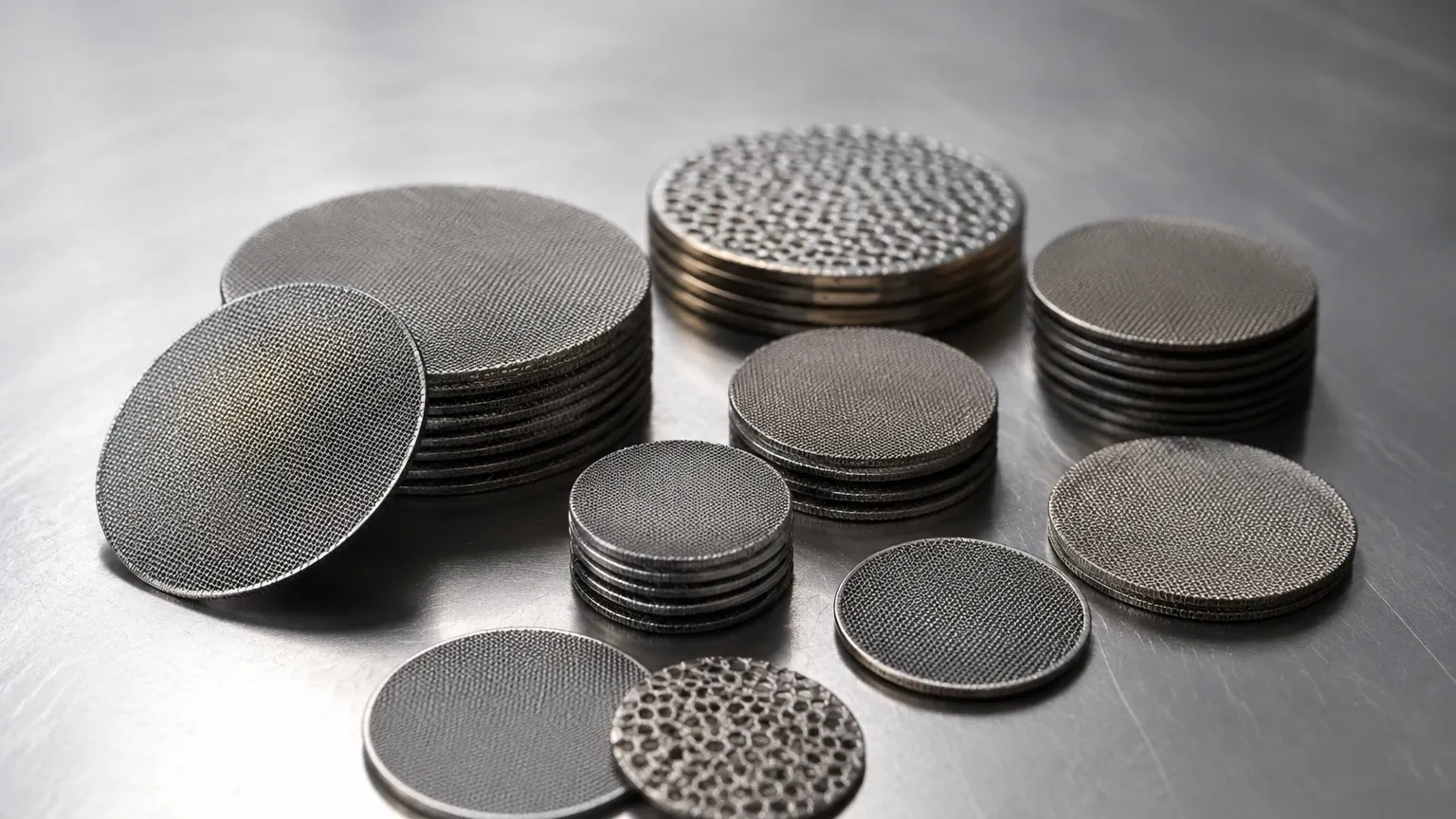
Structural Configurations: Single-Layer vs. Multi-Layer Packs
The physical form of the filter 80 component significantly impacts its installation and performance.
Single-Layer Discs
These are simple, stamped circular or shaped discs used in low-pressure applications or as pre-filters. They are cost-effective and easy to replace. However, they are prone to "media migration" or bypass if not properly seated in the housing.
Multi-Layer Spot-Welded Packs
To improve filtration efficiency and strength, multiple layers of mesh are stacked and spot-welded together. A typical configuration might include a 20-mesh support, an 80-mesh filtration layer, and another 20-mesh protection layer. Spot welding ensures the layers remain aligned during installation and operation.
Rimmed or Framed Packs
For high-pressure extrusion or pharmaceutical applications, the edges of the mesh layers are enclosed in a metal rim (usually aluminum or stainless steel). This "rimming" process prevents fluid bypass around the edges of the filter and provides a gasket-like seal within the machine. It also prevents loose wires from breaking off and entering the process stream—a critical requirement in food-grade environments.
Selection Criteria and Procurement Considerations
When sourcing filter 80 components, purchasing teams and engineers should confirm several factors to ensure the product meets the intended application requirements:
* Dimensional Accuracy: Precise outer diameters (OD) are essential. Even a 0.5 mm variance can lead to bypass in high-pressure systems.
* Mesh Flatness: For automated assembly lines, filter discs must be perfectly flat. Any curling or warping can cause jams in the feeding equipment.
* Cleanliness Standards: In pharmaceutical or semiconductor applications, the mesh must be ultrasonically cleaned to remove residual drawing lubricants or oils from the manufacturing process.
* Customization Options: Many industrial applications require non-standard shapes, such as kidney-shaped discs, oval packs, or pleated inserts. Working with a manufacturer that provides OEM customization ensures that the filter 80 component integrates seamlessly with existing hardware.
Maintenance and Total Cost of Ownership
While the initial cost of a filter 80 disc is a factor, the total cost of ownership (TCO) is driven by the replacement frequency and the ability to clean the media. Stainless steel Filter Discs & Packs offer the advantage of being cleanable and reusable in many applications.
Techniques such as ultrasonic cleaning, backwashing, or chemical pickling can remove accumulated debris, restoring the filter's original flow characteristics. However, repeated cleaning cycles can eventually fatigue the wire mesh. Engineers should establish a maximum number of cleaning cycles or monitor the pressure drop post-cleaning to determine when a pack has reached the end of its functional life.
In high-volume extrusion, the cost of downtime during a filter change often exceeds the cost of the filter itself. Therefore, selecting a high-quality filter 80 with consistent wire diameter and weave density is a prerequisite for maximizing production uptime and ensuring consistent product quality.
