


Disc Filter Housing
In industrial filtration, the efficiency of a system is as much a product of the housing as it is the media itself. A disc filter housing serves as the critical pressure vessel and structural interface that directs fluid flow through various Filter Discs & Packs. For engineers and procurement specialists in the chemical, pharmaceutical, and food processing sectors, selecting the correct housing is a fundamental step in ensuring process integrity, safety, and long-term cost-efficiency.
While the filter media performs the actual separation of contaminants, the disc filter housing provides the necessary environment to maintain pressure, prevent bypass, and facilitate easy maintenance. This article explores the technical specifications, engineering considerations, and selection criteria essential for integrating high-performance filtration components into industrial workflows.
The Role of Disc Filter Housing in Industrial Systems
A disc filter housing is more than a simple container; it is a precision-engineered component designed to manage hydraulic forces while ensuring that 100% of the process fluid passes through the filtration media. In high-pressure applications, such as hydraulic systems or polymer melt filtration, the housing must withstand significant internal stress without deforming, as even a microscopic gap can lead to fluid bypass.
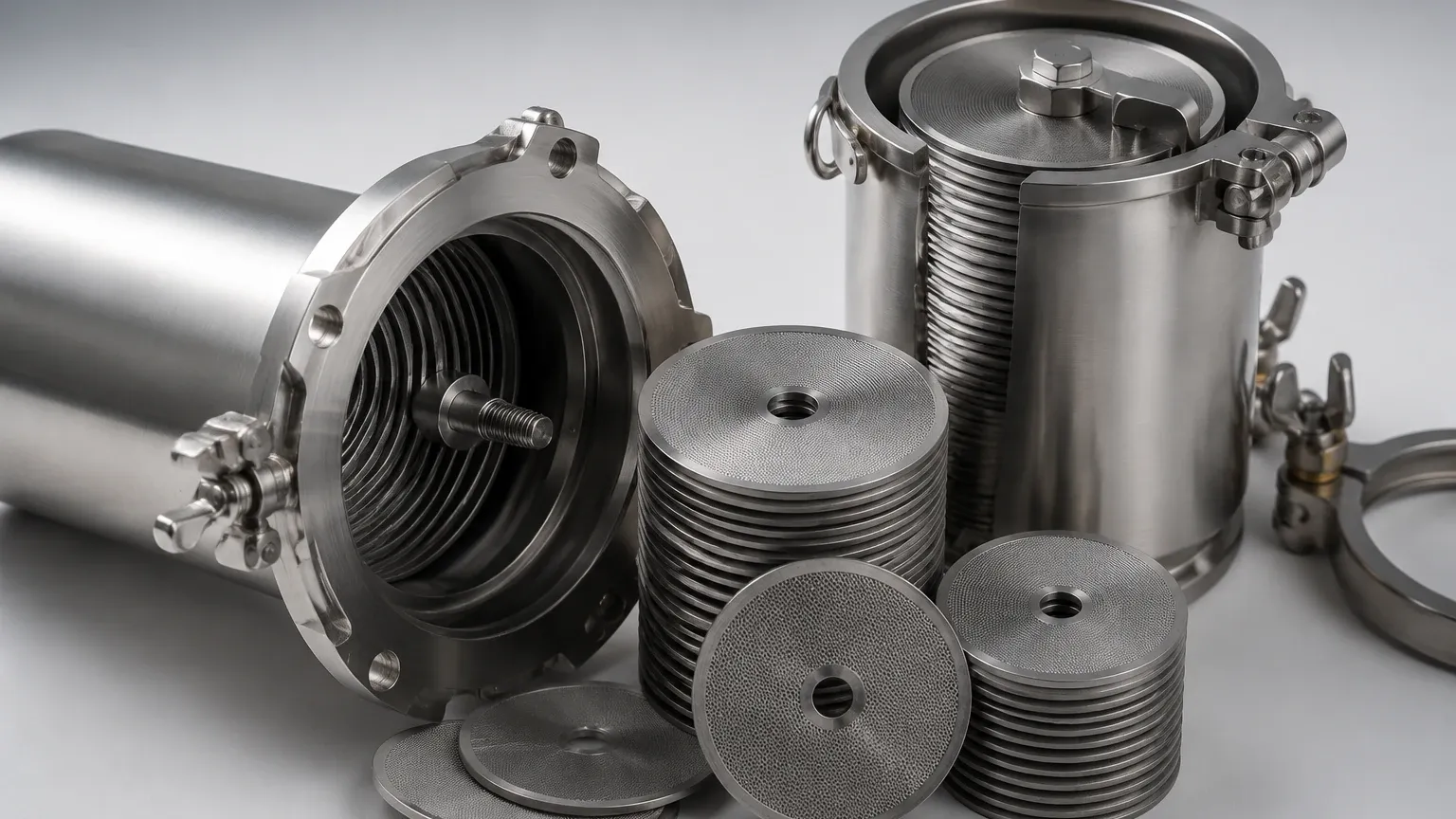
The primary function of the housing is to provide a secure mechanical seal for the filter discs. Whether using single-layer mesh or complex multi-layer packs, the housing’s internal geometry must match the dimensions of the media to ensure a tight fit. This is particularly important in fine filtration (sub-10 micron), where the path of least resistance is often around the edges of the filter rather than through it. By utilizing precision-machined seats and robust clamping mechanisms, the housing eliminates these potential leak paths.
Furthermore, the housing design dictates the flow pattern—whether it is an inline, T-type, or L-type configuration. This choice impacts the footprint of the filtration unit within the factory layout and influences the ease with which technicians can access the internal components for cleaning or replacement.
Key Engineering Specifications for Disc Filter Housings
When specifying a disc filter housing, several technical parameters must be evaluated to ensure compatibility with the operating environment. These specifications go beyond simple dimensions and delve into the metallurgy and mechanical limits of the vessel.
Material Selection and Corrosion Resistance
Stainless steel is the industry standard for disc filter housings due to its durability and resistance to oxidation.
- SS304: Suitable for general industrial water treatment and non-corrosive chemical applications. It offers a cost-effective solution for environments where high-purity standards are not the primary concern.
- SS316L: The preferred choice for pharmaceutical, food and beverage, and highly corrosive chemical processes. The low carbon content and addition of molybdenum enhance resistance to pitting and crevice corrosion, especially in the presence of chlorides.
- Special Alloys: For extreme environments involving high-concentration acids or high temperatures, alloys like Hastelloy or Monel may be required to prevent material degradation.
Pressure and Temperature Ratings
Industrial housings must be rated for the maximum operating pressure of the system, including potential pressure spikes. Engineers should look for housings that comply with international standards such as ASME Section VIII or the Pressure Equipment Directive (PED). Temperature is equally critical; high temperatures can affect the integrity of seals and gaskets, as well as the mechanical strength of the housing itself. A housing rated for 200°C requires different sealing materials (such as PTFE or metal O-rings) compared to one operating at ambient temperatures.
Surface Finish and Cleanability
In sanitary applications, the internal surface finish of the disc filter housing is paramount. A high degree of polishing (measured in Ra, or Roughness Average) prevents bacterial growth and ensures that the housing can be effectively cleaned using Clean-in-Place (CIP) or Sterilization-in-Place (SIP) protocols. Electropolishing is often employed to achieve a mirror-like finish that minimizes particle entrapment.
Integrating Filter Discs & Packs for Optimal Performance
The performance of a disc filter housing is inextricably linked to the Filter Discs & Packs it contains. The housing must be designed to accommodate the specific thickness and diameter of the discs to ensure a uniform distribution of fluid across the entire surface area.
Support Structures and Drainage
Inside the housing, the filter disc is typically supported by a drainage plate or a perforated core. This support structure prevents the mesh from deforming or bursting under high differential pressure. If the housing does not provide adequate support, the filter media may stretch, leading to an increase in pore size and a subsequent loss of filtration accuracy. Engineers must ensure that the housing's internal support geometry does not create "dead zones" where fluid stagnates, as this can lead to contamination or product degradation.
Multi-Layer Packs and Edge Sealing
In many demanding applications, a single layer of wire mesh is insufficient. Multi-layer packs, which combine coarse support layers with fine filtration layers, require a housing with a deeper seating area. Furthermore, the method of edge sealing—whether the housing uses a mechanical compression seal or accommodates discs with welded or aluminum-bound edges—is a critical design choice. A robust disc filter housing will often feature a recessed groove or a compression ring to ensure that the edges of the pack are fully sealed against the housing wall.
Critical Evaluation Criteria for Selection
Selecting the right disc filter housing requires a holistic view of the process requirements. Engineers should use the following criteria to evaluate potential solutions:
1. Flow Rate and Viscosity: The housing must be sized to handle the maximum flow rate without creating excessive turbulence or pressure drop. High-viscosity fluids, such as resins or heavy oils, require larger housings with wider internal passages to maintain efficient throughput.
2. Effective Filtration Area (EFA): The EFA is the total surface area of the filter media that is actively engaged in filtration. The housing design should maximize the EFA relative to its physical size. A housing that restricts the usable area of the disc will lead to faster clogging and more frequent maintenance cycles.
3. Connection Types: The housing must integrate seamlessly with existing piping. Common options include NPT threaded connections for smaller units, flanged connections (ANSI/DIN) for high-pressure industrial lines, and Tri-clamp fittings for sanitary applications.
4. Ease of Maintenance: How quickly can a technician open the housing and replace the filter discs? Swing-bolt closures allow for tool-free access, which is ideal for processes requiring frequent disc changes. In contrast, bolted covers provide a more secure seal for high-pressure hazardous environments but require more time to service.
Common Operational Risks and Mitigation Strategies
Even with a high-quality disc filter housing, operational challenges can arise if the system is not managed correctly. Understanding these risks allows engineers to implement preventative measures.
Fluid Bypass
Bypass occurs when fluid finds a path around the filter media rather than through it. This is usually caused by improper installation of the filter discs or the failure of internal seals. To mitigate this, housings should be equipped with centering guides or specialized gaskets. Regular inspection of the seating surfaces for scratches or debris is also essential.
Differential Pressure (ΔP) Management
As the filter discs capture contaminants, the pressure drop across the housing increases. If the ΔP exceeds the housing’s or the filter media’s design limit, the media may collapse or the housing could sustain damage. Installing pressure gauges on both the inlet and outlet ports of the housing allows operators to monitor ΔP in real-time. Automated systems can be programmed to trigger a cleaning cycle or a system shutdown when a specific pressure threshold is reached.
Material Compatibility
Chemical incompatibility between the fluid and the housing seals can lead to swelling, hardening, or cracking of the O-rings. For example, while Viton is excellent for many chemicals, it may not be suitable for certain ketones or esters. Engineers must confirm that every component of the housing—including the body, seals, and any internal fasteners—is compatible with the process chemistry.
Customization and OEM Considerations for Engineers
Standard off-the-shelf housings may not always meet the unique requirements of a specialized industrial process. In such cases, working with a manufacturer that offers OEM and customization capabilities is vital. Customization allows for the optimization of every aspect of the disc filter housing.
Tailored Dimensions and Configurations
For systems with space constraints, a custom-designed housing can be engineered to fit into tight footprints or unusual orientations. This includes modifying the inlet/outlet positions or adding multiple ports for sensors and sampling. Custom housings can also be designed to hold a specific number of filter discs in a stacked configuration to increase the total filtration capacity without increasing the diameter of the unit.
Certification and Documentation
In regulated industries like pharmaceuticals or aerospace, the documentation is as important as the hardware. Custom housings can be supplied with full material traceability (MTRs), weld maps, and pressure test certificates. Confirming these requirements early in the procurement process ensures that the final product meets all safety and regulatory standards.
Prototyping and Performance Testing
For new or experimental processes, manufacturers can provide prototypes for pilot testing. This allows engineers to verify flow characteristics and filtration efficiency before committing to a full-scale production run. Testing the housing with the actual Filter Discs & Packs intended for use provides the most accurate data on expected performance and replacement cycles.
By focusing on these technical details and maintaining a clear understanding of the relationship between the housing and the filter media, engineering teams can ensure they select a disc filter housing that provides reliable, long-term performance in even the most demanding industrial environments.
