


Whatman Polycarbonate Nuclepore Filter Discs
In the field of precision filtration, the selection of filter media is dictated by the specific requirements of the application—whether it is for analytical laboratory work, environmental monitoring, or industrial scale-up. Whatman polycarbonate Nuclepore filter discs represent a specialized category of track-etched membranes known for their unique pore structure and surface characteristics. While these are often utilized in laboratory settings for microscopy and particle analysis, understanding their performance parameters is essential for engineers who must decide between polymer-based membranes and more robust industrial Filter Discs & Packs for larger-scale operations.
This article examines the technical specifications, manufacturing processes, and application considerations of polycarbonate track-etched membranes, providing a comparative framework for industrial filtration selection.
The Technology Behind Track-Etched Membranes
Unlike traditional depth filters or cast membranes, whatman polycarbonate nuclepore filter discs are manufactured through a two-stage process known as track-etching. This process ensures a level of pore size precision that is difficult to achieve with other manufacturing methods.
1. Irradiation: A thin polycarbonate film is exposed to a beam of high-energy heavy ions. As these ions pass through the polymer, they create narrow paths of localized damage, known as "tracks."
2. Etching: The irradiated film is then passed through a chemical etching solution. The etchant selectively attacks the damaged tracks, dissolving the polymer to create cylindrical, straight-through pores.
The resulting membrane features a smooth, flat surface with pores that are nearly perfectly cylindrical and perpendicular to the membrane surface. This geometry is a critical factor for applications requiring precise particle size cut-offs and high visibility under microscopy.
Key Technical Specifications and Performance Metrics
When evaluating whatman polycarbonate nuclepore filter discs for technical workflows, engineers must consider several physical and chemical properties that define their performance limits.
Pore Size Consistency and Density
Track-etched membranes are characterized by an extremely narrow pore size distribution. Because the etching process is controlled by time and temperature, the diameter of the pores can be regulated with high accuracy. Pore densities typically range from $1 \times 10^5$ to $6 \times 10^8$ pores per square centimeter, depending on the intended filtration rating. This high density allows for relatively high flow rates despite the thinness of the material.
Surface Characteristics and Optical Clarity
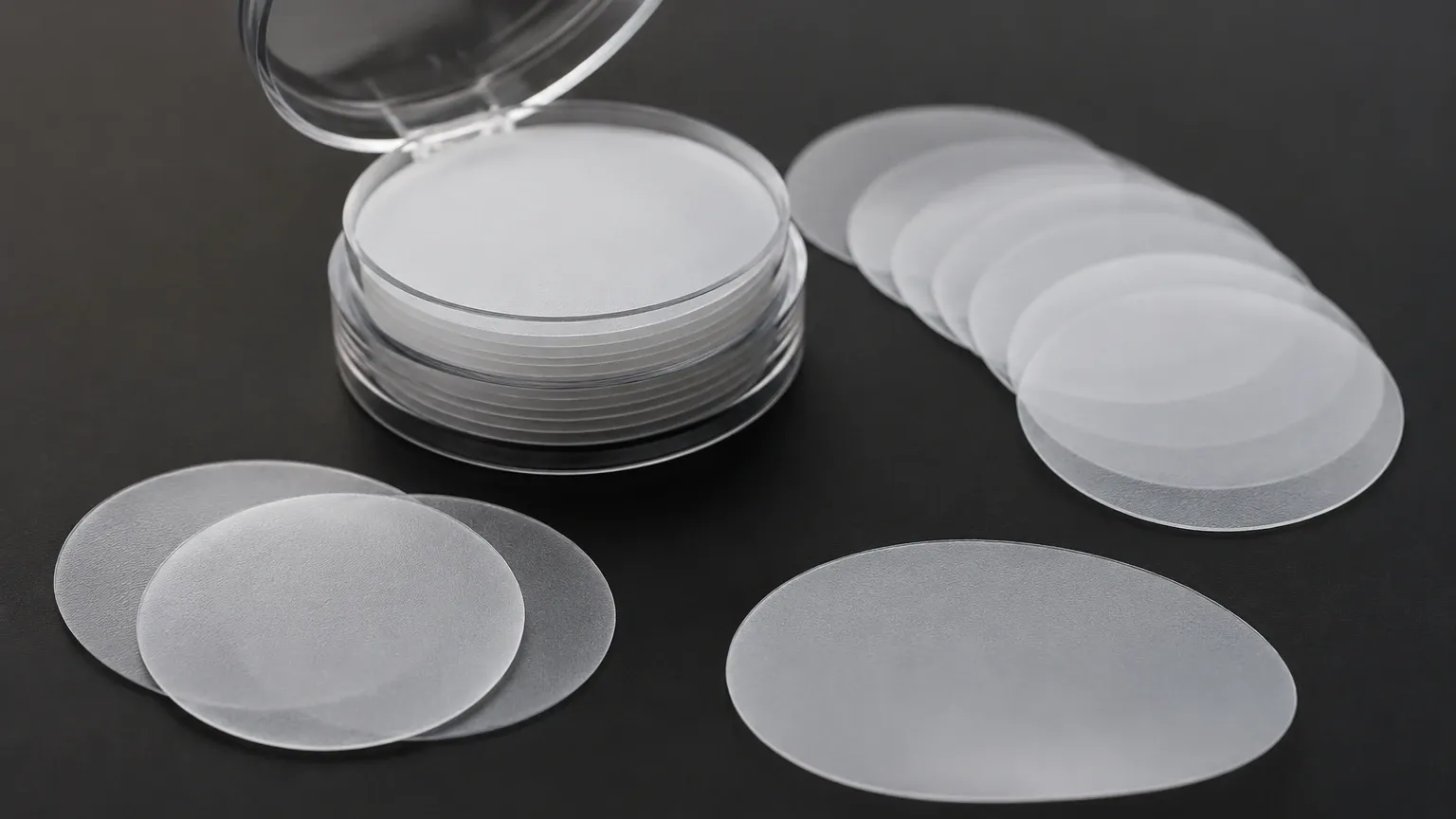
The surface of a polycarbonate Nuclepore disc is exceptionally smooth and non-absorbent. This is a significant advantage in gravimetric analysis and microscopy. Because particles are captured on the surface rather than within a matrix (as seen in depth filters), they are easily visible and can be quantified using scanning electron microscopy (SEM) or optical microscopy. Furthermore, polycarbonate is naturally translucent or transparent, which aids in transmitted light microscopy.
Chemical and Thermal Stability
Polycarbonate is a robust polymer, but it has specific limitations compared to metallic filtration media. It is generally resistant to dilute acids, alcohols, and aliphatic hydrocarbons. However, it is susceptible to damage from strong bases, halogenated hydrocarbons, and certain aromatic solvents. Thermally, these discs are typically rated for use up to 140°C (284°F), which is sufficient for many biological and low-temperature industrial processes but pales in comparison to the 500°C+ capabilities of stainless steel Filter Discs & Packs.
Industrial Scale-up: Polycarbonate vs. Stainless Steel
In many B2B industrial environments, a process may begin with analytical testing using whatman polycarbonate nuclepore filter discs and then transition to high-volume production. At this stage, engineers must evaluate whether to continue with polymer membranes or switch to metal-based filtration components.
Durability and Pressure Resistance
Polycarbonate membranes are thin (typically 6 to 15 microns) and fragile. They require high-quality support structures, such as sintered metal plates or specialized mesh grids, to prevent rupture under differential pressure. In contrast, industrial Filter Discs & Packs made from multi-layer stainless steel wire mesh are self-supporting and can withstand significantly higher operating pressures and mechanical stresses without deformation.
Reusability and Cleaning
Whatman Nuclepore discs are almost exclusively single-use components. Attempting to clean a track-etched polymer membrane often results in pore distortion or material fatigue. For industrial applications where total cost of ownership (TCO) is a priority, stainless steel filter packs offer a distinct advantage. They can be cleaned via ultrasonic baths, backwashing, or chemical cleaning, allowing for multiple cycles and reducing the long-term cost of consumables.
Filtration Mechanism
While Nuclepore discs act as precise surface sieves, industrial metal filter packs can be engineered to provide both surface and depth filtration. By layering different mesh counts, a graduated filtration effect is achieved, which can extend the service life of the filter by preventing premature surface blinding.
Primary Applications in Industrial and Lab Environments
Despite the rise of metal filtration in heavy industry, whatman polycarbonate nuclepore filter discs remain the gold standard in several niche areas where surface capture is paramount.
* Environmental Air Monitoring: Used for the collection of asbestos fibers and other airborne particulates. The flat surface ensures that fibers lie flat for accurate counting under a microscope.
* Water Quality Analysis: Ideal for detecting Giardia, Cryptosporidium, and other microorganisms where the precise pore size acts as a definitive barrier.
* Cell Biology: Used in chemotaxis assays and cell culture, where the smooth surface allows for easy cell growth and observation.
* Fuel and Oil Analysis: Employed in laboratory testing to determine the particulate contamination levels in hydraulic fluids and lubricants, following ISO 4406 or similar standards.
Engineering Considerations for Integration
For technical professionals looking to integrate these filtration solutions into their systems, several engineering considerations must be addressed to ensure reliable performance.
Housing and Sealing
Because track-etched membranes are so thin, the design of the filter holder is critical. Any unevenness in the sealing surface can lead to bypass or membrane tearing. O-ring selection must be compatible with both the fluid being filtered and the polycarbonate material itself. In industrial settings, custom-designed housings are often required to provide the necessary support for the membrane while maintaining a leak-proof seal.
Flow Rate and Flux
Engineers must calculate the "flux" (flow rate per unit area) based on the specific pore size and the viscosity of the fluid. While track-etched membranes have high pore density, their total open area is often lower than that of a woven wire mesh. This may necessitate a larger filtration surface area to achieve the desired throughput without exceeding the maximum allowable differential pressure.
Static Charge and Handling
Polycarbonate is an insulator and can accumulate static charge, which may affect the capture efficiency of certain dry particles. In some laboratory applications, anti-static treatments or specialized handling tools are necessary to ensure that the filter discs remain uncontaminated and functional during the installation process.
Evaluating Total Cost and Selection Criteria
When selecting between whatman polycarbonate nuclepore filter discs and alternative Filter Discs & Packs, the decision should be based on a comprehensive evaluation of the following factors:
1. Required Precision: If the application demands an absolute cut-off with zero tolerance for pore size variation (e.g., analytical microscopy), track-etched polycarbonate is often the only viable choice.
2. Operating Environment: For high-temperature, high-pressure, or chemically aggressive environments, stainless steel or other metal alloys are required to ensure structural integrity.
3. Process Volume: Single-use polymer discs are suitable for batch testing and small-scale processing. For continuous industrial flows, the durability and cleanability of metal filter packs provide a better return on investment.
4. Regulatory Compliance: In industries such as pharmaceuticals or food and beverage, ensure that the chosen filter media meets FDA or USP Class VI requirements for extractables and leachables.
Conclusion for Technical Procurement
Whatman polycarbonate Nuclepore filter discs serve as a critical tool for high-precision analytical filtration. Their track-etched manufacturing process provides a level of pore uniformity that is essential for microscopy and rigorous particle analysis. However, for engineers moving from the lab to the production floor, the transition to industrial-grade Filter Discs & Packs is often necessary to meet the demands of durability, flow capacity, and cost-efficiency.
By understanding the fundamental differences in material science, pore geometry, and mechanical limits, procurement teams and engineers can make informed decisions that balance the need for analytical accuracy with the realities of industrial operational requirements. Whether the priority is the optical clarity of a polycarbonate membrane or the ruggedness of a stainless steel mesh pack, selecting the correct filtration media is the first step toward process optimization and reliable output.
Download Whatman Polycarbonate Nuclepore Filter Discs as a PDF
