


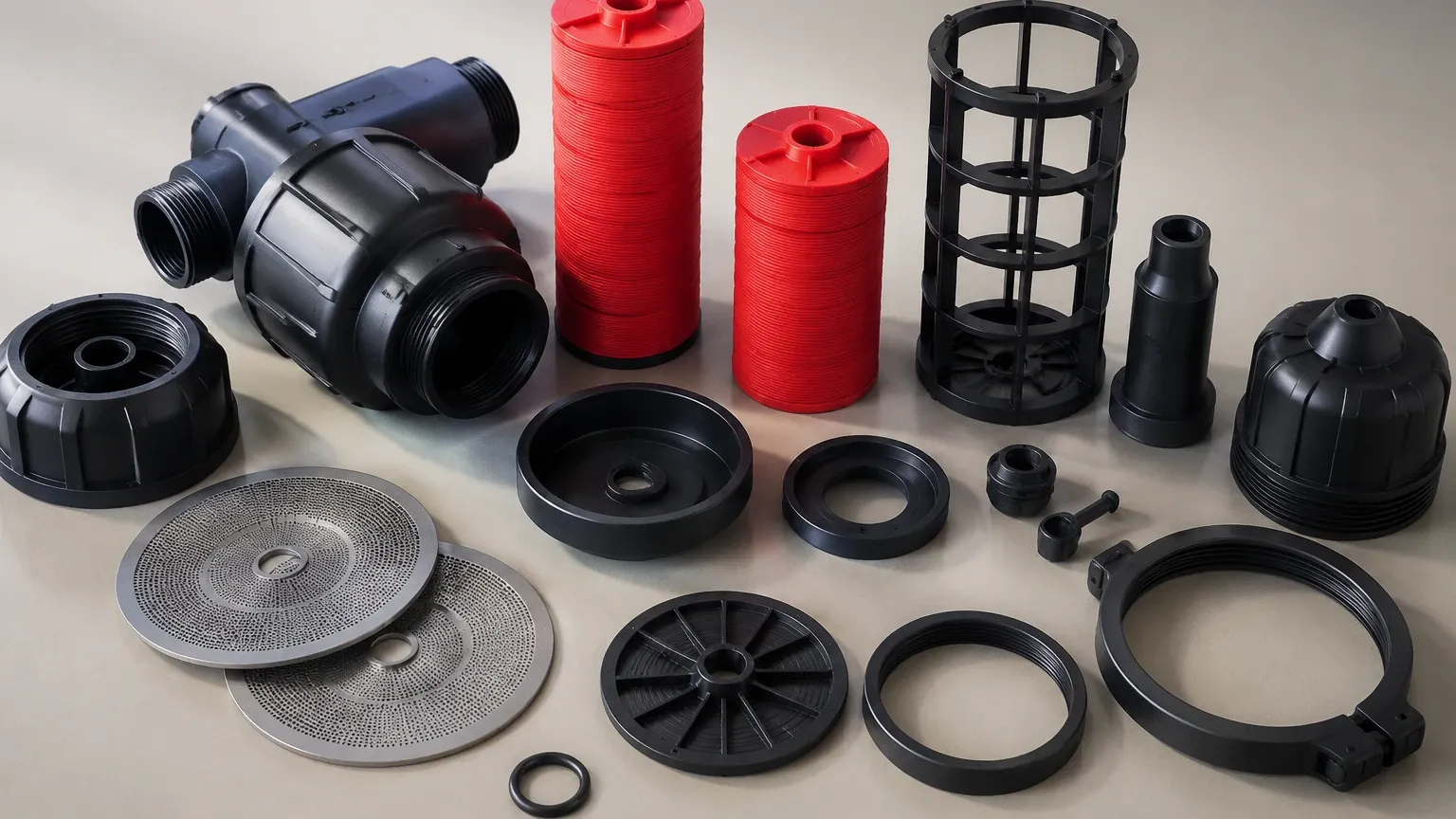
Disc Filter Parts
In industrial processing, the efficiency of a filtration system often depends on the precision and durability of its smallest components. Disc filter parts are essential elements in a wide range of applications, from polymer melt filtration and chemical processing to pharmaceutical manufacturing and hydraulic systems. These components are designed to remove contaminants from fluids or gases under varying pressures and temperatures, ensuring the purity of the final product and protecting downstream equipment from damage.
Selecting the correct disc filter parts requires a deep understanding of material science, fluid dynamics, and mechanical engineering. Because these parts often operate in demanding environments involving corrosive chemicals or high-viscosity fluids, the choice of mesh type, layer configuration, and edge treatment is critical. This guide provides a technical overview of the engineering considerations involved in specifying and procuring high-quality filtration components.
Anatomy of High-Performance Filter Discs & Packs
Industrial Filter Discs & Packs are rarely simple circles of wire mesh. Depending on the application, they may consist of a single layer of precision-woven wire cloth or multiple layers of different mesh counts bonded together. The primary goal is to achieve a specific micron rating while maintaining structural integrity under operational stress.
Single-Layer vs. Multi-Layer Construction
Single-layer discs are typically used in low-pressure applications or as primary strainers where the removal of large particles is the main objective. However, in many industrial settings, multi-layer packs are preferred. These packs combine a fine filtration layer with coarser support layers. The support layers prevent the fine mesh from deforming under pressure and help distribute the flow evenly across the entire surface area.
Spot-Welded and Rimmed Designs
To ensure that multi-layer disc filter parts remain aligned during installation and operation, they are often spot-welded at various points. For more demanding applications, an edge binding or rim is applied. This rim, often made of aluminum, stainless steel, or copper, serves two purposes: it prevents the edges of the wire mesh from fraying and provides a secure sealing surface when the disc is compressed within a filter housing.
Material Engineering: Selecting the Right Alloy
The performance and lifespan of disc filter parts are heavily influenced by the materials used in their construction. Stainless steel is the industry standard due to its balance of mechanical strength and corrosion resistance.
1. AISI 304 Stainless Steel: This is the most common material for general industrial use. It offers good corrosion resistance and is cost-effective for applications involving water, oils, and mild chemicals.
2. AISI 316 and 316L Stainless Steel: For environments involving chlorides or more aggressive chemical agents, 316-grade stainless steel is preferred due to the addition of molybdenum. The "L" (low carbon) version is particularly useful if the filter parts require welding, as it minimizes the risk of sensitization and intergranular corrosion.
3. Specialty Alloys: In extreme cases involving high-temperature oxidation or highly acidic environments, components may be manufactured from Hastelloy, Monel, or Inconel. These materials are selected based on the specific chemical compatibility requirements of the process fluid.
When evaluating materials, engineers must consider the total cost of ownership. While a 316L disc may have a higher initial price than a 304 disc, its extended service life in a corrosive environment often results in lower long-term costs due to reduced downtime and replacement frequency.
Filtration Weave Patterns and Their Performance Characteristics
The weave pattern of the wire mesh determines the filtration accuracy (micron rating), flow rate, and cleaning capability of the disc filter parts. There are several standard weaves used in industrial filtration:
Plain Weave
In a plain weave, each warp wire crosses over and under each shute wire. This creates a simple, square opening. It is ideal for high-flow applications where the particle size distribution is relatively uniform and the pressure drop must be kept to a minimum.
Twill Weave
Twill weave involves wires crossing over two and under two wires. This allows for a heavier wire diameter to be used for a given mesh count, resulting in a stronger mesh that can withstand higher mechanical loads. It is often used for finer filtration where the strength of a plain weave would be insufficient.
Dutch Weave (Plain and Twilled)
Dutch weaves use a larger diameter warp wire and a smaller diameter shute wire. This creates a dense, strong mesh with small, triangular openings. Twilled Dutch weave is capable of achieving the finest micron ratings (down to 1–5 microns) and is commonly used in high-pressure polymer filtration and hydraulic systems. The structure of Dutch weave also provides excellent cake-release properties, making it easier to clean via back-pulsing.
Structural Design: Sintered vs. Non-Sintered Components
For applications involving extreme pressures or the need for repeated cleaning, sintered disc filter parts offer superior performance. Sintering is a process where multiple layers of wire mesh are bonded together using heat and pressure without the use of binders or filler metals. This creates a monolithic structure that is incredibly rigid and stable.
Sintered discs do not suffer from wire migration, a common failure mode in standard woven mesh where individual wires shift under pressure, enlarging the pore size and allowing contaminants to pass through. Furthermore, the sintered structure can be precisely engineered to provide depth filtration, which increases the dirt-holding capacity compared to surface filtration discs.
Technical Evaluation: Key Performance Metrics
Before finalizing the specification for disc filter parts, procurement and engineering teams should evaluate the following metrics:
* Micron Rating (Absolute vs. Nominal): It is critical to distinguish between nominal ratings (an approximate value) and absolute ratings (the size of the largest particle that can pass through the mesh). For critical pharmaceutical or chemical processes, absolute ratings are usually required.
* Differential Pressure (ΔP): This is the difference in pressure between the upstream and downstream sides of the filter. High-quality disc filter parts are designed to maintain a low initial ΔP to maximize the operational window before the filter reaches its terminal pressure drop and requires cleaning or replacement.
* Dirt-Holding Capacity: This refers to the amount of contaminant the filter can retain before the pressure drop becomes unacceptable. A higher dirt-holding capacity leads to longer cycle times and reduced maintenance costs.
* Mechanical Integrity: The parts must be able to withstand the maximum system pressure, including potential pressure spikes, without deforming or collapsing.
Common Failure Modes and Mitigation Strategies
Understanding why disc filter parts fail is essential for optimizing system performance. The most common issues include:
1. Media Migration and Deformation
In high-pressure systems, the wire mesh may stretch or deform if not properly supported. This changes the pore size and compromises filtration accuracy. Using multi-layer packs with heavy-duty support mesh or switching to sintered discs can mitigate this risk.
2. Bypass and Improper Sealing
If the disc filter parts are not manufactured to tight dimensional tolerances, fluid may bypass the filter media at the edges. This is why precision stamping and high-quality edge binding are critical. Engineers should confirm that the outer diameter (OD) and inner diameter (ID) tolerances of the discs match the requirements of the filter housing.
3. Corrosion and Pitting
Even stainless steel can fail if exposed to incompatible chemicals or if the surface finish is compromised. Pitting corrosion can lead to small holes in the mesh, rendering the filter useless. Proper material selection and ensuring that the manufacturing process (such as welding) does not introduce impurities are the primary defenses against corrosion.
Customization: Engineering for Specific Equipment
Many industrial processes utilize proprietary equipment that requires custom-designed disc filter parts. Customization options go beyond simple dimensions and include:
* Shape Variations: While circular discs are standard, applications may require oval, rectangular, or ring-shaped filters.
* Layer Sequencing: Engineers can specify a unique sequence of mesh counts to balance flow rate, filtration depth, and structural strength.
* Surface Treatments: Processes such as electropolishing can be applied to improve corrosion resistance and reduce the adhesion of contaminants, making the filters easier to clean.
* Welding Techniques: Depending on the application, spot welding, ultrasonic welding, or seam welding may be used to join components without introducing contaminants or structural weak points.
Conclusion: Technical Confirmation Before Procurement
When sourcing disc filter parts, engineers and purchasing teams should work closely with manufacturers to confirm all technical specifications. This includes providing details on the operating temperature, chemical composition of the fluid, maximum flow rate, and the specific type of contaminants being targeted.
By focusing on the technical details of mesh weave, material grade, and structural reinforcement, organizations can ensure they are using filtration components that provide the necessary precision and durability. High-quality Filter Discs & Packs are not just consumables; they are engineered components that play a vital role in process stability and product quality. Confirming the manufacturing standards and material certifications of these parts is a necessary step in maintaining an efficient and reliable industrial filtration system.
