


Wedge Wire Dewatering Screen
In industrial solid-liquid separation, the efficiency of the dewatering process directly impacts the quality of the final product and the cost-effectiveness of the entire production line. Among the various technologies available, the use of Wedge Wire Screens has become a standard for demanding applications. These precision-engineered components are designed to handle high-volume throughput while maintaining structural integrity under significant mechanical stress.
A wedge wire dewatering screen is not merely a filter; it is a specialized mechanical interface designed to facilitate the rapid removal of surface moisture from solids. Whether utilized in mining, food processing, or wastewater treatment, understanding the technical nuances of these screens is essential for engineers and procurement teams looking to optimize their filtration systems.
Understanding the Engineering of Wedge Wire Screens
The fundamental advantage of wedge wire technology lies in its unique geometric profile. Unlike traditional woven wire mesh, which consists of intersecting wires that can trap particles, wedge wire is constructed from V-shaped profile wires resistance-welded onto support rods. This design creates a continuous slot that widens inwardly.
From an engineering perspective, this "V" shape provides a critical "two-point contact" for particles. If a particle is small enough to pass through the initial aperture at the surface, it will easily clear the widening gap below. This significantly reduces the risk of blinding or clogging, which is a common failure mode in standard mesh filters. In a wedge wire dewatering screen, this non-clogging characteristic ensures consistent flow rates and reduces the frequency of manual cleaning or backwashing cycles.
Furthermore, the precision of the welding process allows for extremely tight tolerances in slot widths. This level of accuracy is vital when the application requires the retention of specific particle sizes while allowing the liquid phase to exit the system with minimal resistance.
The Functional Role of a Wedge Wire Dewatering Screen
The primary objective of a wedge wire dewatering screen is the separation of liquids from solids through gravity, vibration, or centrifugal force. In a typical dewatering setup, the slurry or wet material is fed onto the screen surface. As the material moves across the screen, the liquid passes through the slots, while the solids are retained and transported to the discharge end.
In mining and aggregate processing, these screens are often subjected to high-frequency vibration to accelerate the separation process. The inherent strength of the stainless steel profile wires allows the screen to withstand these vibrations without deforming. In food and beverage applications, such as corn wet milling or vegetable processing, the screens facilitate the removal of wash water or processing fluids while maintaining strict hygiene standards.
The efficiency of the dewatering process is measured by the moisture content of the discharged solids. A well-designed wedge wire dewatering screen maximizes the open area—the ratio of slot space to the total surface area—to ensure the highest possible drainage rate. However, engineers must balance this open area with the structural requirements of the application, as larger slots or thinner wires may compromise the screen's longevity under heavy loads.
Key Technical Specifications and Selection Criteria
When selecting a wedge wire dewatering screen, several technical parameters must be evaluated to ensure the component meets the application's demands. These criteria go beyond simple dimensions and involve a deep dive into the fluid dynamics and mechanical stresses of the environment.
Slot Size (Aperture)
The slot size is the most critical specification. It must be determined based on the particle size distribution (PSD) of the solids being processed. Generally, the slot size should be smaller than the smallest particle intended for retention, but large enough to prevent excessive pressure drop. In precision applications, slot sizes can be manufactured down to 20 microns, though dewatering applications typically utilize larger apertures ranging from 0.1mm to several millimeters.
Profile Wire and Support Rod Selection
The choice of profile wire (the surface wire) and support rod (the structural backing) depends on the abrasive nature of the material and the mechanical load. Heavier profile wires offer greater wear life in abrasive environments like coal or mineral processing but may reduce the total open area. Support rods are spaced at specific intervals to provide the necessary rigidity to prevent the screen from sagging or buckling under the weight of the material bed.
Open Area Percentage
The open area is calculated by the formula: `Slot Width / (Slot Width + Wire Width) x 100`. For high-capacity dewatering, a higher open area is preferred. However, engineers must ensure that the chosen wire width provides sufficient surface area for wear resistance if the material is abrasive.
Material Selection and Chemical Compatibility
Material selection is a cornerstone of industrial filtration performance. Most Wedge Wire Screens are manufactured from stainless steel due to its excellent mechanical properties and resistance to environmental degradation.
* Grade 304 Stainless Steel: This is the standard choice for general industrial applications. It offers good corrosion resistance and is cost-effective for environments where chemical exposure is moderate.
* Grade 316L Stainless Steel: For applications involving high chloride levels, acidic environments, or pharmaceutical-grade requirements, 316L is the preferred material. The addition of molybdenum enhances its resistance to pitting and crevice corrosion.
* Duplex Stainless Steels: In extreme cases, such as seawater filtration or highly corrosive chemical processing, duplex alloys may be used to provide superior strength and corrosion resistance compared to standard austenitic grades.
For a wedge wire dewatering screen, the material must also be compatible with the cleaning agents used during maintenance. In the food industry, for instance, screens must withstand caustic (CIP) cleaning cycles without losing their structural integrity or surface finish.
Structural Integrity and Customization Options
Industrial filtration is rarely a one-size-fits-all solution. Each system has unique spatial constraints and flow requirements. A professional manufacturer like Kaifil provides extensive customization options to ensure the wedge wire dewatering screen integrates seamlessly into existing machinery.
Screen Configurations
* Flat Panels: Commonly used in vibrating dewatering machines or static sieve bends.
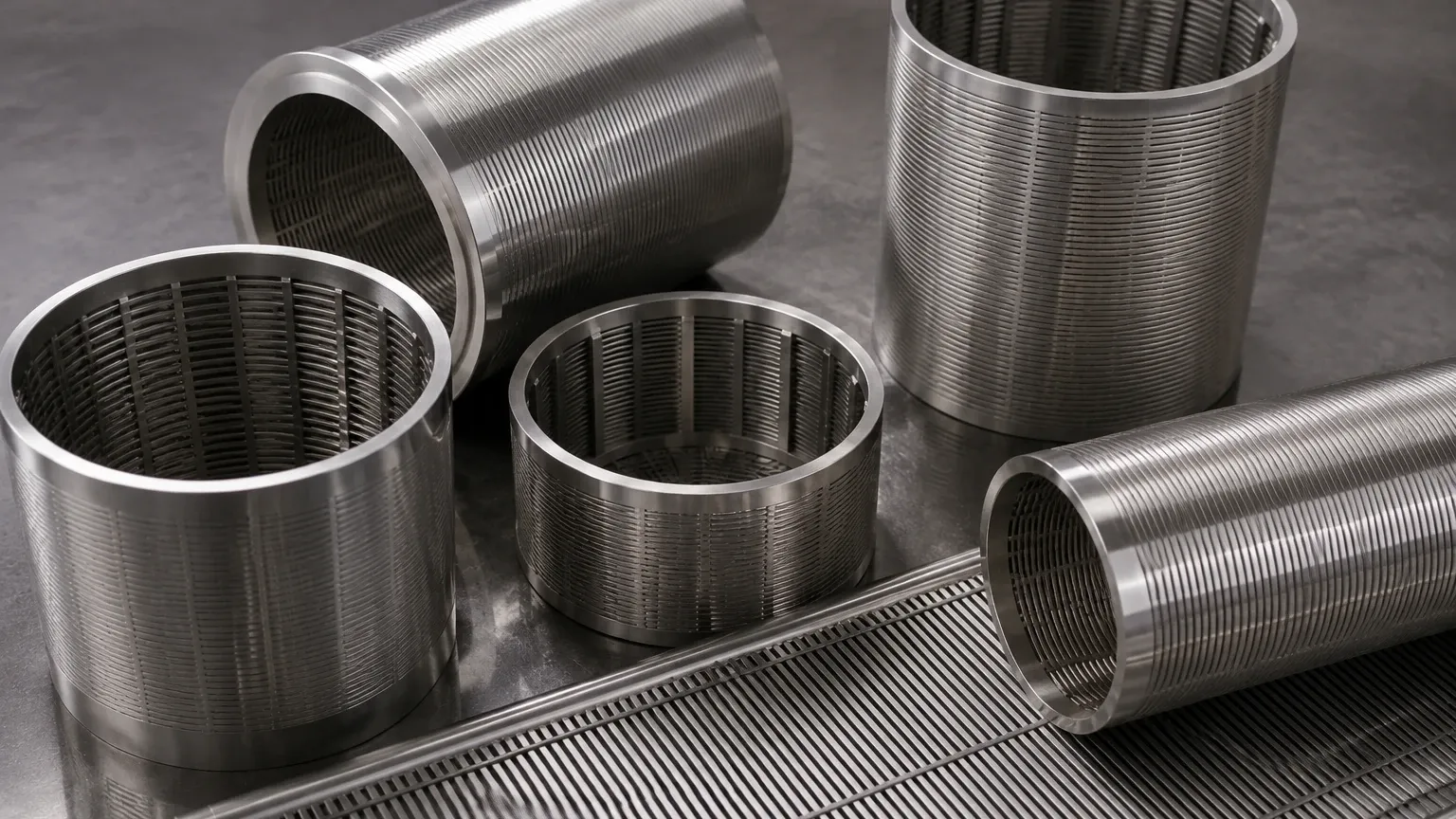
* Cylindrical Screens: Used in screw presses or rotary drum thickeners where the material is processed internally or externally.
* Sieve Bends (DSM Screens): Curved panels that utilize the Coanda effect to separate liquids from solids more efficiently than flat screens in certain gravity-fed applications.
Framing and Reinforcement
Customization also extends to the framing. Screens can be supplied with various edge treatments, including angle irons, flat bars, or specialized bolt-hole patterns for easy installation. For high-stress environments, additional reinforcement ribs can be welded to the support rods to extend the service life of the component.
Operational Efficiency and Maintenance Protocols
The total cost of ownership (TCO) of a wedge wire dewatering screen is influenced by its maintenance requirements and replacement cycle. While stainless steel wedge wire is exceptionally durable, it is not immune to wear, especially in abrasive slurry applications.
Monitoring Wear Patterns
Engineers should regularly inspect screens for signs of "rounding" on the leading edges of the profile wires. As the sharp edges of the V-wire wear down, the dewatering efficiency may decrease, and the risk of blinding may increase. In vibrating screens, it is also important to check for fatigue cracks in the welds or support rods.
Cleaning Procedures
While the V-shaped wire is self-cleaning, certain sticky or fibrous materials may still accumulate over time. High-pressure water jets or ultrasonic cleaning can be effective. Because wedge wire is a rigid, welded structure, it can withstand higher cleaning pressures than woven mesh, which might deform or shift under the same conditions.
Replacement Cycles
Establishing a predictable replacement cycle is essential for avoiding unplanned downtime. By tracking the moisture content of the discharge over time, operators can identify when a wedge wire dewatering screen has reached the end of its effective service life. Replacing a screen before it fails structurally prevents the contamination of the filtrate with solids and protects downstream equipment.
Common Risks and Mitigation Strategies
Investing in industrial filtration components involves navigating several technical risks. One of the primary risks is the incorrect specification of slot sizes. If the slots are too large, valuable solids are lost to the filtrate; if they are too small, the system will experience reduced throughput and increased moisture in the final product.
To mitigate this, it is recommended to conduct a thorough particle size analysis before finalizing the screen design. Additionally, the orientation of the profile wires relative to the flow of material is crucial. For dewatering, wires are typically oriented perpendicular to the flow to "cut" the water film and direct it through the slots.
Another risk is mechanical failure due to improper installation. If a wedge wire dewatering screen is not properly tensioned or supported within its frame, the resulting vibration can lead to premature weld failure. Ensuring that the screen is manufactured to precise dimensional tolerances is the first step in preventing these installation-related issues.
Conclusion
The wedge wire dewatering screen remains a vital component in the industrial toolkit for solid-liquid separation. Its combination of high mechanical strength, non-clogging geometry, and material versatility makes it superior to many alternative filtration media. By focusing on precise engineering specifications—such as slot size, wire profile, and material grade—engineers can ensure their dewatering processes are both efficient and durable.
When sourcing these components, partnering with a manufacturer that understands the complexities of industrial applications is paramount. Customization, quality control in welding, and technical support are the pillars that support a successful filtration solution. For those seeking to optimize their systems, reviewing the available Wedge Wire Screens options is a critical step toward achieving reliable, long-term performance in even the most demanding industrial environments.
