


Z Wedge Stage
In the realm of high-precision industrial engineering and automated manufacturing, the ability to control vertical motion with sub-micron accuracy is a fundamental requirement. For industries relying on sophisticated filtration components, such as those utilizing Wedge Wire Screens, the integration of a Z wedge stage into production or inspection systems is often the difference between standard performance and high-efficiency output. This article examines the technical specifications, mechanical principles, and industrial applications of Z wedge stages, providing engineers and procurement teams with the factual basis needed for informed decision-making.
Understanding the Mechanics of a Z Wedge Stage
A Z wedge stage is a specialized mechanical positioning device designed to provide vertical (Z-axis) movement. Unlike traditional vertical stages that may use a direct-drive lead screw or a scissor-lift mechanism, the Z wedge stage employs an inclined plane—or wedge—to convert horizontal motion into vertical displacement.
The Inclined Plane Principle
In a typical configuration, a motor (stepper or servo) drives a horizontal actuator. This actuator moves a precision-ground wedge along a horizontal track. As the wedge moves forward, it slides beneath a top platform supported by precision bearings, forcing the platform to rise. Conversely, retracting the wedge allows the platform to descend.
This mechanical conversion offers several distinct engineering advantages:
1. Mechanical Advantage: The slope of the wedge allows for a high gear ratio, meaning a relatively small horizontal force can lift a significant vertical load.
2. Increased Stiffness: Because the load is supported across the surface area of the wedge rather than a single point on a screw thread, the stage exhibits superior vertical stiffness and vibration damping.
3. Low Profile: The horizontal orientation of the drive mechanism allows for a much lower overall height compared to direct vertical actuators, which is critical in space-constrained industrial environments.
The Role of Precision Positioning in Wedge Wire Screen Manufacturing
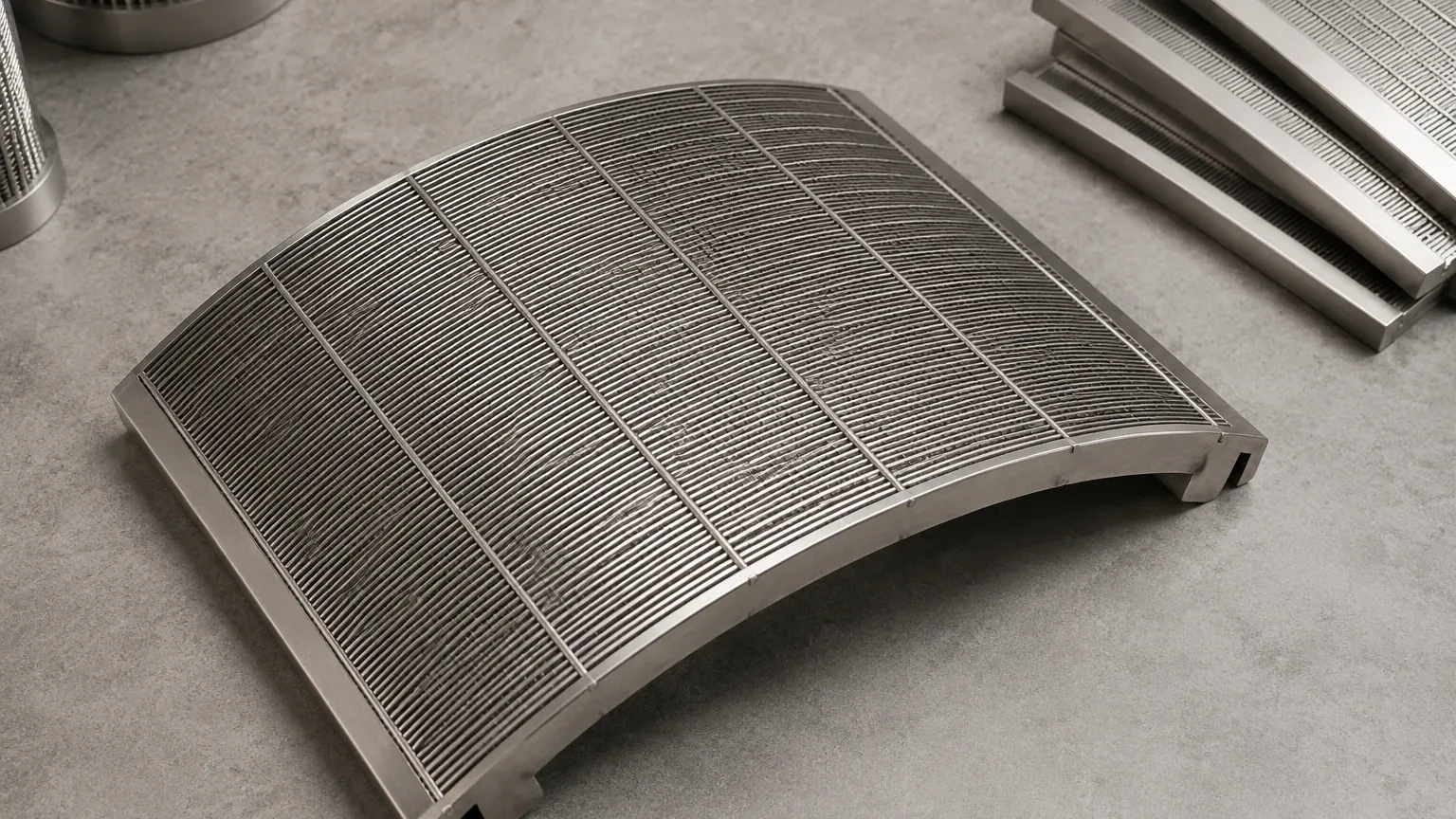
To understand why a z wedge stage is relevant to filtration technology, one must look at the manufacturing tolerances required for high-performance Wedge Wire Screens. These screens consist of V-shaped profile wires resistance-welded onto support rods. The distance between the surface wires—the slot opening—determines the filtration accuracy.
Slot Uniformity and Inspection
In applications like pharmaceutical processing or fine chemical filtration, slot widths may be as small as 20 microns. During the manufacturing process, maintaining the vertical alignment of the welding head or the optical inspection camera is paramount. A z wedge stage provides the necessary resolution to adjust these components with extreme precision. If the inspection camera is even slightly out of focus due to vertical drift, the automated quality control system may fail to detect a variance in slot width, leading to compromised filtration performance.
Automated Assembly
In the assembly of complex cylindrical filters or custom-flat panels, the Z-axis positioning of the workpiece ensures that the resistance welding process occurs at the exact focal point of the electrical contact. The high load capacity of a wedge-driven stage allows it to support heavy stainless steel screen assemblies while maintaining the delicate movements required for precise welding increments.
Key Performance Indicators for Industrial Z Wedge Stages
When evaluating a z wedge stage for integration into a filtration production line or an automated processing system, engineers must prioritize specific performance metrics over generic marketing claims.
Travel Range and Resolution
While Z wedge stages are known for precision, they typically have a more limited travel range than lead-screw stages, often ranging from 5mm to 25mm. However, the resolution—the smallest increment of motion the stage can reliably execute—can reach the nanometer scale. For most industrial filtration applications, a resolution of 0.1 μm to 1 μm is sufficient to ensure the integrity of the screen geometry.
Load Capacity and Moment Stiffness
Industrial environments often involve heavy components. A robust z wedge stage must be rated for both static and dynamic loads. Furthermore, moment stiffness (resistance to tilting when a load is applied off-center) is critical. In the production of large-scale Wedge Wire Screens, the stage must resist deflection to ensure that the slot width remains uniform across the entire surface of the screen.
Bi-directional Repeatability
Repeatability refers to the ability of the stage to return to a specific position from the same direction. Bi-directional repeatability accounts for backlash—the play in the mechanical linkage when reversing direction. High-end stages utilize preloaded bearings and precision-ground wedges to minimize backlash, ensuring that vertical adjustments are consistent throughout a 24/7 production cycle.
Material Selection and Environmental Considerations
In the B2B sector, particularly in industries like food and beverage or chemical processing, the operating environment dictates the material requirements for motion control components.
Corrosion Resistance
If the z wedge stage is used in an environment where it may be exposed to cleaning agents or corrosive vapors, standard carbon steel components are inadequate. Engineers should specify stages with stainless steel housings or specialized coatings (such as electroless nickel plating). This mirrors the material selection process for the filters themselves, where 304 or 316L stainless steel is standard for durability.
Cleanroom and Vacuum Compatibility
For pharmaceutical and semiconductor applications, the stage must be compatible with cleanroom standards. This involves using low-outgassing lubricants and ensuring that the mechanical friction does not generate particulate matter that could contaminate the filtration media. Some Z wedge stages are specifically designed for high-vacuum environments, featuring vented screws and specialized materials to prevent cold-welding of moving parts.
Common Technical Risks and Mitigation Strategies
Implementing a z wedge stage is not without technical challenges. Understanding these risks is essential for maintaining the total cost of ownership and system uptime.
Thermal Expansion
In industrial settings with fluctuating temperatures, thermal expansion of the wedge material can lead to "position drift." Even a few degrees of change can cause a micron-level shift in the Z-axis. To mitigate this, systems should be calibrated at operating temperature, or stages made from materials with low coefficients of thermal expansion (such as Invar) should be considered for ultra-high precision tasks.
Lubrication Failure
The wedge mechanism relies on a thin film of lubricant between the sliding surfaces. In high-cycle applications, the lubricant can break down or become contaminated with industrial dust. Regular maintenance schedules and the use of automated lubrication systems are necessary to prevent increased friction, which leads to positioning errors and premature mechanical wear.
Cable Management
Because the drive motor for a Z wedge stage often moves horizontally while the platform moves vertically, cable management is a frequent point of failure. Using high-flex cables and properly designed drag chains prevents cable fatigue and ensures that electrical signals to the encoders remain clear and uninterrupted.
Integrating Wedge Wire Screens into Automated Systems
For technical professionals designing systems that incorporate Wedge Wire Screens, the Z-axis control often pertains to the cleaning or backwashing mechanism. In automated self-cleaning filters, a nozzle or scraper must be positioned at a precise distance from the screen surface to effectively remove debris without causing mechanical wear to the wire profiles.
Using a z wedge stage in the design of these automated systems allows for:
* Variable Gap Adjustment: The system can automatically adjust the distance between the cleaning head and the screen based on the type of contaminant or the pressure drop across the filter.
* Wear Compensation: As cleaning brushes or scrapers wear down over time, the Z-axis stage can compensate for the loss of material, maintaining optimal contact pressure and extending the service life of the cleaning components.
* Automated Calibration: The system can perform a "homing" routine to re-establish the zero point, ensuring that the filtration system operates within its designed parameters even after maintenance or component replacement.
Procurement and Technical Confirmation Checklist
Before finalizing a purchase or specification for a z wedge stage, purchasing teams and engineers should confirm the following data points with their suppliers:
1. Direct vs. Indirect Drive: Confirm if the motor is directly coupled to the wedge or if there is a belt/gear reduction, as this affects both speed and precision.
2. Encoder Type: Determine if the stage uses a linear encoder (measuring the platform directly) or a rotary encoder (measuring the motor shaft). Linear encoders generally provide higher accuracy by accounting for mechanical errors in the drive train.
3. Mounting Orientation: Verify that the stage is rated for the specific orientation required. While designed for vertical lift, some stages have different load ratings if mounted on an incline or upside down.
4. Environmental Rating: Ensure the IP (Ingress Protection) rating matches the washdown or dust requirements of the facility.
5. Interoperability: Check that the stage controller is compatible with existing PLC (Programmable Logic Controller) or motion control software used in the plant.
By focusing on these factual engineering requirements, businesses can ensure that their investment in motion control technology supports the long-term reliability of their filtration processes. Whether used in the manufacturing of Wedge Wire Screens or integrated into the final filtration machinery, the z wedge stage remains a critical component for achieving industrial-grade precision.
