


Filter Cartridges for Water
In industrial water treatment and process engineering, the selection of filtration media is a critical factor influencing both operational efficiency and product quality. While various materials exist for fluid clarification, stainless steel filter cartridges for water have become the standard for demanding applications where durability, temperature resistance, and precise micron ratings are non-negotiable. For engineers and procurement teams, understanding the technical nuances of these components—ranging from material grade to structural design—is essential for optimizing filtration systems and managing the total cost of ownership.
Industrial water filtration encompasses a wide spectrum of requirements, from removing coarse debris in cooling towers to fine particulate removal in pharmaceutical process water. Unlike disposable polymer-based alternatives, metal Filter Cartridges offer a reusable, high-strength solution capable of withstanding high differential pressures and aggressive cleaning cycles.
Engineering Requirements for Industrial Water Filtration
When specifying filter cartridges for water systems, engineers must first define the physical and chemical characteristics of the influent. Water is rarely just H2O; it often contains a mix of suspended solids, dissolved minerals, and biological matter. The filtration objective—whether it is protecting downstream equipment like Reverse Osmosis (RO) membranes or ensuring the purity of food-grade ingredients—dictates the necessary cartridge specifications.
Flow Rate and Differential Pressure
One of the primary engineering considerations is the relationship between flow rate and differential pressure ($ΔP$). As water passes through the filter media, resistance causes a pressure drop. An undersized filtration system will result in excessive $ΔP$, leading to reduced flow rates, increased energy consumption by pumps, and potential structural failure of the filter media. Properly designed stainless steel cartridges are engineered to maximize the effective filtration area, often through pleating, to maintain high flux rates while keeping the initial $ΔP$ low.
Particle Size Distribution
Selecting the correct micron rating requires an analysis of the particle size distribution (PSD) in the water source. Using a filter with an unnecessarily fine micron rating can lead to rapid clogging (blinding) and frequent maintenance. Conversely, a rating that is too coarse will fail to protect downstream processes. In industrial water applications, it is common to use a multi-stage approach, utilizing coarse strainers followed by fine-mesh filter cartridges for water to achieve the desired clarity efficiently.
Material Selection: The Role of Stainless Steel
In many industrial environments, the chemical composition of the water and the cleaning protocols involved make standard plastic or fiber filters unsuitable. Stainless steel is the preferred material for high-performance filter cartridges due to its mechanical properties and corrosion resistance.
Grade 304 vs. Grade 316L
* Stainless Steel 304: This is the standard grade for general water filtration applications, providing excellent strength and basic corrosion resistance. It is suitable for cooling water, pre-filtration in municipal systems, and general industrial process water.
* Stainless Steel 316L: Containing molybdenum, 316L offers superior resistance to chlorides and acids. This grade is essential for applications involving brackish water, seawater, or water treated with high concentrations of chlorine. In the pharmaceutical and food and beverage industries, 316L is often mandated due to its superior surface finish and resistance to chemical sanitization agents.
Thermal and Chemical Stability
Unlike polypropylene or polyester cartridges, which may soften or degrade at temperatures exceeding 60°C (140°F), stainless steel cartridges can operate at temperatures up to 300°C (572°F) or higher, depending on the seal material. This makes them ideal for steam filtration, hot condensate return, and high-temperature CIP (Clean-In-Place) processes.
Construction Types and Filtration Mechanisms
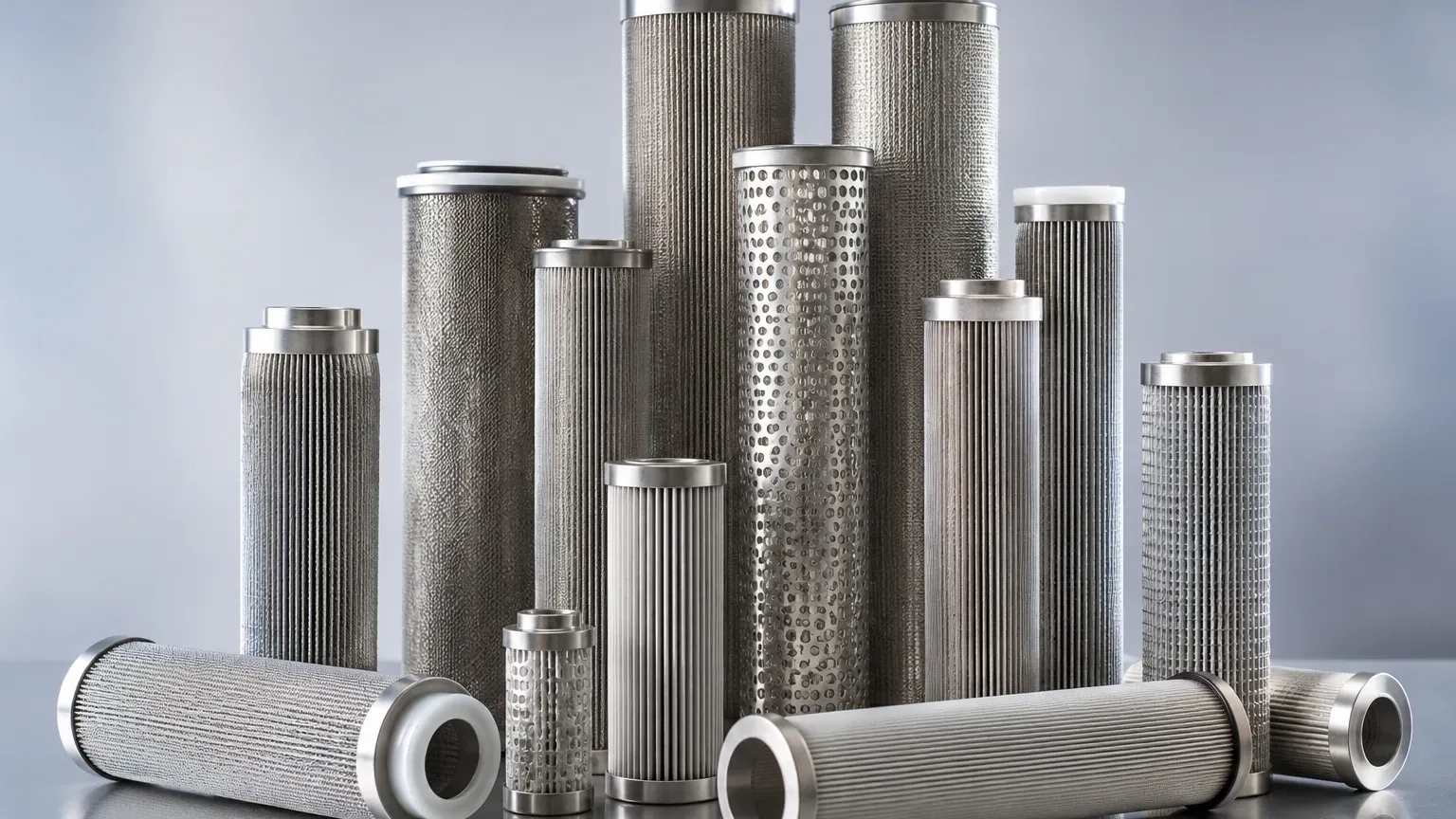
The performance of filter cartridges for water is largely determined by the construction of the filter media. Kaifil specializes in several designs tailored to specific industrial needs.
Woven Wire Mesh
Woven wire mesh filters provide surface filtration. They are characterized by precise pore sizes and are highly effective for removing rigid, non-deformable particles. Because the filtration occurs on the surface, these cartridges are the easiest to clean via backwashing or ultrasonic treatment. They are commonly used in cooling water circuits and as pre-filters for sensitive equipment.
Sintered Metal Mesh
Sintered mesh is created by diffusion-bonding multiple layers of wire mesh together under high heat and pressure. This process creates a robust, integrated structure that combines the precision of fine mesh with the mechanical strength of coarser support layers. Sintered cartridges are preferred for high-pressure water applications where the media must resist migration or deformation under stress.
Pleated Designs
To increase the surface area within a standard 10-inch or 20-inch cartridge footprint, the metal mesh can be pleated. Pleating significantly increases the dirt-holding capacity and extends the service life between cleanings. For water applications with high particulate loads, pleated stainless steel cartridges offer a superior balance of longevity and flow efficiency.
Performance Metrics: Micron Ratings and Efficiency
Understanding how filter cartridges are rated is vital for technical procurement. There are two primary ways to describe filtration accuracy: nominal and absolute.
1. Nominal Rating: This refers to the ability of the filter to retain a major percentage (usually 60% to 90%) of particles of a specific size. While useful for general guidance, nominal ratings do not guarantee the removal of all particles at that size.
2. Absolute Rating: This indicates that the filter will retain 99.9% (or higher) of particles at the specified micron size. In critical water applications, such as pharmaceutical manufacturing or microelectronics, absolute-rated cartridges are necessary to ensure process consistency.
Engineers should also consider the Beta Ratio (β), which is the ratio of particles of a given size in the influent versus the effluent. A higher Beta ratio indicates higher filtration efficiency. For example, a β1000 rating at 5 microns means that for every 1,000 particles of 5 microns entering the filter, only one passes through.
Application-Specific Considerations in Water Treatment
Different sectors utilize filter cartridges for water in distinct ways, necessitating customized designs.
Food and Beverage Processing
In this sector, filters must comply with FDA and EU food-contact regulations. Stainless steel is favored because it does not shed fibers or chemicals into the product stream. Applications include the filtration of ingredient water, carbonated beverages, and the removal of yeast or bacteria in breweries and wineries.
Cooling Tower and Boiler Feed Water
Water used in cooling towers and boilers must be free of suspended solids to prevent scaling and fouling of heat exchangers. Stainless steel cartridges provide a durable solution that can handle the high flow rates and potential chemical additives used for pH adjustment and biocidal control.
Pharmaceutical and Biotech
Water for Injection (WFI) and purified water systems require the highest levels of filtration. Stainless steel cartridges are often used as vent filters on storage tanks or as final polishing filters. Their ability to be sterilized via autoclaving or in-situ steam is a primary advantage in these sterile environments.
Maintenance, Cleaning, and Total Cost of Ownership
One of the most significant advantages of stainless steel Filter Cartridges is their reusability. While the initial capital expenditure (CAPEX) is higher than that of disposable filters, the total cost of ownership (TCO) is often lower over the long term due to reduced waste and replacement costs.
Cleaning Procedures
Depending on the nature of the contaminants, stainless steel cartridges can be cleaned using several methods:
* Backwashing: Reversing the flow of water to dislodge surface-bound particles.
* Chemical Cleaning: Using acids, alkalis, or surfactants to dissolve organic or mineral deposits.
* Ultrasonic Cleaning: High-frequency sound waves create cavitation bubbles that remove fine particles from deep within the mesh pores.
* High-Temperature Burn-off: Used for removing organic contaminants that cannot be dissolved chemically.
Determining Replacement Cycles
While stainless steel filters are durable, they are not infinite. Repeated cleaning cycles and mechanical stress can eventually lead to work hardening or media fatigue. Engineers should monitor the "clean" differential pressure after each cleaning cycle. If the baseline $ΔP$ begins to rise significantly, it indicates that the media is becoming permanently fouled and the cartridge should be replaced to maintain system efficiency.
Technical Checklist for Purchasing Teams
Before finalizing a purchase of filter cartridges for water, technical teams should confirm the following specifications with the manufacturer:
1. Micron Rating Requirement: Is an absolute or nominal rating required for this specific process step?
2. Housing Compatibility: Does the cartridge use standard end-cap configurations (e.g., Code 7, DOE, 222, or 226)?
3. Seal Material: Are the O-rings or gaskets compatible with the water chemistry and operating temperature (e.g., EPDM, Viton, or PTFE)?
4. Structural Strength: What is the maximum allowable differential pressure before the core or media risks collapse?
5. Certification Needs: Does the application require material traceability (MTRs) or compliance with specific industry standards (e.g., 3-A Sanitary Standards)?
By focusing on these technical parameters, industrial facilities can ensure they select filtration solutions that provide reliable performance, minimize downtime, and contribute to a more sustainable and cost-effective water management strategy.
