


General Water Filter Cartridges
In industrial water treatment, the selection of filtration components is a critical decision that impacts system efficiency, equipment longevity, and product quality. General water filter cartridges serve as the primary mechanism for removing suspended solids, sediment, and organic contaminants from process water. While the term "general" suggests a broad application, the engineering requirements behind these components are highly specific, necessitating a deep understanding of fluid dynamics, material science, and filtration mechanics.
For engineers and procurement professionals, navigating the landscape of Filter Cartridges requires moving beyond surface-level specifications. This guide examines the technical nuances of general water filter cartridges, focusing on material selection, performance metrics, and the transition from disposable media to high-performance stainless steel solutions.
The Role of General Water Filter Cartridges in Industrial Systems
General water filter cartridges are deployed across a vast spectrum of industries, including chemical processing, food and beverage production, pharmaceuticals, and power generation. Their primary function is to act as a barrier against particulate matter that could otherwise damage downstream equipment, such as high-pressure pumps, reverse osmosis (RO) membranes, and precision nozzles.
In most industrial configurations, these cartridges are housed within a pressure vessel. As water passes through the filter media, contaminants are trapped either within the depth of the material or on its surface. The choice of cartridge influences not only the clarity of the water but also the operational costs associated with pressure drop and maintenance cycles.
Categorizing Filter Media: Depth vs. Surface Filtration
When evaluating general water filter cartridges, the first technical distinction to understand is the filtration mechanism: depth filtration versus surface filtration.
Depth Filtration
Depth filters, such as melt-blown polypropylene or string-wound cartridges, utilize the entire thickness of the filter media to capture particles. They are characterized by a graded density structure, where the outer layers catch larger particles and the inner layers capture finer ones.
* Advantages: High dirt-holding capacity and relatively low initial cost.
* Disadvantages: Susceptibility to media migration (where fibers shed into the filtrate) and a tendency to unload trapped particles if pressure surges occur.
Surface Filtration
Surface filters, most notably pleated cartridges, capture contaminants on a thin, single-layer membrane or mesh. These are designed for high-efficiency particle removal and provide a much larger surface area within the same footprint as a depth filter.
* Advantages: Precise micron ratings, high flow rates, and lower initial pressure drop.
* Disadvantages: Higher initial cost per unit compared to basic depth filters, though often offset by longer service life.
Engineering Considerations for Material Selection
The material of a filter cartridge dictates its chemical compatibility and thermal limits. While polymer-based general water filter cartridges (polypropylene, polyester, nylon) are common in low-temperature, non-corrosive applications, they often fail in demanding industrial environments.
The Move Toward Stainless Steel
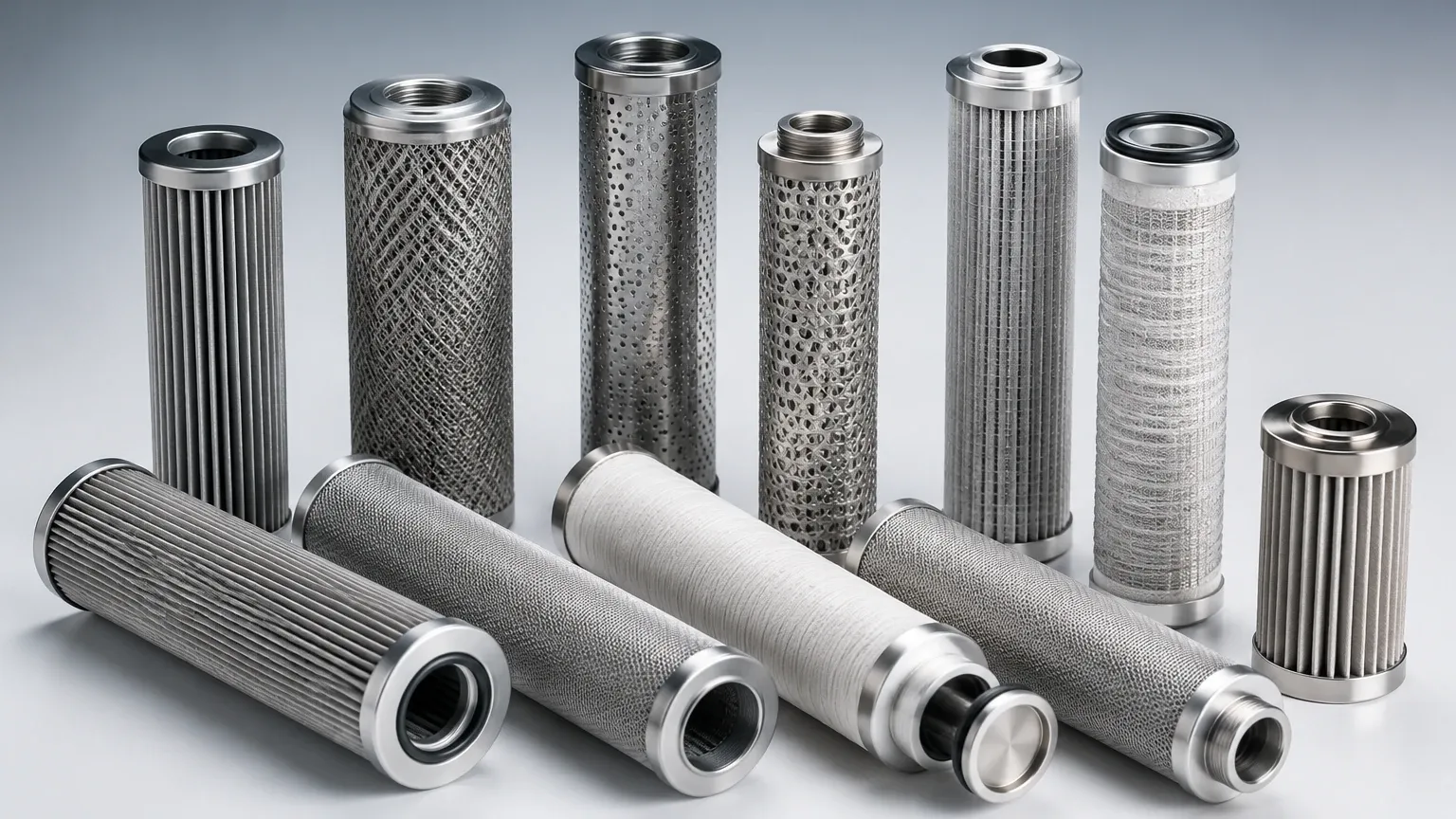
In applications involving high temperatures, aggressive chemicals, or high differential pressures, stainless steel filter cartridges are the preferred engineering choice. Utilizing 304 or 316L stainless steel wire mesh or sintered metal fibers provides several advantages:
1. Thermal Stability: Unlike polymers that soften or degrade at elevated temperatures, stainless steel maintains structural integrity up to several hundred degrees Celsius.
2. Chemical Resistance: Stainless steel is resistant to a wide range of solvents, acids, and bases, making it ideal for chemical processing water loops.
3. Mechanical Strength: Metal cartridges can withstand significantly higher differential pressures without collapsing or bypassing, ensuring consistent filtration performance under stress.
4. Cleanability: Perhaps the most significant advantage is that stainless steel cartridges are often cleanable and reusable. Through backwashing, ultrasonic cleaning, or chemical soaking, the original flow characteristics can be restored, eliminating the waste and recurring costs associated with disposable cartridges.
Understanding Micron Ratings: Absolute vs. Nominal
A common point of confusion in the procurement of general water filter cartridges is the micron rating. Engineers must distinguish between nominal and absolute ratings to ensure the protection of downstream components.
* Nominal Micron Rating: This is an arbitrary value indicating that the filter will trap a certain percentage (often 50% to 85%) of particles at the stated size. It does not guarantee total removal and is best suited for pre-filtration stages.
* Absolute Micron Rating: This indicates that the filter will remove 99.9% (Beta 1000) or more of particles at the specified size. For critical processes, such as protecting sensitive membranes or ensuring pharmaceutical-grade water, absolute-rated cartridges are mandatory.
When selecting general water filter cartridges, it is essential to request the Beta ratio data from the manufacturer to understand the true efficiency of the media under operational conditions.
Flow Rates and Differential Pressure (ΔP)
The relationship between flow rate and differential pressure is a primary driver of system design. Every filter cartridge introduces a resistance to flow, known as the clean pressure drop. As the filter accumulates contaminants, this resistance increases.
Engineers must calculate the total system pressure and ensure that the selected cartridge can handle the required flow rate without exceeding the maximum allowable differential pressure. Over-sizing the filter housing to accommodate more cartridges or larger surface area cartridges can drastically reduce the frequency of change-outs, leading to lower labor costs and less system downtime.
Customization and OEM Integration
Standard off-the-shelf general water filter cartridges do not always meet the unique spatial or performance constraints of specialized industrial machinery. This is where custom manufacturing becomes essential. Customization options often include:
* End-Cap Configurations: Matching specific housing requirements (e.g., Code 7, 222, 226, or DOE).
* Custom Lengths and Diameters: Fitting non-standard vessels or maximizing filtration area in tight spaces.
* Specialized Alloys: Utilizing Monel, Hastelloy, or specific grades of stainless steel for extreme environments.
* Reinforced Cores: Adding internal support to handle high-viscosity fluids or extreme pressure spikes.
For original equipment manufacturers (OEMs), partnering with a specialist like Kaifil allows for the development of proprietary filtration components that are optimized for the specific fluid dynamics of their equipment.
Total Cost of Ownership (TCO) Analysis
When evaluating general water filter cartridges, the purchase price is only one component of the Total Cost of Ownership. A comprehensive TCO analysis should include:
1. Replacement Frequency: How often does the system need to be shut down to replace cartridges?
2. Labor Costs: The man-hours required for maintenance and disposal.
3. Disposal Costs: In many regions, disposing of used polymer cartridges (especially those contaminated with industrial chemicals) incurs significant environmental fees.
4. Energy Consumption: A filter with a high pressure drop requires the pump to work harder, increasing energy costs over the life of the system.
By investing in high-quality, cleanable stainless steel Filter Cartridges, facilities can often achieve a lower TCO despite a higher initial capital expenditure. The durability of metal media reduces the volume of waste and ensures that the filtration system remains a reliable part of the production line for years rather than weeks.
Quality Assurance and Compliance
In industries such as food and beverage or pharmaceuticals, general water filter cartridges must comply with strict regulatory standards. This includes FDA compliance for food-contact materials and USP Class VI plastics testing for medical applications. For stainless steel components, material traceability is paramount. Ensuring that the manufacturer provides mill test reports (MTRs) for the alloys used guarantees that the filters will not introduce unwanted contaminants into the water stream.
Conclusion: Making an Informed Selection
Selecting the right general water filter cartridges is a balance of technical performance, material compatibility, and economic reality. Whether the application requires a simple pre-filter for a cooling tower or a high-precision stainless steel element for a chemical reactor, understanding the underlying engineering principles is key to system success.
Before finalizing a filtration strategy, engineers should confirm the following:
* The specific particulate size and distribution in the source water.
* The maximum operating temperature and chemical composition of the fluid.
* The desired flow rate and the maximum allowable pressure drop.
* The feasibility of using cleanable, reusable media to reduce long-term operational costs.
By focusing on these factual boundaries, purchasing teams and engineers can implement filtration solutions that provide consistent, reliable performance in even the most demanding industrial environments.
