


Are Water Filter Cartridges Interchangeable
In industrial process engineering and facility management, the question of whether filter cartridges are interchangeable is rarely a simple "yes" or "no." While the consumer market often relies on standardized sizes for residential systems, industrial filtration environments—ranging from chemical processing to food and beverage production—operate under much stricter tolerances. For engineers and procurement specialists, determining interchangeability requires a deep dive into physical dimensions, end-cap configurations, material compatibility, and performance specifications.
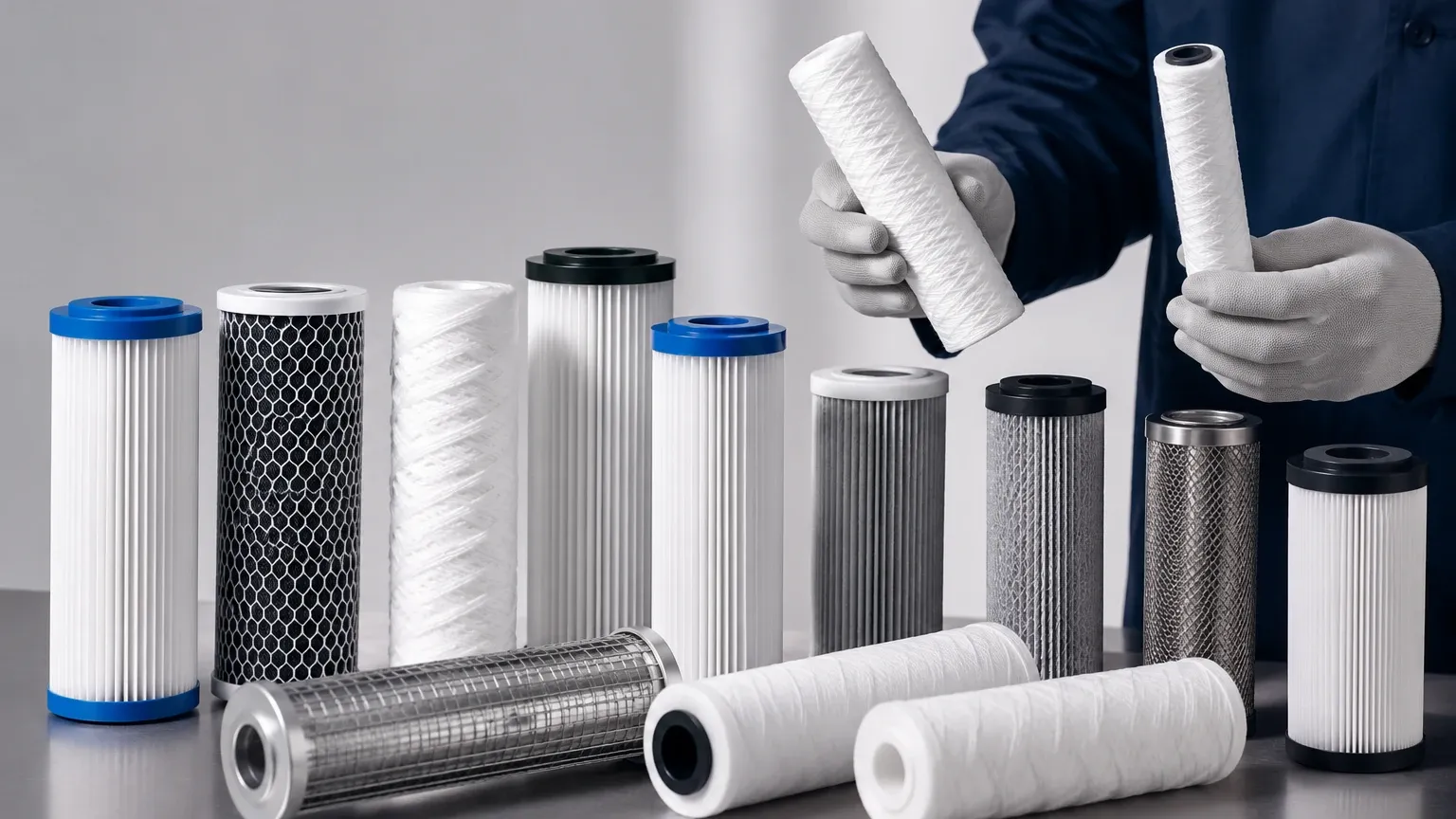
Understanding the nuances of Filter Cartridges is essential for maintaining system integrity. A mismatch, even by a fraction of a millimeter, can lead to fluid bypass, downstream contamination, or catastrophic equipment failure. This guide explores the technical criteria that define interchangeability and the engineering considerations necessary when selecting replacement components.
The Concept of Universal Standards vs. Proprietary Designs
The industrial filtration market is divided between "universal" standard sizes and proprietary designs. Standardized cartridges typically follow nominal lengths of 10, 20, 30, or 40 inches. In many water treatment applications, the 2.5-inch and 4.5-inch (often referred to as "Big Blue") outer diameters are common. If a system is designed around these dimensions, many third-party cartridges may physically fit the housing.
However, the question "are water filter cartridges interchangeable" becomes more complex when dealing with high-precision or high-pressure systems. Many original equipment manufacturers (OEMs) design housings with unique locking mechanisms or seating surfaces to ensure that only their specific cartridges can be used. This is often done to guarantee a specific performance level, but it can also limit a facility's sourcing options. When evaluating interchangeability, one must first identify if the housing is an "open" industry standard or a "closed" proprietary design.
Physical Dimensions and Mechanical Fit
Physical fit is the most basic requirement for interchangeability, but it is also the most common point of failure. There are three primary dimensions to consider:
1. Length: While 10-inch or 20-inch lengths are standard, the actual measurement can vary slightly between manufacturers. A cartridge that is 1/8th of an inch too short may not compress the gaskets sufficiently, leading to bypass. Conversely, a cartridge that is too long may prevent the housing from sealing correctly.
2. Outer Diameter (OD): The OD must allow for sufficient clearance within the housing bowl to ensure uniform flow distribution across the entire surface area of the media. In multi-round housings, the OD is critical to ensure cartridges do not touch each other, which could create flow dead zones.
3. Inner Diameter (ID): The ID must match the center post or riser pipe of the housing. If the ID is too large, the cartridge will not center properly, risking an uneven seal at the end caps.
For stainless steel filter cartridges, these dimensions are even more critical because the metal media does not "give" or compress like polypropylene or pleated paper. Precision machining is required to ensure that the metal-to-metal or metal-to-gasket interface is airtight.
End Cap Configurations: The Key to a Secure Seal
The method by which a cartridge connects to the housing is perhaps the most significant barrier to interchangeability. Industrial Filter Cartridges utilize a variety of end cap styles, each designed for specific pressure and purity requirements. Common configurations include:
* Double Open End (DOE): These cartridges are open at both ends and rely on flat gaskets and housing compression to create a seal. While widely interchangeable, they are prone to bypass if the housing spring is weak or the cartridge length is off.
* Single Open End (SOE) with O-Rings: These are often categorized by "Codes." For example, Code 7 features two 226 O-rings and a locking bayonet (tabs), while Code 3 uses two 222 O-rings with a flat bottom. These are generally not interchangeable with each other. A Code 7 cartridge will not fit into a housing designed for a Code 3 or a DOE cartridge.
* Threaded Connections: Some high-pressure or hydraulic systems use NPT or BSP threaded connections to ensure the cartridge cannot be dislodged by pressure surges. These are highly specific and rarely interchangeable across different brands unless the thread pitch and diameter are identical.
When asking are water filter cartridges interchangeable, the engineer must verify the specific Code or end-cap geometry. Using the wrong end-cap style can result in a total lack of filtration if the fluid simply flows around the O-ring seat.
Material Compatibility and Chemical Resistance
Interchangeability is not just about fit; it is about survival within the process environment. A cartridge that fits perfectly but is made of the wrong material will fail. In industrial B2B applications, the choice of material is dictated by the chemical composition of the fluid, the operating temperature, and the required durability.
For instance, a polypropylene melt-blown cartridge might be interchangeable with a pleated polyester cartridge in a standard water line. However, if the process involves aggressive solvents, high temperatures (above 140°F), or high viscosity fluids, stainless steel cartridges (304 or 316L) are often required.
Furthermore, the seal material is a critical variable. O-rings and gaskets are available in EPDM, Viton (FKM), Silicone, and PTFE. If a replacement cartridge comes standard with EPDM but the process fluid is a petroleum-based oil, the seal will swell and degrade, leading to leaks and contamination. Therefore, a cartridge is only truly interchangeable if its construction materials—both media and seals—match or exceed the specifications of the original part.
Performance Specifications: Micron Ratings and Efficiency
One of the most misunderstood aspects of filter interchangeability is the micron rating. Two cartridges may both be labeled as "5 Micron," but their performance in the field can be vastly different. This is due to the distinction between Nominal and Absolute ratings.
* Nominal Rating: This is an industrial "average." A 5-micron nominal filter might only trap 60% to 80% of particles at that size.
* Absolute Rating: This implies a 99.9% (Beta 5000) or higher efficiency at the specified micron size.
If an engineer replaces an absolute-rated cartridge with a nominal-rated "equivalent" to save costs, the downstream equipment (such as a high-pressure pump or a reverse osmosis membrane) may be exposed to damaging particulates. When evaluating whether Filter Cartridges are interchangeable, one must compare the Beta Ratio or efficiency curves, not just the micron number on the box.
Additionally, the dirt-holding capacity and the clean pressure drop ($\\Delta P$) must be considered. A replacement cartridge with less surface area (fewer pleats) will reach its terminal pressure drop much faster, leading to increased labor costs for frequent change-outs and higher total cost of ownership (TCO).
Structural Integrity and Pressure Differential
In heavy-duty industrial applications, cartridges must withstand significant differential pressures. This is particularly true in hydraulic systems or high-viscosity chemical processing. The collapse pressure of a cartridge is a vital safety specification.
Stainless steel cartridges, such as those manufactured by Kaifil, are often chosen for their high structural strength. They can withstand much higher differential pressures than plastic or paper alternatives. If a system is designed to operate at a $\\Delta P$ of 50 PSI before change-out, replacing a high-strength metal cartridge with a standard polymer version could result in the cartridge collapsing, sending debris into the process stream. Engineers must verify that any "interchangeable" candidate meets the maximum operating pressure and burst pressure requirements of the system.
The Role of Customization in Industrial Filtration
In many cases, the search for interchangeable filters leads back to the need for customization. Standard off-the-shelf solutions may not meet the specific flow rates, chemical resistances, or longevity requirements of a unique industrial process. This is where working with a specialized manufacturer becomes advantageous.
Customized filtration solutions allow engineers to specify the exact weave of a wire mesh, the reinforcement of the center core, and the precise alloy of the end caps. By moving away from generic "interchangeable" parts and toward application-specific Filter Cartridges, facilities can often extend the life of their filtration systems and reduce the frequency of maintenance. Customization also solves the problem of legacy equipment where the original manufacturer may no longer support the replacement parts.
Risks of Improper Substitution
The risks associated with assuming all cartridges are interchangeable can be significant. Beyond the immediate mechanical issues, there are several long-term risks to consider:
1. Media Migration: Lower-quality replacement cartridges may shed fibers (media migration) into the process stream, which is unacceptable in pharmaceutical or food and beverage applications.
2. Bypass: As mentioned, poor fitment leads to bypass. In a sterilization process, even a 1% bypass can result in a contaminated batch, costing thousands of dollars in lost product.
3. Warranty Voidance: Some housing manufacturers will void the warranty of the entire filtration system if non-approved or non-validated cartridges are used.
4. Increased Energy Costs: A filter that is not optimized for the flow characteristics of the housing may create excessive turbulence or a higher initial pressure drop, forcing pumps to work harder and increasing energy consumption.
Conclusion: How to Verify Interchangeability
Before making a purchasing decision, technical teams should follow a rigorous verification process to determine if a replacement cartridge is truly suitable. This involves more than just a visual comparison.
First, obtain the technical data sheet (TDS) for both the original and the proposed replacement. Compare the absolute micron rating, the material of construction, and the seal type. Second, measure the physical dimensions with calipers if possible, paying close attention to the end-cap geometry. Third, consider the operating environment—if the process involves heat or chemicals, ensure the replacement is rated for those extremes.
While the answer to "are water filter cartridges interchangeable" is often "yes" for basic water applications, the answer for industrial process filtration is "only if all engineering specifications match." For critical applications, consulting with a manufacturer like Kaifil can provide the technical assurance needed to ensure that a replacement cartridge will perform reliably under pressure. By focusing on quality and precision, engineers can optimize their filtration processes, protect downstream assets, and achieve a lower total cost of operation through durable, high-performance filtration components.
Download Are Water Filter Cartridges Interchangeable as a PDF
