


Industrial Sediment Filter
In industrial processing, the presence of suspended solids, particulates, and debris can lead to catastrophic equipment failure, reduced product quality, and significant operational downtime. An industrial sediment filter serves as the primary line of defense in fluid handling systems, removing physical contaminants such as sand, scale, rust, and silt from liquids. Unlike residential or light-commercial systems, industrial-grade sediment filtration requires robust materials, precise engineering, and the ability to withstand high pressures, temperatures, and corrosive environments.
For engineers and procurement professionals, selecting the right filtration solution involves more than just identifying a micron rating. It requires a comprehensive understanding of fluid dynamics, material science, and the specific demands of the application. As a specialized manufacturer of stainless steel filtration solutions, Kaifil provides the technical expertise and manufacturing capabilities necessary to develop high-performance components that ensure system longevity and process efficiency.
The Role of Industrial Sediment Filters in Process Systems
Industrial sediment filters are integrated into process streams to protect downstream components and maintain the purity of the process fluid. In sectors such as chemical processing, food and beverage production, and hydraulic systems, the presence of even microscopic particles can cause abrasive wear on pump seals, clog precision nozzles, or contaminate final products.
Protecting Downstream Equipment
High-value equipment like heat exchangers, membrane systems (such as Reverse Osmosis), and sensitive instrumentation are particularly vulnerable to sediment. Silt and scale can accumulate on heat transfer surfaces, leading to reduced thermal efficiency and localized overheating. In membrane applications, sediment acts as a primary cause of fouling, necessitating frequent and expensive chemical cleanings or premature membrane replacement. By implementing a robust industrial sediment filter at the intake or pre-treatment stage, facilities can significantly extend the mean time between failures (MTBF) for their most critical assets.
Maintaining Product Consistency
In the food, beverage, and pharmaceutical industries, sediment removal is a matter of quality control and regulatory compliance. Particulates in the fluid stream can alter the clarity, taste, or chemical composition of the final product. Stainless steel wire mesh filters are often preferred in these sectors due to their non-leaching properties and ability to be sterilized using Clean-in-Place (CIP) protocols.
Technical Specifications: Micron Ratings and Filtration Efficiency
When evaluating an industrial sediment filter, the micron rating is the most common metric used to define performance. However, engineers must distinguish between nominal and absolute ratings to ensure the filter meets the required safety margins.
* Nominal Micron Rating: This indicates the filter's ability to retain a majority of particles of a specific size (usually between 60% and 90%). Nominal filters are often used for primary sediment removal where total capture is less critical than high flow rates.
* Absolute Micron Rating: This refers to the diameter of the largest hard spherical particle that will pass through the filter under specified test conditions. For critical applications where no particles above a certain size can be tolerated, absolute-rated stainless steel cartridges are the industry standard.
Beyond the micron rating, the "dirt-holding capacity" is a vital consideration. This refers to the volume of contaminants a filter can retain before the pressure drop across the media reaches a terminal level, requiring cleaning or replacement. In high-sediment environments, choosing a filter with a larger surface area—such as a pleated stainless steel cartridge—can significantly extend service intervals.
Material Selection: Why Stainless Steel is the Standard
While polymer-based filters are common in low-demand environments, industrial applications typically require the mechanical strength and chemical resistance of metal. Stainless steel, specifically grades 304 and 316L, is the preferred material for industrial sediment filter components for several reasons:
1. Thermal Stability: Industrial processes often involve high-temperature fluids that would degrade or melt plastic filter media. Stainless steel maintains its structural integrity at temperatures exceeding 500°F (260°C).
2. Pressure Resistance: High-pressure hydraulic systems and high-flow water treatment plants generate significant differential pressures. Stainless steel wire mesh and sintered metal components can withstand high collapse pressures that would rupture fiber-based filters.
3. Corrosion Resistance: In chemical processing and marine environments, the fluid being filtered may be acidic, alkaline, or saline. 316L stainless steel, with its molybdenum content, provides superior resistance to pitting and crevice corrosion.
4. Sustainability and Reusability: Unlike disposable polypropylene or paper filters that contribute to industrial waste, stainless steel filters are cleanable and reusable. This alignment with sustainable manufacturing practices also reduces long-term operational costs.
Engineers looking for reliable, high-performance filtration components can Review product options and application support to find solutions tailored to these demanding material requirements.
Evaluating Flow Rates and Pressure Drop
A common challenge in designing a filtration system is balancing filtration fineness with the required flow rate. Every industrial sediment filter introduces a degree of resistance to the fluid flow, known as the pressure drop ($ΔP$).
The Impact of Clean Pressure Drop
The "clean pressure drop" is the initial resistance of the filter when it is first installed. If the initial $ΔP$ is too high, it limits the available pressure for downstream processes and increases the energy consumption of the pumps. Engineering teams must size the filter housing and the internal elements (cartridges or mesh) to ensure that the fluid velocity through the media remains within optimal limits, typically minimizing turbulence and premature clogging.
The Terminal Pressure Drop
As the industrial sediment filter captures particles, the effective open area of the mesh decreases, causing the pressure drop to rise. The terminal pressure drop is the point at which the filter must be cleaned or replaced. Monitoring this via differential pressure gauges is essential for preventing system bypass or element collapse. For automated systems, backwashing filters can be programmed to trigger a cleaning cycle once a specific $ΔP$ threshold is reached.
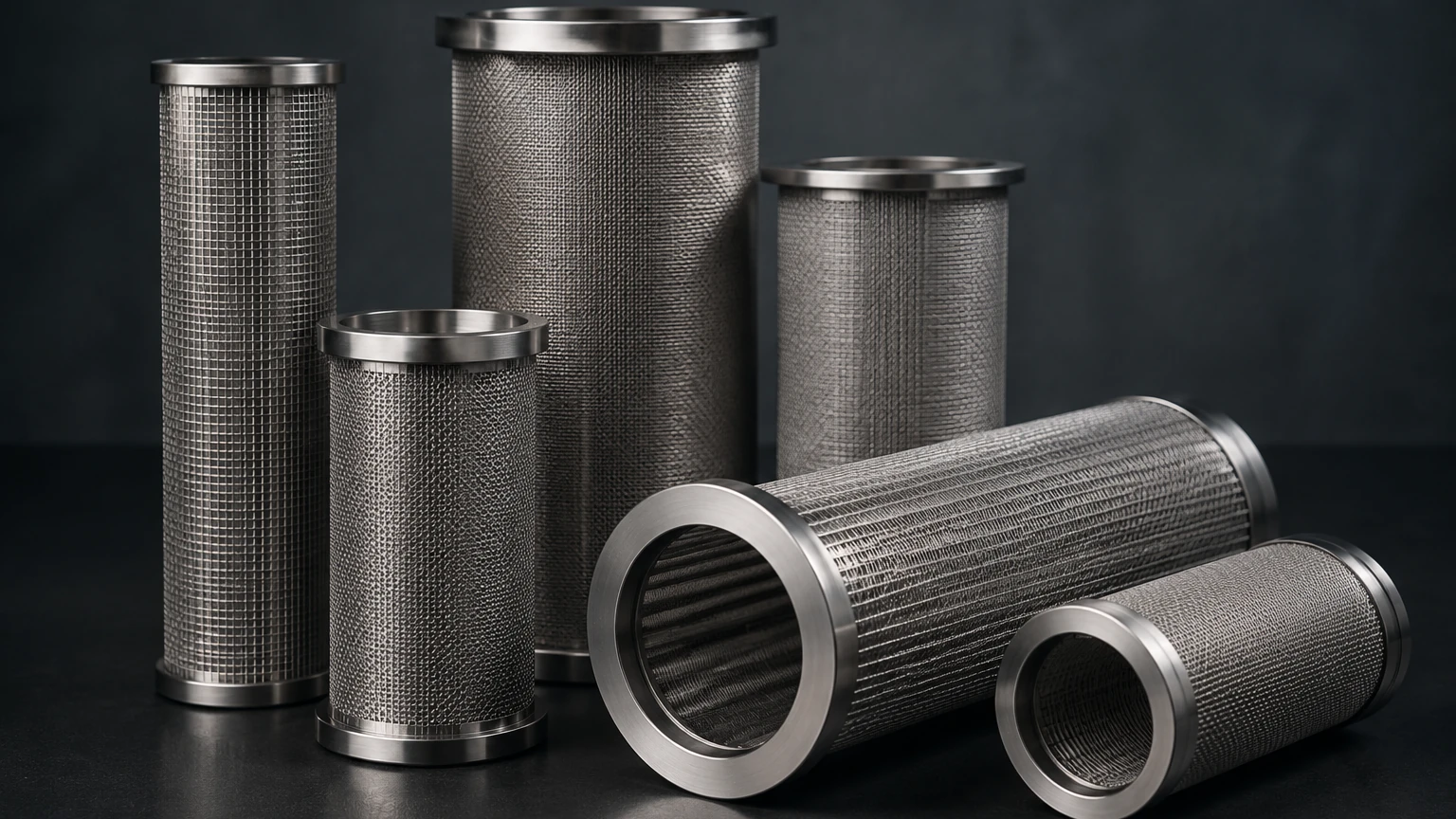
Customization for Specialized Industrial Applications
Standard off-the-shelf filters rarely meet the precise needs of complex industrial setups. Customization is often required to ensure the filter fits existing housing geometries, meets specific flow requirements, or adheres to unique connection standards (such as NPT, flange, or sanitary tri-clamp fittings).
Kaifil specializes in the OEM manufacture of custom stainless steel filter cartridges and wire mesh components. This includes:
* Custom Geometries: Designing filters for non-standard housings or integrated machine components.
* Variable Layering: Combining multiple layers of wire mesh (coarse for strength, fine for filtration) through sintering to create a robust, high-precision filter element.
* Reinforced Structures: Adding internal cores or external cages to filter elements to prevent deformation under extreme hydraulic shocks or high-viscosity fluid flow.
By working directly with a manufacturer, engineering teams can ensure that the industrial sediment filter is an optimized component of the overall machine design rather than an afterthought.
Maintenance, Cleaning, and Total Cost of Ownership
When calculating the total cost of ownership (TCO) for a filtration system, the initial purchase price is only one factor. Operational costs—including downtime, labor for replacement, and disposal fees for spent cartridges—often outweigh the capital expenditure over the life of the system.
Cleaning Protocols for Stainless Steel Filters
One of the primary advantages of an industrial sediment filter made from stainless steel is its cleanability. Depending on the contaminant, various methods can be used to restore the filter’s performance:
* Backwashing: Reversing the flow of fluid to dislodge particles from the surface of the mesh.
* Ultrasonic Cleaning: Using high-frequency sound waves in a solvent bath to remove fine particles trapped deep within the mesh layers.
* Chemical Cleaning: Using specialized surfactants or acids to dissolve organic or mineral scale without damaging the stainless steel substrate.
Replacement Cycles
While stainless steel filters are durable, they are not infinite. Over years of service and multiple cleaning cycles, the wire mesh may experience work hardening or localized wear. Regular inspection for "blinding" (permanent clogging) or mechanical fatigue is necessary to ensure the filter continues to meet its micron-rating specifications. Establishing a clear maintenance schedule based on differential pressure trends is the most effective way to manage these assets.
Key Information to Confirm Before Procurement
Before finalizing the specification for an industrial sediment filter, the following data points should be confirmed with the manufacturer:
1. Fluid Characteristics: What is the viscosity, temperature, and pH of the fluid?
2. Contaminant Profile: What is the nature of the sediment (hard, soft, fibrous)? What is the typical particle size distribution?
3. Flow Requirements: What are the minimum, normal, and maximum flow rates expected?
4. Housing Compatibility: Does the filter element require specific end-cap configurations (e.g., 222/O-ring, 226/Bayonet, or Flat Gasket) to ensure a bypass-free seal?
5. Regulatory Standards: Does the application require compliance with FDA, 3-A Sanitary, or other industry-specific certifications?
By addressing these factors early in the design or procurement phase, companies can avoid the costs associated with under-performing filtration and ensure their processes remain efficient and reliable. For comprehensive technical data and engineering guidance on high-performance filtration components, visit the Kaifil Main Page to explore our range of custom stainless steel solutions.
