


Strainer Wire Mesh
Strainer wire mesh serves as the primary functional component in industrial filtration systems designed to remove coarse particles from liquid or gas streams. Unlike fine filtration media intended for sub-micron separation, strainer mesh is engineered for mechanical durability, high flow rates, and the protection of downstream equipment such as pumps, valves, and heat exchangers. In industrial environments, the selection of strainer wire mesh is a critical engineering decision that impacts system pressure, maintenance frequency, and the operational lifespan of the entire processing line.
For engineers and procurement teams, understanding the technical nuances of wire diameter, weave patterns, and material grades is essential for optimizing performance. This guide provides a technical overview of strainer wire mesh, focusing on the engineering considerations required for successful implementation in demanding industrial applications.
Fundamental Principles of Strainer Wire Mesh
The performance of strainer wire mesh is defined by its ability to provide a consistent physical barrier while maintaining structural integrity under hydraulic load. The two most critical metrics in its specification are the mesh count and the micron rating.
Mesh count refers to the number of openings per linear inch. For example, a 20-mesh screen has 20 openings per inch in both the warp and shute directions. However, mesh count alone does not define the filtration capability because the wire diameter significantly influences the size of the aperture. The actual opening size, or the space between adjacent wires, determines the largest particle that can pass through the strainer.
Engineers must also consider the "open area" percentage. This is the ratio of the total area of the openings to the total area of the mesh. A higher open area results in a lower initial pressure drop and higher flow capacity but may compromise the mechanical strength of the mesh. Balancing the wire diameter to achieve the necessary tensile strength without excessively restricting flow is the core challenge in strainer design. To explore specific configurations for your project, you can visit the Main Page for detailed technical specifications.
Material Selection and Metallurgical Considerations
Industrial strainer wire mesh is predominantly manufactured from stainless steel due to its mechanical strength and resistance to corrosion. The choice of alloy depends on the chemical composition of the process fluid, the operating temperature, and the presence of abrasive particles.
Stainless Steel 304
This is the standard grade for general industrial use. It provides excellent strength and good corrosion resistance in non-acidic environments. It is commonly used in water treatment, HVAC systems, and food processing where high concentrations of chlorides are not present.
Stainless Steel 316 and 316L
For applications involving chemical processing, marine environments, or pharmaceutical production, SS316 is the preferred material. The addition of molybdenum enhances resistance to pitting and crevice corrosion, particularly in chloride-rich environments. SS316L, the low-carbon version, is utilized when the mesh must be welded into frames or housings, as it prevents carbide precipitation that can lead to intergranular corrosion.
High-Nickel Alloys
In extreme environments involving high temperatures or highly corrosive acids (such as sulfuric or hydrochloric acid), specialized alloys like Monel, Inconel, or Hastelloy may be required. These materials maintain their structural integrity at temperatures where standard stainless steels would fail or undergo rapid oxidation.
Weave Geometry and Filtration Characteristics
The method by which the wires are interlaced—the weave—determines the strainer wire mesh's stability, surface smoothness, and filtration accuracy.
Plain Weave
The most common configuration, where each warp wire crosses alternately over and under each shute wire. It provides the highest open area and is ideal for coarse straining where low pressure drop is a priority. However, in very fine mesh counts, plain weave can lack the rigidity required for high-pressure applications.
Twill Weave
In a twill weave, each warp wire passes alternately over and under two shute wires. This allows for the use of heavier wire diameters in a given mesh count, increasing the mechanical strength and durability of the strainer. It is often used when the mesh must withstand significant backpressure or abrasive wear.
Dutch Weave (Plain and Twill)
Dutch weaves utilize different wire diameters for the warp and shute. Usually, the shute wires are smaller and driven closer together, creating a dense, wedge-shaped opening. This weave provides superior strength and is capable of much finer filtration than standard square mesh. It is frequently employed in high-pressure hydraulic strainers and fuel filtration systems where absolute particle retention is critical.
Engineering for Pressure Drop and Flow Efficiency
One of the most common errors in specifying strainer wire mesh is over-filtering. Selecting a mesh that is significantly finer than necessary increases the rate of particulate buildup, leading to a rapid increase in differential pressure (Delta P).
When a fluid passes through the mesh, it experiences a loss of kinetic energy due to the physical obstruction. The pressure drop is influenced by the fluid's viscosity, velocity, and the mesh's open area. Engineers use the Cv (flow coefficient) to calculate the expected pressure drop across a clean strainer. As the mesh captures debris, the effective open area decreases, and the pressure drop increases exponentially.
To mitigate this, many industrial strainers utilize a "gross screen area" to "pipe area" ratio, often 4:1 or 6:1. This ensures that even as the strainer wire mesh becomes partially clogged, the system can still maintain adequate flow without reaching the bypass pressure or causing pump cavitation.
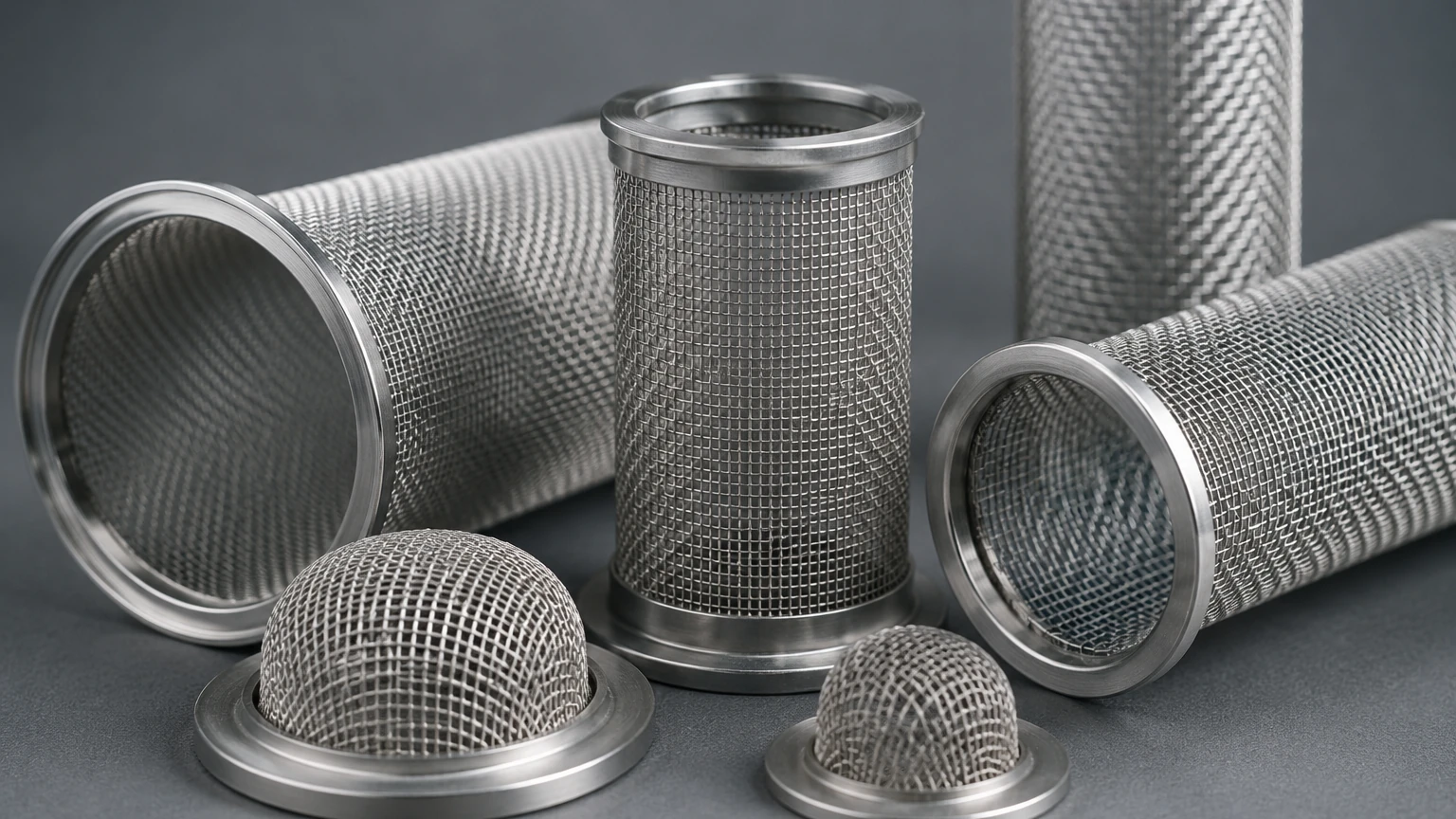
Custom Fabrication and Reinforcement Techniques
In many heavy-duty industrial applications, the strainer wire mesh is not used as a standalone component. It is often fabricated into specific shapes—such as baskets, cones (witch's hats), or cylinders—and reinforced to prevent collapse.
Support Layers
For fine mesh applications, the primary filtration layer is often laminated or sintered to a coarser, heavier support mesh. This "double-layer" construction provides the precision of a fine mesh with the structural rigidity of a heavy-duty screen. In high-pressure systems, a perforated metal plate may be used as an external cage to support the wire mesh.
Pleating
To increase the surface area within a fixed housing volume, the strainer wire mesh can be pleated. Pleating significantly reduces the face velocity of the fluid through the mesh, which lowers the initial pressure drop and extends the time between cleaning cycles. This is a common requirement in hydraulic and lube oil systems where space is limited but high dirt-holding capacity is required.
Edge Treatments and Welding
Proper termination of the mesh edges is vital to prevent bypassing. Custom strainers often feature machined flanges, silicone or PTFE gaskets, or resistance-welded seams. For pharmaceutical and food-grade applications, the welds must be ground smooth to eliminate crevices where bacteria could proliferate.
Application-Specific Engineering Standards
The requirements for strainer wire mesh vary significantly across different industrial sectors:
* Chemical Processing: Focuses on material compatibility and the ability to withstand aggressive cleaning solvents. The mesh must resist stress-corrosion cracking.
* Food and Beverage: Requires compliance with FDA and 3A standards. The mesh must be non-leaching, and the construction must allow for Clean-in-Place (CIP) procedures.
* Oil and Gas: Prioritizes erosion resistance. Strainer wire mesh in this sector often deals with high-velocity flows containing sand or scale, requiring hardened alloys or heavy wire diameters.
* Water Treatment: Often uses large-scale basket strainers with coarse mesh to protect membranes and UV disinfection systems from large debris and organic matter.
Maintenance, Cleaning, and Replacement Protocols
The longevity of strainer wire mesh depends heavily on the maintenance regime. Unlike disposable filter cartridges, stainless steel mesh is designed to be cleaned and reused.
Cleaning Methods
* Backwashing: Reversing the flow of the fluid to dislodge particles from the surface of the mesh. This is effective for surface-loading weaves like plain weave.
* Ultrasonic Cleaning: Using high-frequency sound waves in a cleaning solution to remove fine particles trapped within the intersections of the wires. This is particularly useful for Dutch weave mesh.
* Chemical Cleaning: Using acids or bases to dissolve organic or mineral scaling. The chemical compatibility of the mesh material must be verified before this process.
Indicators for Replacement
While durable, strainer wire mesh is subject to mechanical fatigue and abrasive wear. Engineers should monitor for "blinded" areas where particles have become permanently wedged (peened) into the openings. Physical signs of failure include wire thinning, broken strands, or deformation of the weave pattern (racking). If the differential pressure remains high even after a thorough cleaning, it usually indicates that the mesh has reached the end of its functional life.
Conclusion
Selecting the correct strainer wire mesh requires a detailed analysis of the process environment, including flow dynamics, chemical exposure, and particulate characteristics. By balancing mesh geometry with material science, engineers can ensure that their filtration systems provide reliable protection without introducing unnecessary energy losses. For technical support in designing custom filtration components or to review standard mesh specifications, visit the Main Page to connect with filtration specialists who can assist in optimizing your system's performance.
