


Sintered Porous Metal Filter Elements
Sintered porous metal filter elements represent a critical component in high-performance industrial filtration systems. These elements are engineered to withstand extreme temperatures, high pressures, and corrosive environments where traditional polymer or glass fiber filters would fail. By utilizing advanced powder metallurgy or fiber sintering techniques, manufacturers create a rigid, self-supporting structure that offers precise filtration accuracy and exceptional mechanical durability. For engineers and procurement teams, understanding the technical nuances of these elements is essential for optimizing process efficiency and ensuring the longevity of downstream equipment.
Understanding the Sintering Process and Material Science
The production of sintered porous metal filter elements begins with the selection of high-purity metal powders or fine metal fibers. The most common material used is 316L stainless steel due to its excellent corrosion resistance and mechanical properties. However, for specialized applications involving highly aggressive chemicals or extreme temperatures, alloys such as Hastelloy, Inconel, Monel, or Titanium are utilized.
The sintering process involves heating the metal particles or fibers in a controlled atmosphere furnace to a temperature just below their melting point. At this temperature, molecular diffusion causes the contact points of the particles to bond, forming a continuous, porous matrix. This process, often preceded by isostatic pressing or gravity settling, determines the final pore size distribution and porosity of the element. Unlike woven wire mesh, which relies on a geometric pattern, sintered porous media create a "tortuous path" for the fluid. This path forces contaminants to change direction multiple times, increasing the probability of particle entrapment throughout the depth of the media.
From an engineering perspective, the porosity—typically ranging from 30% to 50%—is a careful balance between permeability and structural integrity. Higher porosity reduces the initial pressure drop but may compromise the burst pressure rating of the element. Conversely, a denser structure provides higher filtration accuracy but requires more energy to drive the fluid through the media.
Key Performance Characteristics of Sintered Porous Media
When evaluating sintered porous metal filter elements, several performance metrics define their suitability for industrial service. These characteristics are not merely marketing specifications but are the result of rigorous metallurgical engineering.
Thermal and Chemical Stability
One of the primary advantages of sintered metal is its ability to operate in temperatures exceeding 450°C (842°F) in oxidizing environments, and even higher in reducing or inert atmospheres. This makes them indispensable for steam filtration, hot gas cleaning, and high-temperature catalyst recovery. Chemically, the choice of alloy allows these filters to resist a wide range of acids, alkalis, and organic solvents, ensuring that the filter media does not leach contaminants into the process stream.
Mechanical Strength and Pressure Resistance
Because the particles are metallurgically bonded, sintered elements possess high mechanical strength and are self-supporting. They can withstand high differential pressures (ΔP) without deforming or shedding media. This structural rigidity is vital in high-viscosity applications, such as polymer melt filtration, where the pressure required to move the fluid is significant. It also allows for effective backwashing or back-pulsing, where the flow is reversed to dislodge accumulated cake from the filter surface.
Filtration Accuracy and Pore Distribution
Sintered metal filters provide consistent filtration ratings, typically ranging from 0.1 microns to 200 microns. The pore size is controlled during the manufacturing process by selecting specific particle sizes and adjusting the sintering parameters. Engineers often distinguish between "nominal" and "absolute" ratings; sintered porous metal elements are frequently rated as absolute filters, meaning they can achieve a 99.9% efficiency at their specified micron rating, verified through bubble point testing according to ISO 2942 standards.
Engineering Selection Criteria for Industrial Applications
Selecting the correct sintered porous metal filter element requires a comprehensive analysis of the process conditions. Engineers must look beyond the micron rating to ensure the system operates efficiently over its intended service life. For more detailed technical specifications and to explore various configurations, engineers can refer to the Main Page for comprehensive product data.
Flow Rate and Pressure Drop Calculations
The relationship between flow rate and pressure drop is governed by Darcy’s Law for porous media. When designing a filtration system, it is crucial to calculate the initial clean pressure drop to ensure it fits within the pump's operational curve. Factors such as fluid viscosity, face velocity, and the permeability coefficient of the sintered media must be considered. A common mistake is undersizing the filter area, which leads to rapid pressure buildup and frequent cleaning cycles.
Contaminant Loading Capacity
The nature of the solids being removed—whether they are hard, deformable, or gelatinous—dictates the choice between surface filtration and depth filtration. Sintered powder elements generally act as depth filters, providing a high dirt-holding capacity for fine particles. Sintered fiber felt, which has higher porosity, offers even greater loading capacity and lower pressure drops, making it ideal for high-flow gas applications.
Compatibility with Housing and Seals
An often-overlooked aspect is the interface between the filter element and the filter housing. Sintered elements are available in various end-cap configurations, including DOE (Double Open End), SOE (Single Open End) with 222 or 226 O-rings, and threaded connections (NPT or BSP). Ensuring that the gasket or O-ring material (e.g., Viton, PTFE, EPDM) is compatible with the process fluid is critical for maintaining a leak-free seal.
Customization and Structural Design Options
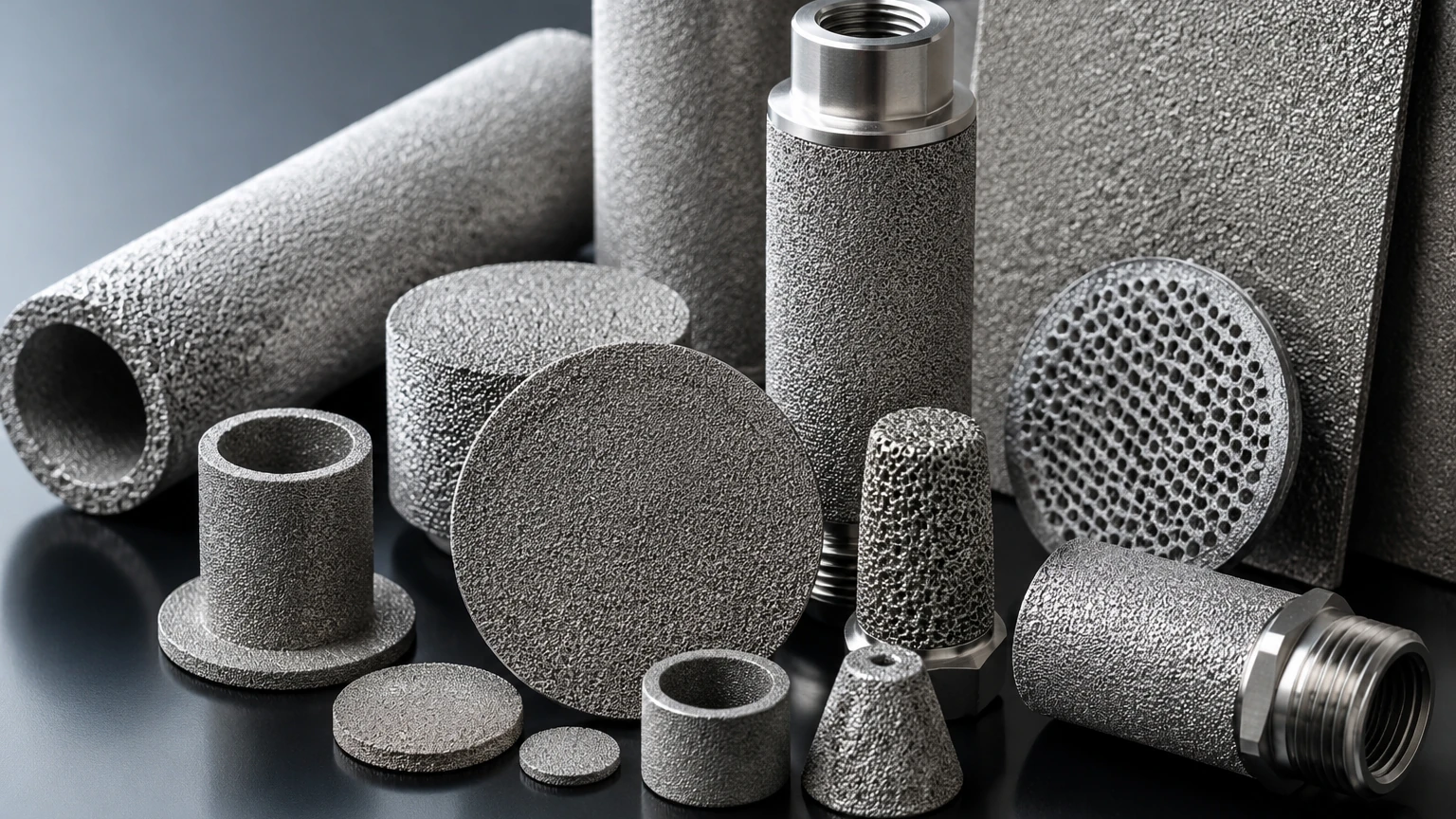
Industrial filtration challenges are rarely solved with off-the-shelf products. Manufacturers like Kaifil specialize in providing customized solutions that address specific geometric and performance requirements. Sintered porous metal filter elements can be fabricated into several forms to suit different vessel designs:
* Cylindrical Cartridges: The most common form, used in liquid and gas filtration. These can be produced in seamless lengths or welded to meet specific height requirements.
* Porous Discs and Plates: Often used in fluidization, sparging, or as support plates for other filter media. They provide uniform flow distribution across a flat surface.
* Conical and Frustum Shapes: Utilized in specialized reactor designs or as intake strainers where specific flow patterns are required.
* Sintered Metal Tubes: Frequently used in cross-flow filtration or as aeration stones in water treatment and fermentation processes.
Customization also extends to the "grading" of the media. Multi-layered sintered elements can combine a fine filtration layer with coarser support layers. This composite structure provides the precision of a fine filter with the mechanical strength of a heavy-duty support, preventing the fine media from collapsing under high differential pressure.
Maintenance, Cleaning, and Service Life Optimization
The total cost of ownership (TCO) for sintered porous metal filter elements is often lower than disposable alternatives because they are cleanable and reusable. However, achieving a long service life requires a disciplined approach to maintenance.
Cleaning Methodologies
Depending on the contaminant, several cleaning methods can be employed:
1. Backwashing/Back-pulsing: For surface-loaded contaminants, reversing the flow with clean liquid or gas is the most efficient method. This is often automated in continuous process systems.
2. Ultrasonic Cleaning: High-frequency sound waves in a cleaning solvent create cavitation bubbles that dislodge deeply embedded particles from the tortuous path of the porous structure.
3. Chemical Cleaning: Soaking the elements in acids, caustic solutions, or specialized solvents can dissolve organic or inorganic deposits without damaging the metal matrix.
4. Thermal Burn-off: For polymer or organic residues, heating the element in a controlled oven (pyrolysis) can carbonize the contaminants, which are then removed by ultrasonic cleaning.
Determining Replacement Cycles
While cleanable, sintered elements will eventually reach a point where the "permanent" pressure drop (the pressure drop after cleaning) exceeds an acceptable limit. This occurs due to the gradual accumulation of sub-micron particles that cannot be removed or due to physical wear from repeated cleaning cycles. Monitoring the trend of the clean pressure drop over time is the best way to predict the end-of-life for the filter element.
Industry-Specific Application Scenarios
The versatility of sintered porous metal filter elements allows them to serve diverse sectors, each with unique technical demands.
* Chemical and Petrochemical: Used for catalyst recovery in slurry reactors, filtration of aggressive solvents, and high-pressure gas filtration. The ability to handle corrosive fluids like sulfuric acid or hydrofluoric acid (using specialized alloys) is a key requirement.
* Pharmaceutical and Biotechnology: In these industries, the focus is on purity and cleanability. Sintered stainless steel elements are used for nitrogen sparging in fermenters, steam filtration for sterilization (SIP), and the removal of carbon or catalysts from active pharmaceutical ingredients (APIs).
* Food and Beverage: Sintered metal is used for the filtration of culinary steam, carbonation of beverages, and the removal of yeast or bacteria from liquids. The materials must be FDA-compliant and capable of withstanding CIP (Clean-in-Place) procedures.
* Hydraulic and Power Generation: These filters protect sensitive valves and pumps from particulate contamination in high-pressure hydraulic systems. In power plants, they are used for condensate polishing and gas turbine air intake filtration.
Conclusion
Sintered porous metal filter elements are an essential technology for demanding industrial filtration tasks. Their unique combination of mechanical strength, thermal stability, and precise filtration accuracy provides a level of reliability that disposable media cannot match. By carefully considering material compatibility, flow dynamics, and cleaning protocols, engineers can implement filtration solutions that not only protect downstream equipment but also improve overall process efficiency. For organizations seeking to optimize their filtration systems, collaborating with a manufacturer that understands these engineering principles is the first step toward achieving long-term operational success.
