


Drum Thickener
In the landscape of industrial wastewater treatment and sludge management, the drum thickener—often referred to as a rotary drum thickener (RDT)—serves as a critical mechanical component for liquid-solid separation. Its primary function is to reduce the volume of sludge by removing a significant portion of the water content before the material undergoes further dewatering or disposal. For engineers and facility managers, selecting the right drum thickener involves a deep understanding of hydraulic loading, solids concentration, and, most importantly, the technical specifications of the filtration media that facilitate the separation process.
As a specialized manufacturer of stainless steel filtration solutions, Kaifil provides the high-precision components that define the efficiency of these systems. Understanding the engineering nuances of the drum thickener allows procurement teams to optimize their processes, reduce chemical consumption, and extend the service life of their equipment.
The Engineering Principles of Sludge Thickening
The operation of a drum thickener is based on gravity drainage facilitated by continuous mechanical agitation. The process typically begins with the conditioning of the influent sludge. Because raw sludge often contains fine particles that are difficult to separate, chemical flocculants (polymers) are introduced to aggregate these particles into larger "flocs."
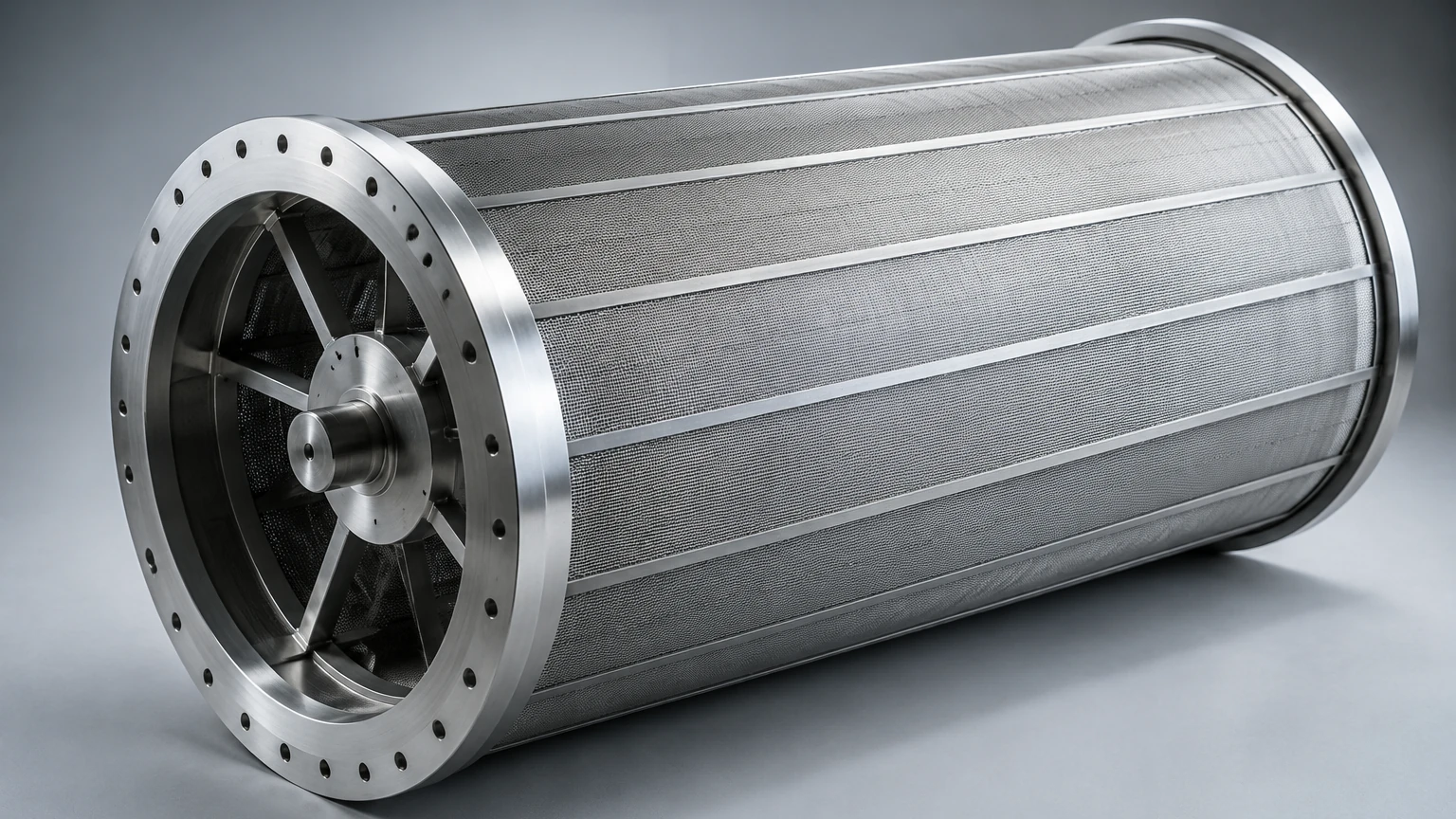
Once conditioned, the sludge enters the interior of a rotating cylindrical drum. This drum is lined with a specialized filtration medium—frequently a stainless steel wire mesh or a wedge wire screen. As the drum rotates at a controlled speed, the free water passes through the mesh openings by gravity, while the thickened solids are retained on the surface. Internal flights or baffles within the drum gently convey the solids toward the discharge end. This continuous movement prevents the formation of a static filter cake, which would otherwise impede the drainage of water.
From a technical perspective, the efficiency of a drum thickener is measured by its solids capture rate and the final concentration of the thickened sludge. A well-designed system can increase sludge concentration from a dilute 0.5%–1.0% solids to a manageable 5%–8% solids, effectively reducing the total volume by up to 90%.
Filtration Media: The Core of the Drum Thickener
The performance of any drum thickener is fundamentally limited by the quality and design of its filter screen. While synthetic cloths are sometimes used, industrial applications involving abrasive materials, high temperatures, or aggressive chemicals necessitate the use of stainless steel filtration components.
Engineers must evaluate several factors when specifying the filtration media for a rotary drum:
1. Material Selection: Stainless steel grades such as 304 and 316L are the industry standards. 316L is preferred in environments with high chloride content or acidic conditions to prevent localized pitting and crevice corrosion.
2. Aperture Size and Precision: The mesh opening must be small enough to retain the flocculated solids but large enough to allow rapid water discharge. Common aperture sizes range from 100 to 500 microns, depending on the sludge characteristics. Precision in the weaving or welding process ensures a uniform flow rate across the entire surface of the drum.
3. Structural Integrity: The filtration medium is subject to constant centrifugal forces and the weight of the sludge. High-strength wire mesh or wedge wire provides the necessary rigidity to prevent deformation over long operational cycles.
For organizations looking to optimize their filtration performance or source custom-engineered components, visiting the Main Page provides access to technical specifications and OEM capabilities that support the development of high-performance drum thickener screens.
Key Evaluation Criteria for Industrial Selection
When specifying a drum thickener for a new installation or upgrading an existing facility, engineers should focus on several performance-driven metrics beyond simple throughput capacity.
Hydraulic Loading and Solids Loading
Hydraulic loading refers to the volume of liquid the thickener can process per hour per unit of filter area. Solids loading refers to the mass of dry solids processed. It is essential to balance these two; an over-loaded drum will lead to "blinding" of the mesh, where water can no longer escape, resulting in poor thickening performance and potential overflow.
Polymer Consumption Efficiency
The cost of chemical polymers is a significant portion of the total cost of ownership (TCO) for sludge treatment. A drum thickener that utilizes an optimized internal mixing system and a high-efficiency stainless steel screen can often achieve the desired solids concentration with lower polymer dosages. This is achieved by maximizing the gravity drainage area and ensuring the floc structure is not sheared by excessive mechanical force.
Solids Capture Rate
A high-quality drum thickener should achieve a solids capture rate of 95% or higher. This means that 95% of the influent solids are retained in the thickened sludge, while the filtrate (the water passing through the mesh) remains relatively clear. High filtrate quality is crucial if the water is to be recycled within the plant or sent to a secondary treatment stage without overloading the system.
Common Risks and Operational Challenges
Despite their relative mechanical simplicity, drum thickeners are susceptible to specific operational risks that can lead to downtime or increased maintenance costs.
* Media Blinding: This occurs when fine particles or grease build up within the openings of the filter mesh. While most drum thickeners include an automated backwash spray bar, persistent blinding may indicate that the mesh pore size is incorrectly matched to the sludge type or that the spray pressure is insufficient.
* Mechanical Wear: The bearings, drive motors, and seals of a drum thickener operate in a high-moisture environment. Regular lubrication and the use of corrosion-resistant materials for the frame and housing are necessary to prevent premature mechanical failure.
* Floc Shear: If the drum rotates too quickly or if the internal baffles are too aggressive, the delicate flocs can break apart. This releases fine particles that pass through the filter mesh, lowering the capture rate and increasing the turbidity of the filtrate.
Customization and OEM Solutions
Industrial applications often present unique challenges that standard off-the-shelf drum thickeners cannot meet. For example, in food processing, the equipment must adhere to strict sanitary standards, requiring smooth-welded stainless steel surfaces and specialized cleaning-in-place (CIP) systems. In mining or chemical processing, the sludge may be highly abrasive or chemically volatile.
Customization options for the filtration drum include:
* Variable Speed Drives (VSD): Allowing operators to adjust drum rotation speed in response to changing influent sludge characteristics.
* Specialized Mesh Weaves: Utilizing Dutch weave or twilled mesh patterns to enhance drainage while maintaining high mechanical strength.
* Adjustable Internal Baffles: Allowing for the modification of the sludge retention time within the drum to achieve precise exit concentrations.
Kaifil specializes in manufacturing these precision metal components, offering OEM services that allow equipment manufacturers to integrate durable, high-accuracy stainless steel filters into their drum thickener designs.
Maintenance and Total Cost of Ownership
To ensure the longevity of a drum thickener, a proactive maintenance schedule is required. The most critical aspect of maintenance is the inspection of the filter screen. Over time, even the most durable stainless steel mesh can experience fatigue or localized wear from abrasive particles.
Engineers should confirm the following before finalizing a purchase or replacement order:
1. Replacement Cycle: What is the expected lifespan of the filter media under specific operating conditions? High-quality stainless steel typically offers a significantly longer life than synthetic alternatives.
2. Ease of Access: Is the drum designed so that the filter screen can be easily inspected or replaced without dismantling the entire machine?
3. Backwash Efficiency: Does the system utilize a high-pressure spray bar with non-clogging nozzles? Efficient cleaning of the mesh during operation is the best way to prevent blinding and maintain consistent throughput.
By focusing on these technical details, purchasing teams can move beyond initial capital expenditure (CAPEX) and focus on the long-term operational expenditure (OPEX). A drum thickener equipped with superior filtration components reduces the load on downstream dewatering equipment, such as belt presses or centrifuges, by providing a consistent, high-concentration feed.
Conclusion
The drum thickener remains a cornerstone of efficient sludge management due to its small footprint, low power consumption, and continuous operation. However, the success of the system depends heavily on the interface between the sludge and the filtration media. By selecting precision-engineered stainless steel mesh and understanding the hydraulic variables at play, industrial operators can achieve reliable, cost-effective solids separation.
For technical professionals seeking to source or design filtration components for industrial applications, the expertise found on the Main Page serves as a vital resource for ensuring that every drum thickener operates at its peak engineering potential.
