


Hydraulic Oil Filtration System
In industrial hydraulic applications, the cleanliness of the operating fluid is the primary determinant of component longevity and system reliability. A well-engineered hydraulic oil filtration system is not merely a peripheral component but a critical safeguard against premature wear, component failure, and unplanned downtime. For engineers and maintenance professionals, understanding the technical nuances of filtration—from micron ratings and beta ratios to material compatibility and pressure drop—is essential for optimizing system performance.
Contamination is responsible for an estimated 70% to 80% of all hydraulic system failures. These contaminants, which include metal shavings, silica, rubber particles, and chemical degradation products, act as abrasive agents that erode valve seats, score cylinder walls, and damage high-precision pump components. By implementing a robust hydraulic oil filtration system, facilities can maintain fluid cleanliness levels within specified ISO 4406 standards, significantly extending the mean time between failures (MTBF).
The Role of Filtration in Hydraulic System Reliability
The primary function of a hydraulic oil filtration system is to remove particulate matter and moisture from the hydraulic fluid. Hydraulic systems operate under high pressures and tight tolerances; even microscopic particles can cause catastrophic damage if they enter sensitive areas like servo valves or piston pumps.
There are three main types of contamination that a filtration system must address:
1. Built-in Contamination: Debris left over from the manufacturing or assembly process, such as welding slag, metal burrs, and lint.
2. Ingested Contamination: Particles that enter the system from the external environment through breathers, cylinder rod seals, or during fluid replenishment.
3. Generated Contamination: Particles created within the system due to the wear of moving parts, such as pump vanes or valve spools.
Effective filtration manages these threats by strategically placing filter elements throughout the hydraulic circuit to capture particles before they can reach critical components. To explore specific component designs and engineering support for these systems, professionals can visit the Main Page of specialized manufacturers.
Key Components of a Comprehensive Hydraulic Oil Filtration System
A complete hydraulic oil filtration system rarely relies on a single filter. Instead, it utilizes a series of filters at different points in the circuit, each serving a specific protective role.
Suction Filters and Strainers
Located on the inlet side of the pump, suction filters are designed to protect the pump from large debris. While they prevent catastrophic failure from large ingestants, they must be engineered with low pressure drop ($\\Delta P$) to avoid pump cavitation. Typically, these use coarser stainless steel wire mesh to ensure adequate flow while providing essential protection.
Pressure Line Filters
Installed downstream of the pump, pressure line filters are designed to withstand the full system operating pressure. These filters protect sensitive downstream components, such as proportional valves and actuators. Because they must handle high-pressure surges, the filter housing and the stainless steel filter cartridges must be engineered for high structural integrity and fatigue resistance.
Return Line Filters
Return line filters capture wear particles generated by the system's components before the oil returns to the reservoir. This is often the most cost-effective location for high-efficiency filtration, as the pressures are lower than in the pressure line, allowing for larger filter surface areas and finer micron ratings.
Off-line (Kidney Loop) Filtration
An off-line hydraulic oil filtration system operates independently of the main hydraulic circuit. It consists of its own pump and motor, drawing oil from the reservoir, passing it through high-efficiency filters, and returning it. This allows for continuous cleaning even when the main system is idle, and it is an excellent method for removing moisture and fine silt-sized particles.
Technical Specifications: Understanding Efficiency and Performance
When selecting components for a hydraulic oil filtration system, engineers must look beyond simple micron ratings. The performance of a filter is more accurately described by its Beta Ratio ($\\beta$).
The Beta Ratio (ISO 16889)
The Beta Ratio is a measure of a filter's capture efficiency. It is calculated by dividing the number of particles of a specific size upstream of the filter by the number of particles of that same size downstream. For example, if a filter has a $\\beta_{10} = 200$, it means that for every 200 particles of 10 microns entering the filter, only one passes through. This equates to a 99.5% efficiency at that micron size.
ISO 4406 Cleanliness Codes
The goal of any hydraulic oil filtration system is to achieve a specific ISO 4406 cleanliness code, expressed as three numbers (e.g., 18/16/13). These numbers represent the quantity of particles larger than 4µm, 6µm, and 14µm per milliliter of fluid. High-pressure systems with sensitive servo valves typically require much cleaner fluid (e.g., 16/14/11) than low-pressure industrial power units.
Material Selection: The Advantages of Stainless Steel Media
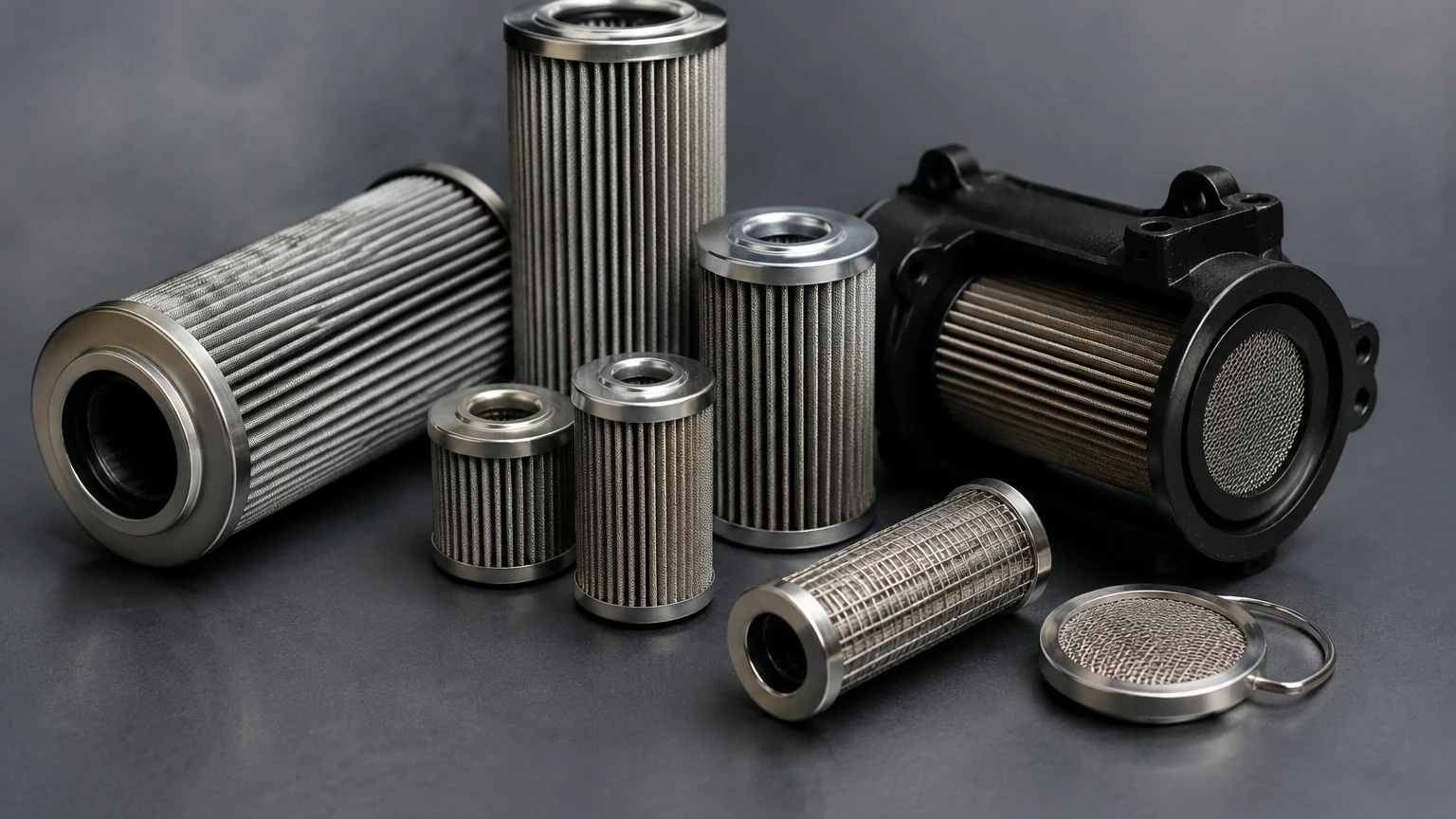
In demanding industrial environments, the choice of filter media is critical. While cellulose and synthetic glass fibers are common, stainless steel wire mesh and sintered metal fibers offer distinct advantages for specialized hydraulic applications.
* Durability and Pressure Resistance: Stainless steel filter elements can withstand higher differential pressures without collapsing, making them ideal for high-pressure hydraulic oil filtration system applications.
* Chemical and Thermal Compatibility: Stainless steel is resistant to a wide range of hydraulic fluids, including fire-resistant phosphate esters and water-glycol solutions, which can degrade standard synthetic media. They also perform reliably in high-temperature environments.
* Cleanability and Reuse: Unlike disposable elements, many stainless steel wire mesh filters can be cleaned (via ultrasonic cleaning or backflushing) and reused, reducing the long-term total cost of ownership and environmental impact.
* Precision Filtration: Advanced manufacturing allows for precise control over pore size, ensuring consistent filtration performance in critical aerospace, chemical processing, and pharmaceutical hydraulic systems.
Engineering Considerations for System Integration
Designing or upgrading a hydraulic oil filtration system requires careful consideration of several engineering variables to ensure the system does not introduce new problems, such as flow restriction or aeration.
Pressure Drop ($\\Delta P$)
Every filter introduces a restriction to flow. As the filter captures contaminants, the pressure drop across the element increases. Engineers must size the filter so that the initial "clean" pressure drop is well below the bypass valve setting. Factors influencing $\\Delta P$ include fluid viscosity (which changes with temperature), flow rate, and the effective filtration area of the media.
Viscosity and Temperature
Hydraulic oil viscosity is highly temperature-dependent. At cold startups, high viscosity can cause a high pressure drop across the filter, potentially triggering the bypass valve and allowing unfiltered oil into the system. A well-designed system may include heaters or specific bypass logic to manage these conditions, or utilize high-strength stainless steel media that can handle higher startup pressures.
Seal Compatibility
The seals within the filter housing (O-rings and gaskets) must be compatible with the hydraulic fluid. While Nitrile (Buna-N) is standard for mineral oils, Viton (FKM) or EPDM may be required for synthetic fluids or high-temperature applications to prevent leaks and system contamination.
Maintenance and Life Cycle Management
A hydraulic oil filtration system is only effective if it is properly maintained. Relying solely on a fixed calendar schedule for filter changes often leads to either premature replacement (wasting money) or delayed replacement (risking system damage).
Differential Pressure Monitoring
The most reliable way to determine when a filter element needs replacement is by monitoring the differential pressure. Visual indicators or electrical sensors can alert operators when the element is reaching its dirt-holding capacity. This ensures that the element is replaced before the bypass valve opens.
Oil Analysis
Regular oil analysis is a vital diagnostic tool. By measuring the particle count (ISO 4406), water content, and chemical health of the oil, maintenance teams can verify that the filtration system is performing as expected. A sudden increase in particle count can indicate a breached filter element or an accelerating wear condition in a pump or motor.
Selecting a Custom Filtration Partner
For many OEM and specialized industrial applications, off-the-shelf filters may not meet the specific spatial or performance requirements of a complex hydraulic oil filtration system. Customization allows for the optimization of filter geometry, media selection, and housing design to fit unique operational envelopes.
When evaluating a manufacturer for custom stainless steel filtration solutions, engineers should confirm:
* Manufacturing Capabilities: Does the provider have experience with precision wire mesh weaving and sintering?
* Technical Support: Can they assist in calculating the required filtration area and pressure drop for specific flow rates and viscosities?
* Quality Control: Are the products tested for pore size consistency and structural integrity?
Kaifil specializes in providing these types of high-performance, customized metal filtration components. By working closely with engineering teams, they develop solutions that address the specific challenges of demanding industrial environments, ensuring that the hydraulic oil filtration system provides maximum protection for the investment.
In conclusion, the selection and maintenance of a hydraulic oil filtration system are fundamental to the operational efficiency of industrial machinery. By prioritizing high-quality materials like stainless steel and adhering to rigorous engineering standards for fluid cleanliness, organizations can achieve superior system reliability and significantly reduce long-term maintenance costs. For further technical specifications and product options, professionals are encouraged to review the resources available on the Main Page.
