


Strainer Ladle
In the landscape of industrial filtration, the strainer ladle serves as a critical manual tool for material handling, sampling, and localized debris removal. While larger, automated systems handle the bulk of fluid processing, the precision and durability of a high-quality stainless steel strainer ladle are indispensable for maintaining batch integrity and operational efficiency. For engineers and procurement specialists, selecting the right manual filtration component requires a deep understanding of material science, mesh configurations, and the specific demands of the processing environment.
Industrial strainer ladles are not merely oversized versions of commercial kitchenware; they are engineered components designed to withstand corrosive chemicals, extreme temperatures, and rigorous cleaning protocols. This guide examines the technical specifications, application logic, and selection criteria necessary for integrating these tools into professional industrial workflows.
Understanding the Role of the Strainer Ladle in Industrial Processes
The primary function of an industrial strainer ladle is the separation of solids from liquids in a manual or semi-manual capacity. In sectors such as chemical processing, food and beverage production, and pharmaceutical manufacturing, these tools are often the first line of defense during batch transitions or quality control sampling.
Unlike inline Strainers & Baskets that are fixed within a piping system, the strainer ladle provides flexibility. It allows operators to remove oversized particles, coagulated materials, or foreign contaminants directly from open tanks, vats, or kettles. This manual intervention is frequently required in high-viscosity fluid processing where automated sensors might fail to detect localized clumping, or in artisanal-scale chemical synthesis where precision sampling is paramount.
From an engineering perspective, the ladle must be balanced for ergonomic use while maintaining the structural rigidity required to lift heavy saturated solids. The transition point between the handle and the basket is a common failure zone; therefore, industrial-grade ladles utilize reinforced welding techniques, such as TIG (Tungsten Inert Gas) welding, to ensure long-term durability under mechanical stress.
Material Selection and Corrosion Resistance
The performance of a strainer ladle is fundamentally tied to its metallurgy. In industrial environments, the risk of oxidation and chemical degradation is high, making the choice of stainless steel critical.
Stainless Steel 304 vs. 316L
Most industrial filtration components are manufactured from either Grade 304 or Grade 316L stainless steel.
* Grade 304: Suitable for general-purpose applications where moisture is present but chemical exposure is limited. It offers excellent formability and cost-effectiveness for food-grade applications that do not involve high salt concentrations or acidic cleaners.
* Grade 316L: Containing molybdenum, this grade provides superior resistance to chlorides and acids. For pharmaceutical and chemical processing, 316L is the standard, as it prevents pitting corrosion and ensures that the filtration tool does not introduce metallic contaminants into the batch.
Surface Finishing and Sanitary Standards
For industries governed by strict hygiene regulations, such as dairy or biopharmaceuticals, the surface finish of the strainer ladle is as important as the material itself. A high-grit polished finish or electropolishing reduces surface roughness (measured in Ra). A lower Ra value means fewer microscopic crevices where bacteria or residue can accumulate, facilitating more effective Clean-in-Place (CIP) or manual sterilization processes.
Customization Options for Specific Industrial Applications
One size rarely fits all in industrial filtration. Customization is essential to ensure the strainer ladle meets the specific geometric and functional requirements of a facility.
Handle Length and Ergonomics
In deep-tank applications, standard handle lengths may be insufficient or unsafe. Custom-manufactured ladles can feature extended handles with reinforced bracing to prevent bending when the basket is fully loaded. Ergonomic considerations, such as handle diameter and grip texture, are also vital for operator safety, particularly when handling hot liquids or caustic solutions.
Basket Geometry and Volume
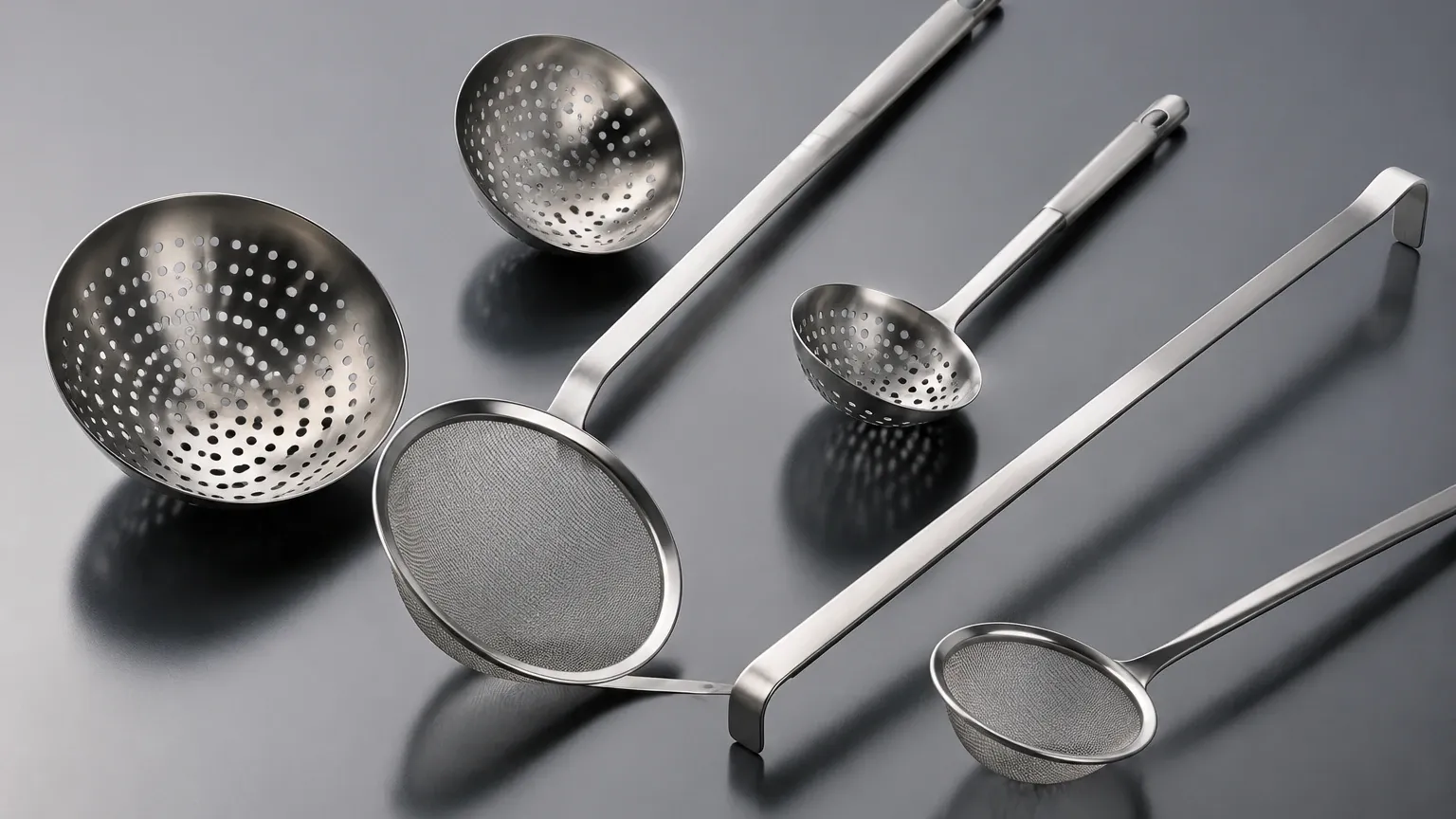
The "basket" or head of the ladle can be designed in various shapes—hemispherical, cylindrical, or flat-bottomed—depending on the vessel it will be used in. A flat-bottomed strainer ladle is often preferred for scraping solids from the base of a rectangular tank, while a hemispherical design offers the best structural distribution for lifting heavy loads.
Perforation vs. Wire Mesh
Depending on the required filtration accuracy, the ladle may feature a perforated metal plate or a fine wire mesh lining. Perforated plates offer higher mechanical strength and are easier to clean, making them ideal for coarse straining. Conversely, a wire mesh lining allows for much finer filtration, capturing particles down to the micron level. In many high-performance designs, a perforated exterior provides the structural cage, while an interior wire mesh layer provides the precise filtration surface.
Performance Metrics: Filtration Accuracy and Flow Characteristics
When evaluating a strainer ladle, engineers must consider the balance between filtration accuracy (micron rating) and flow rate (open area).
Micron Rating and Mesh Count
The mesh count refers to the number of openings per linear inch. A higher mesh count results in a lower micron rating, meaning finer particles are captured. However, as the mesh becomes finer, the total open area often decreases, which can lead to faster clogging or "blinding" of the strainer. For viscous fluids, a larger open area is necessary to allow the liquid phase to pass through the ladle efficiently while still retaining the target solids.
Open Area Calculations
The percentage of open area determines the speed at which a liquid will drain from the ladle. In high-speed production environments, a low open area can bottle-neck the process. Engineering teams must calculate the optimal ratio that provides the necessary structural integrity without sacrificing the drainage speed required for efficient manual operation.
Integrating Manual Tools with Industrial Strainers & Baskets
A comprehensive filtration strategy recognizes that manual tools like the strainer ladle complement larger, permanent installations. While Strainers & Baskets installed in-line handle the continuous flow of product, the manual ladle is used for:
1. Pre-filtration Inspection: Checking the consistency of a batch before it enters the main filtration system.
2. Emergency Recovery: Removing large debris that could potentially clog or damage expensive automated filter elements.
3. Scavenging: Recovering valuable solid catalysts or products from the bottom of a reactor that the primary drainage system cannot reach.
By matching the material and mesh specifications of the manual ladle to the primary inline filters, facilities ensure consistency in filtration quality across all stages of production. This alignment prevents the introduction of contaminants that might otherwise bypass the secondary filtration stages.
Operational Best Practices: Maintenance and Longevity
To maximize the ROI of industrial filtration components, a rigorous maintenance schedule is required. Even the most robust stainless steel strainer ladle can suffer from fatigue or localized corrosion if not properly cared for.
Cleaning and Sterilization
In the food and pharmaceutical sectors, the ladle must be compatible with sterilization techniques such as autoclaving or steam-cleaning. It is essential to verify that the mesh-to-frame bonds can withstand the thermal expansion and contraction associated with these processes. Any signs of mesh fraying or weld cracking should result in immediate decommissioning of the tool to prevent foreign object contamination (FOC) in the product stream.
Inspection for Mesh Integrity
Over time, the wire mesh in a strainer ladle may experience "wire migration" or thinning due to abrasive particles. Regular visual inspections under magnification can identify early signs of wear. For critical applications, pressure testing or bubble-point testing may be adapted to ensure the mesh still meets its original micron rating.
Storage and Handling
Proper storage is often overlooked. Storing ladles on dedicated racks prevents the mesh from coming into contact with hard surfaces that could cause denting or punctures. Furthermore, separating tools by material grade (e.g., keeping 304 tools away from 316L tools) prevents cross-contamination and potential galvanic corrosion.
Conclusion
The strainer ladle remains a fundamental component in the industrial toolkit, bridging the gap between manual oversight and automated processing. By focusing on high-grade materials like 316L stainless steel, precise mesh engineering, and customized structural designs, manufacturers can ensure these tools provide reliable service in the most demanding environments. Whether used for sampling, debris removal, or batch management, the technical integrity of the ladle directly impacts the quality and safety of the final product. For organizations looking to optimize their manual filtration capabilities, selecting a partner capable of providing tailored engineering solutions is the most effective path toward operational excellence.
