


Basket Strainer Oil
In industrial fluid management, the efficiency of a system is often determined by the cleanliness of the media circulating through it. For systems handling lubricants, fuels, and hydraulic fluids, the use of a basket strainer oil application is a fundamental requirement to protect downstream equipment from particulate contamination. Unlike standard water filtration, oil filtration involves complex variables such as varying viscosity, temperature fluctuations, and chemical compatibility with additives.
Industrial Strainers & Baskets serve as the primary line of defense. By capturing large debris—such as scale, rust, and metal shavings—before they reach sensitive pumps, nozzles, or heat exchangers, these components prevent catastrophic mechanical failure and reduce unplanned downtime. Selecting the correct basket strainer for oil requires a deep understanding of fluid dynamics and material science to ensure the chosen solution can withstand the rigors of heavy industrial use.
Engineering Fundamentals of Oil Filtration
The primary challenge in designing a basket strainer oil system is the relationship between viscosity and pressure drop. Oil is significantly more viscous than water, and its flow characteristics change dramatically based on its temperature and grade. For engineers, the goal is to maximize the open area of the strainer basket to minimize the pressure differential (ΔP) across the unit.
Viscosity and Temperature Effects
When oil is cold, its viscosity is high, leading to a higher resistance to flow. If a strainer is undersized or uses a mesh that is too fine for the specific oil grade, the pressure drop can exceed the system's limits, potentially causing pump cavitation or triggering safety bypass valves. Conversely, as oil heats up during operation, its viscosity drops, which may allow smaller particles to pass through more easily if the filtration media is not precisely calibrated.
Engineering a basket strainer involves calculating the "clean pressure drop" and ensuring it remains within a safe margin. Typically, for oil applications, a larger basket housing or a specialized pleated mesh design may be required to provide the necessary surface area to handle high-viscosity fluids without compromising flow rates.
Material Selection and Chemical Compatibility
For industrial oil applications, material selection is critical. While carbon steel is sometimes used for non-corrosive fuels, stainless steel (SS304, SS316, or SS316L) remains the industry standard for high-performance filtration. Stainless steel offers several advantages in a basket strainer oil environment:
1. Corrosion Resistance: Many industrial oils contain additives, moisture, or sulfur compounds that can be corrosive to lesser metals. Stainless steel maintains its structural integrity over long service lives.
2. Thermal Stability: Industrial oils often operate at high temperatures, especially in lubrication systems for heavy machinery or in heat transfer applications. Stainless steel baskets do not warp or degrade under these thermal stresses.
3. Cleanability: Unlike disposable synthetic filters, stainless steel wire mesh baskets are cleanable and reusable. This is particularly important in oil systems where the cost of replacing large-format filters can be significant.
Beyond the metal housing and basket, engineers must also consider the seals and gaskets. For oil applications, elastomers like Viton or Buna-N are typically specified because they resist swelling and degradation when exposed to hydrocarbons and synthetic lubricants.
Design Variations: Simplex vs. Duplex Systems
When integrating a basket strainer into an oil pipeline, one of the most critical decisions is whether to use a simplex or duplex configuration. This choice depends entirely on the operational requirements of the facility.
Simplex Basket Strainers
A simplex strainer is used in systems where the flow can be safely interrupted. When the basket becomes clogged with debris, the system is shut down, the pressure is relieved, and the basket is removed for cleaning. These are common in batch processing or in systems with redundant parallel lines.
Duplex Basket Strainers
In continuous-duty applications—such as power plant lubrication or refinery fuel lines—shutting down the system for maintenance is not an option. A duplex strainer consists of two separate strainer chambers connected by a diverter valve. When one basket reaches its dirt-holding capacity, the operator (or an automated system) switches the flow to the clean chamber. This allows for "on-the-fly" maintenance without interrupting the oil flow, ensuring constant protection for downstream components.
Technical Specifications: Micron Ratings and Mesh Selection
The effectiveness of a basket strainer oil setup is defined by its filtration accuracy, often measured in microns or mesh size. Because basket strainers are generally considered "coarse" filters (intended to catch larger particles), their ratings typically range from 40 microns up to several millimeters.
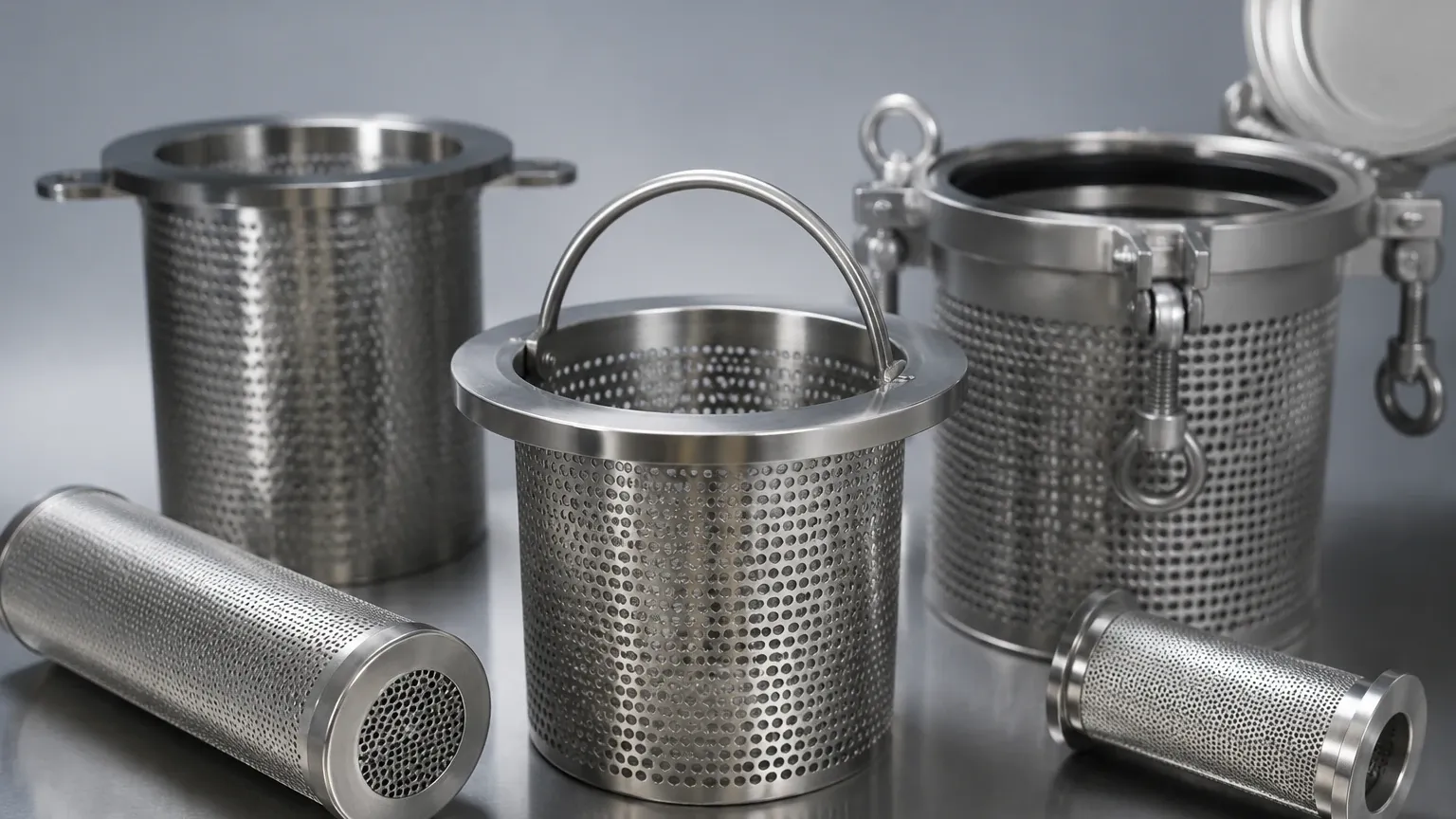
* Perforated Metal: Used for heavy-duty applications where the primary goal is to catch large stones, bolts, or scale. Perforated baskets provide high mechanical strength.
* Wire Mesh Liners: For finer filtration, a perforated basket is lined with a stainless steel wire mesh. This allows for precise control over the particle size that can pass through.
In oil systems, the choice of mesh is a balancing act. A mesh that is too fine will clog rapidly, especially if the oil is prone to carbon buildup or sludge. A mesh that is too coarse will allow particles through that could damage precision-machined pump rotors or clog fine spray nozzles. Engineers often specify a 100-mesh or 200-mesh liner for general lubrication oil, while heavier fuel oils may only require a 40-mesh screen.
Maintenance and Operational Longevity
The total cost of ownership (TCO) for a basket strainer is heavily influenced by its maintenance requirements. In oil applications, monitoring the pressure differential is the most effective way to determine when a basket needs cleaning.
Monitoring and Cleaning
Most industrial basket strainers are equipped with ports for differential pressure gauges. A significant increase in ΔP indicates that the basket is accumulating debris. Neglecting maintenance can lead to basket collapse if the pressure differential exceeds the structural limits of the wire mesh.
Cleaning a stainless steel basket typically involves ultrasonic cleaning or high-pressure washing with a compatible solvent. Because the baskets are manufactured from durable metal, they can be cleaned and returned to service hundreds of times, making them a more sustainable and cost-effective choice than disposable cartridges in high-volume oil applications.
Customization for Demanding Environments
Standard off-the-shelf strainers may not meet the specific needs of every industrial oil system. Customization is often required to address unique challenges such as:
* High-Pressure Ratings: Some hydraulic systems operate at extremely high pressures, requiring heavy-walled strainer housings and reinforced baskets.
* Space Constraints: In compact machinery skids, custom inlet/outlet orientations or low-profile designs may be necessary.
* Magnetic Inserts: Since many oil systems suffer from fine metallic wear particles (swarf), magnetic assemblies can be added to the interior of the basket to capture sub-micron ferrous particles that would otherwise pass through the mesh.
As a manufacturer specializing in custom stainless steel filtration, Kaifil provides the engineering expertise needed to develop these specialized solutions. From selecting the appropriate wire mesh weave to designing the structural reinforcement of the basket, every detail is tailored to the specific viscosity and flow requirements of the client's oil system.
Conclusion: Selecting the Right Solution
Implementing an effective basket strainer oil strategy requires more than just picking a part from a catalog. It demands a technical evaluation of the oil's properties, the system's flow requirements, and the environmental conditions of the facility. By prioritizing high-quality materials like stainless steel and selecting the appropriate configuration (simplex or duplex), engineers can ensure their systems remain protected against the damaging effects of particulate contamination.
Whether the application involves crude oil, refined fuel, or high-performance lubricants, the integration of robust Strainers & Baskets is an investment in the longevity and reliability of the entire industrial operation. Through precise engineering and customized manufacturing, these components provide the essential filtration necessary for modern industrial fluid handling.
