


Filters for Half Mask
In industrial environments where respiratory protection is paramount, the efficacy of a half mask respirator is fundamentally determined by its internal filtration components. While the outer shell provides the seal, the internal filter elements—often comprised of precision-engineered Filter Discs & Packs—perform the critical task of removing airborne contaminants. For engineers and safety procurement officers, understanding the technical nuances of these metal filtration components is essential for ensuring both compliance and operational longevity.
Industrial filters for half mask applications are not limited to simple fabric inserts. In heavy-duty sectors such as chemical processing, metalworking, and high-temperature manufacturing, stainless steel wire mesh discs and multi-layer packs offer structural advantages and filtration precision that synthetic alternatives cannot match. This guide explores the engineering considerations, material science, and performance metrics required to select the correct filtration components for industrial respiratory assemblies.
The Role of Metal Filter Discs in Respiratory Protection
When discussing filters for half mask systems, it is important to distinguish between the various layers of protection. In many advanced industrial respirators, a metal mesh disc or pack serves as either a primary particulate filter or a pre-filter designed to protect more sensitive chemical absorption layers.
Stainless steel filter discs are preferred in environments where the filtration media must withstand high pressure, corrosive gases, or extreme temperatures. Unlike polymer-based media, metal wire mesh does not shed fibers, ensuring that the air delivered to the user remains free of secondary contaminants. Furthermore, the rigidity of a metal filter pack ensures that the filtration surface area remains constant, even under the heavy inhalation loads typical of strenuous industrial labor.
Material Engineering: 304 vs. 316L Stainless Steel
The selection of the alloy is the first critical decision in the design of filters for half mask applications. Most industrial filter discs are manufactured from either Grade 304 or Grade 316L stainless steel.
* Grade 304 Stainless Steel: This is the standard industrial choice, offering excellent durability and resistance to oxidation. It is suitable for most general manufacturing environments where moisture and basic chemical exposure are present.
* Grade 316L Stainless Steel: For environments involving high salinity, acidic vapors, or pharmaceutical-grade requirements, 316L is the superior choice. The addition of molybdenum provides enhanced resistance to pitting and crevice corrosion, making it the authoritative standard for chemical processing and marine-adjacent industrial sites.
Beyond basic alloys, specialized materials like Monel or Inconel may be utilized for niche applications involving highly reactive gases, though stainless steel remains the most versatile and cost-effective solution for the majority of B2B filtration needs.
Technical Specifications of Wire Mesh Weaves
The performance of filters for half mask systems depends heavily on the weave pattern of the wire mesh. Engineers must balance filtration accuracy (micron rating) with breathability (pressure drop). Common weave types include:
Plain Weave
Plain weave is the most straightforward construction, where each warp wire crosses over and under each shute wire. This provides a high percentage of open area, which is ideal for reducing breathing resistance. However, it is generally limited to coarser filtration levels.
Twilled Weave
In a twilled weave, each wire passes over and under two wires, allowing for a heavier wire diameter and a more robust mesh. This is often used in multi-layer filter packs to provide structural support without significantly impeding airflow.
Dutch Weave (Plain and Twilled)
Dutch weaves utilize a higher density of wires in one direction, creating a "tortuous path" for particulates. This weave is the industry standard for high-precision filtration, capable of achieving very fine micron ratings while maintaining the mechanical strength required for high-pressure environments.
Understanding Micron Ratings and Airflow Resistance
For an engineer specifying filters for half mask use, the relationship between the micron rating and the pressure drop (Delta P) is the most critical performance metric.
1. Micron Rating: This defines the size of the particles the filter can effectively trap. For industrial respirators, ratings typically range from 5 microns for coarse dust to sub-micron levels for fine aerosols.
2. Pressure Drop: This refers to the resistance the air encounters as it passes through the filter. In respiratory applications, a high pressure drop leads to user fatigue and reduced compliance.
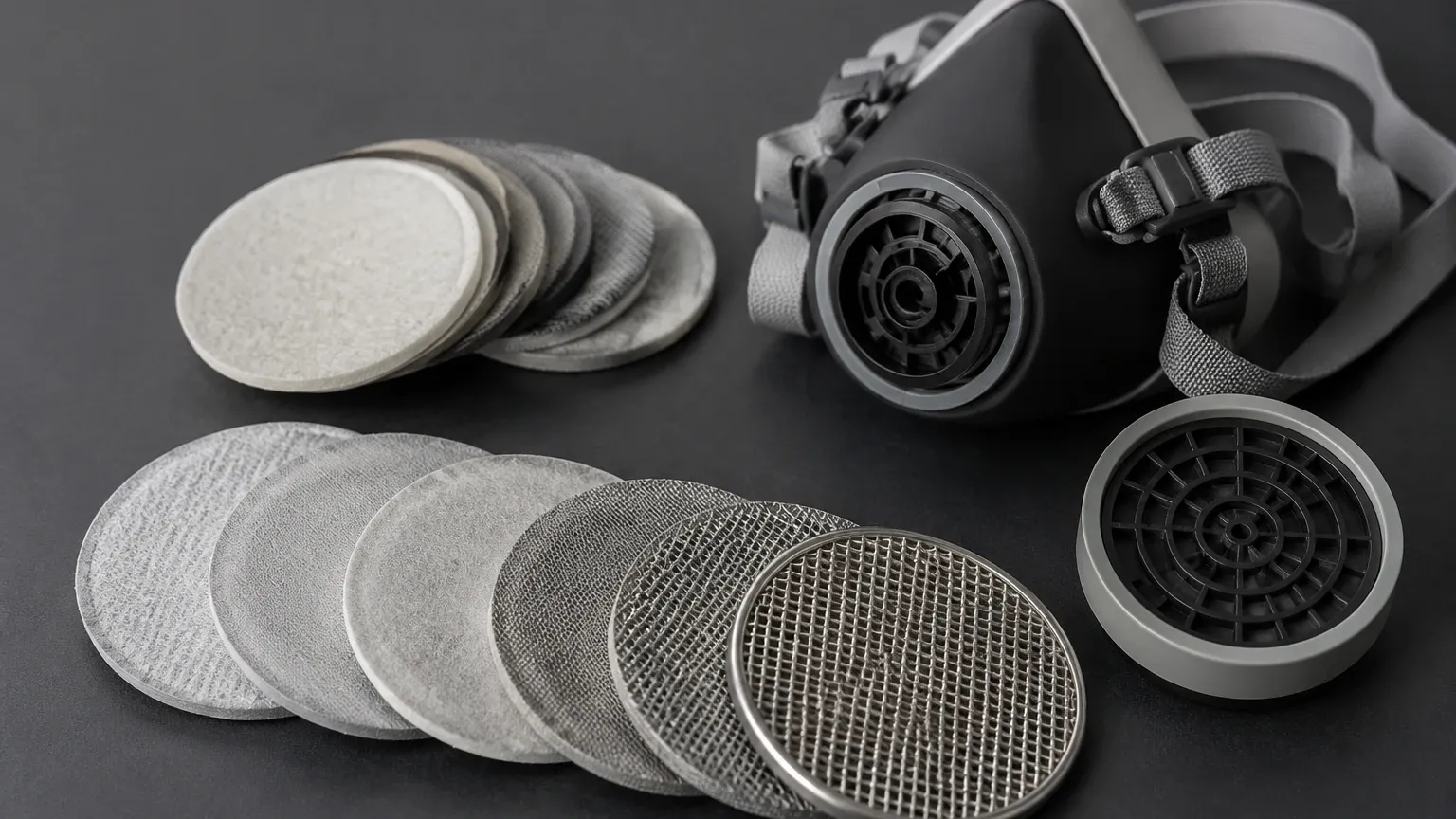
To optimize these factors, manufacturers often utilize multi-layer Filter Discs & Packs. By combining a fine Dutch weave layer for filtration with a coarse plain weave layer for support, it is possible to achieve high filtration efficiency with minimal breathing resistance.
Customization and OEM Integration
Industrial half masks are rarely "one-size-fits-all" in terms of their internal components. OEM (Original Equipment Manufacturer) requirements often dictate specific dimensions, edge treatments, and assembly methods.
Edge Binding and Spot Welding
To prevent fraying and ensure a secure fit within the mask housing, filter discs can be finished with various edge treatments. Aluminum or stainless steel binding (rimming) provides a smooth, compressed edge that prevents air bypass. Alternatively, multi-layer packs can be spot-welded to maintain alignment during high-vibration use or frequent assembly/disassembly.
Geometric Precision
Using advanced CNC punching and laser cutting technologies, filter discs can be manufactured to exact tolerances. Whether the mask design requires a standard circular disc, an oval shape, or a complex geometric pack, precision manufacturing ensures that the filter fits perfectly into the respirator's cartridge or housing, eliminating the risk of leakages.
Durability and Maintenance of Metal Filters
One of the primary drivers for selecting stainless steel filters for half mask systems is the potential for reusability and sterilization. In many industrial settings, disposable filters represent a significant recurring cost and a waste management challenge.
Metal filter discs can be cleaned using several methods:
* Ultrasonic Cleaning: High-frequency sound waves in a cleaning solution can dislodge fine particulates trapped deep within a Dutch weave.
* Backwashing: For larger assemblies, forcing air or liquid in the reverse direction can clear the mesh surface.
* Chemical Cleaning: Stainless steel's resistance to solvents allows for the removal of oils, resins, or chemical residues that would destroy synthetic filters.
However, it is vital to establish a strict inspection protocol. If the wire mesh shows signs of deformation, broken wires, or permanent clogging that increases pressure drop beyond the manufacturer’s specifications, the filter pack must be replaced to ensure user safety.
Evaluation Criteria for Purchasing Teams
When sourcing filters for half mask applications, B2B purchasing teams should evaluate suppliers based on technical capability rather than just unit price. Key confirmation points include:
* Material Certification: Ensure the supplier provides mill test reports (MTRs) to verify the grade of stainless steel.
* Filtration Consistency: Inquire about the bubble point test or other validation methods used to ensure the micron rating is consistent across production batches.
* Structural Integrity: For multi-layer packs, confirm the method of bonding (sintering, welding, or mechanical binding) and its suitability for the intended environment.
* Total Cost of Ownership (TCO): While the initial cost of a stainless steel filter disc is higher than a disposable fabric filter, the extended service life and cleanability often result in a lower TCO over a 12-to-24-month period.
Conclusion
The selection of filters for half mask applications is a technical process that directly impacts industrial safety and operational efficiency. By prioritizing high-quality materials like 316L stainless steel and utilizing advanced weave patterns in specialized Filter Discs & Packs, engineering teams can develop respiratory protection systems that are both effective and durable.
As industrial standards for air quality and worker safety continue to evolve, the transition toward precision-engineered metal filtration components offers a reliable path forward. Whether for OEM development or the optimization of existing industrial processes, understanding the mechanics of wire mesh filtration is the first step toward superior respiratory performance.
