


6 Water Filter Cartridges
In industrial water treatment and process fluid management, the configuration of filtration hardware is a critical factor in determining system efficiency, downtime, and overall operational costs. While single-cartridge housings serve low-flow applications, medium-to-high flow requirements often necessitate multi-round housings. A common industrial configuration involves the use of 6 water filter cartridges within a single pressure vessel. This setup provides a balanced approach to flow rate management, filtration surface area, and footprint optimization.
For engineers and procurement professionals, selecting the correct Filter Cartridges for a 6-round system requires a deep understanding of fluid dynamics, material compatibility, and the specific contaminants involved. This article examines the technical considerations, engineering specifications, and performance expectations associated with multi-cartridge industrial water filtration.
Understanding Multi-Cartridge Filtration Systems
Industrial water filtration systems are rarely "one size fits all." When a process requires a flow rate that exceeds the capacity of a single 10-inch or 20-inch cartridge without inducing excessive pressure drop, a multi-round housing is employed. A housing designed for 6 water filter cartridges allows the fluid to be distributed across six parallel paths.
Flow Rate and Velocity
By utilizing six cartridges, the total effective filtration area (EFA) is increased sixfold compared to a single-cartridge system of the same length. This reduction in flux (flow per unit area) is essential for maintaining filtration efficiency. High velocity through a filter medium can lead to "particle bypass," where contaminants are forced through the pores due to sheer pressure, or it can cause premature blinding of the filter surface. A 6-cartridge configuration allows for a more laminar flow profile within the housing, extending the service life of each individual component.
Housing Geometry
The physical arrangement of 6 water filter cartridges inside a housing is typically a hexagonal or circular pattern. This design ensures that the inlet fluid is distributed evenly. For engineers, it is vital to ensure that the housing's internal seals and riser tubes are manufactured to high tolerances to prevent internal bypass, which would allow unfiltered water to reach the downstream process.
Engineering Considerations for Industrial Filter Cartridges
When specifying cartridges for a 6-round water system, the material of construction and the structural design of the cartridge are the most significant variables. In demanding industrial environments, stainless steel is often the preferred material over polymers due to its thermal and chemical resilience.
Material Selection: SS304 vs. SS316L
For most industrial water applications, Stainless Steel 304 provides adequate corrosion resistance. However, in processes involving brackish water, high-salinity brines, or aggressive chemical cleaning agents, SS316L is required. The addition of molybdenum in SS316L enhances resistance to pitting and crevice corrosion. Kaifil specializes in manufacturing these high-grade metal filters to ensure structural integrity under high-pressure differentials.
Micron Ratings and Filtration Efficiency
Filtration accuracy is defined by the micron rating, but engineers must distinguish between nominal and absolute ratings.
- Nominal Rating: Indicates the ability to retain a majority of particles at a specific size (e.g., 80-90%).
- Absolute Rating: Refers to the pore size where 99.9% (Beta 5000) of particles at that size are retained.
In a 6-cartridge system, the choice of micron rating directly impacts the pressure drop. A finer mesh or smaller pore size will increase the initial clean pressure drop (ΔP), necessitating a more robust pump or a larger housing if the flow rate must be maintained.
Applications of 6 Water Filter Cartridges in Industrial Processes
The use of 6-round filtration systems is prevalent across various sectors where water quality is paramount to the final product or the protection of downstream equipment.
Food and Beverage Processing
In the food and beverage industry, water is used both as an ingredient and for cleaning-in-place (CIP) processes. A 6-cartridge setup is often used to filter incoming utility water to remove suspended solids, sand, and scale. Stainless steel cartridges are particularly valued here because they can withstand steam sterilization and high-temperature sanitization cycles without off-gassing or structural degradation.
Pharmaceutical and Biotech
Pre-filtration for Reverse Osmosis (RO) systems in pharmaceutical plants often utilizes multi-cartridge housings. By using 6 water filter cartridges as a pre-filter, the system protects expensive RO membranes from fouling. The ability to use pleated stainless steel mesh allows for high dirt-holding capacity while maintaining a compact footprint in cleanroom environments.
Chemical and Petrochemical
In chemical processing, water is often used as a solvent or a cooling medium. These fluids may contain aggressive chemicals that would degrade standard polypropylene filters. Stainless steel filter cartridges provide the necessary chemical compatibility to handle diverse pH levels and solvent exposures while ensuring that particulate matter does not interfere with chemical reactions or clog heat exchangers.
Performance Metrics and Selection Criteria
To optimize a filtration system, engineers must look beyond the initial purchase price and evaluate the performance metrics that impact long-term operations.
Dirt Holding Capacity (DHC)
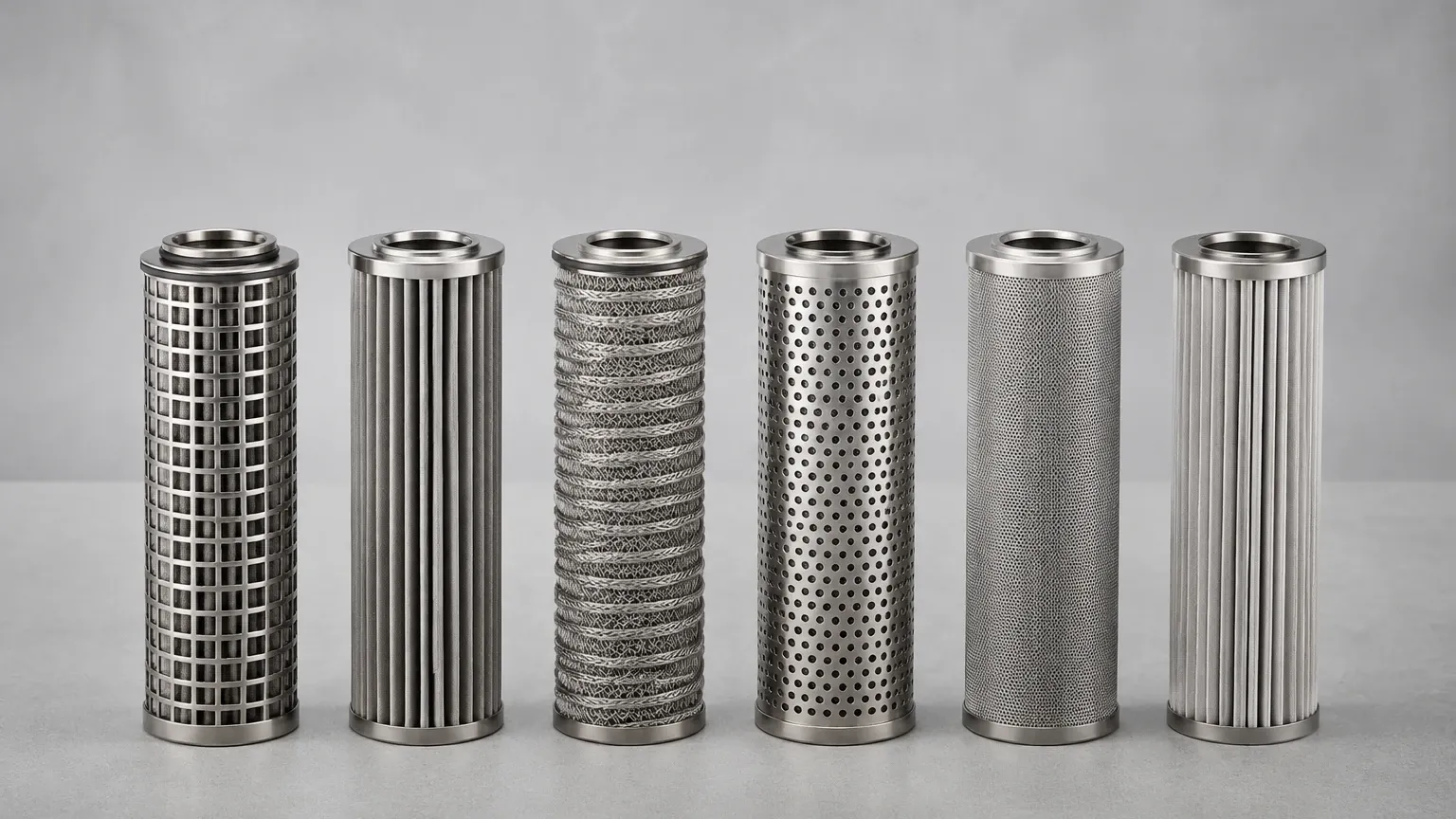
The DHC determines how much contaminant a set of 6 water filter cartridges can retain before the pressure drop reaches the terminal limit. Pleated designs significantly increase the surface area compared to cylindrical (wrap) designs. For a 6-cartridge system, maximizing the EFA through pleating can result in significantly longer run times between maintenance intervals.
Structural Strength and Collapse Pressure
Industrial filters must withstand high differential pressures, especially during process upsets or when the filters are heavily loaded with contaminants. Stainless steel cartridges manufactured by Kaifil are engineered with internal support cores to prevent collapse. This is a critical safety feature; a collapsed filter can release a slug of contaminants into the downstream process, causing catastrophic equipment failure.
End Cap Configurations
The method by which the cartridges are secured in the housing is vital for preventing bypass. Common configurations for 6-round housings include:
- Double Open End (DOE): Uses flat gaskets at both ends; requires a tie-rod and seal plate.
- 222/Fine or 226/Bayonet: Features O-ring seals and a locking mechanism for a more secure, leak-proof fit. 226 fittings are often preferred in critical applications to ensure the cartridges remain seated during pressure surges.
Maintenance, Replacement Cycles, and Total Cost of Ownership
One of the primary advantages of using stainless steel Filter Cartridges in a 6-round configuration is the potential for cleaning and reuse, which dramatically alters the Total Cost of Ownership (TCO).
Monitoring Differential Pressure
System operators should monitor the pressure gauges at the inlet and outlet of the 6-cartridge housing. A typical starting ΔP for clean filters is 1-3 psi. Replacement or cleaning is usually recommended when the ΔP reaches 15-25 psi. Operating beyond this point risks media migration or bypassing the seals.
Cleaning vs. Disposal
Unlike disposable polymer filters, stainless steel cartridges can be cleaned using ultrasonic baths, backflushing, or chemical solvents. For a system utilizing 6 water filter cartridges, the ability to clean and reuse the media can offset the higher initial capital expenditure within a few months of operation. This is especially true in applications with high solids loading where disposable filters would need to be changed weekly.
TCO Calculation
When calculating TCO, engineers should consider:
1. Initial Purchase Price: Higher for stainless steel, lower for plastic.
2. Disposal Costs: Significant for contaminated polymer filters; zero for reusable metal filters.
3. Labor Costs: Frequent changes of disposable filters increase maintenance labor.
4. Product Loss: Downtime during filter changes results in lost production capacity.
Customization Options for Industrial Filtration
Kaifil provides extensive customization for 6-round filtration requirements. Because every industrial process has unique variables, standard off-the-shelf solutions may not always provide the highest efficiency.
Custom Lengths and Diameters
While 10, 20, 30, and 40-inch lengths are standard, custom housing heights may require non-standard cartridge lengths. Precision manufacturing allows for the creation of cartridges that fit perfectly into legacy housings or specialized OEM equipment.
Specialized Media Layers
For complex filtration tasks, cartridges can be designed with multiple layers of wire mesh. A coarse outer layer can act as a pre-filter for a finer inner layer, effectively creating a multi-stage filtration process within a single cartridge. This "graded density" approach in a 6-cartridge system significantly enhances the life of the fine filtration layer.
Conclusion: Selecting the Right Solution
Implementing a system with 6 water filter cartridges is a strategic decision to balance flow capacity and filtration precision. For engineers, the priority is to select components that offer the highest reliability and the lowest operational risk. Stainless steel filtration solutions provide the durability, temperature resistance, and cleanability required for modern industrial standards.
When evaluating your filtration needs, consider the specific chemical environment, the nature of the contaminants, and the desired maintenance interval. By choosing high-quality, precision-engineered cartridges, facilities can ensure consistent water quality while optimizing their long-term filtration budget. For detailed technical specifications and support in selecting the appropriate media for your application, you can Review product options and application support to find a solution tailored to your specific industrial requirements.
