


Filter Cartridge 5 Micron 40 Inch
In industrial liquid and gas processing, the selection of filtration components is a critical engineering decision that impacts product purity, equipment longevity, and operational efficiency. Among the most common specifications encountered in high-capacity systems is the filter cartridge 5 micron 40 inch. This configuration represents a balance between fine particulate retention and high-volume throughput, making it a standard in multi-cartridge housing systems across the chemical, pharmaceutical, and water treatment sectors.
Understanding the technical nuances of this specific size and rating is essential for engineers and procurement professionals who must ensure that their Filter Cartridges meet the rigorous demands of industrial environments. This guide examines the engineering principles, material considerations, and application-specific factors that define the performance of a 5-micron, 40-inch filtration element.
Technical Specifications: Defining the 5 Micron 40 Inch Standard
The performance of a filter cartridge is primarily defined by its micron rating and its physical dimensions. When specifying a 5-micron 40-inch element, two distinct factors must be analyzed: the filtration accuracy and the structural scale.
Micron Rating: Absolute vs. Nominal
A "5 micron" rating refers to the size of the particles the filter is designed to trap. However, in an industrial context, it is vital to distinguish between nominal and absolute ratings.
* Nominal Rating: This is an approximate value indicating that the filter will retain a major percentage (typically 60% to 80%) of particles 5 microns or larger. Nominal filters are often used for pre-filtration or non-critical clarification.
* Absolute Rating: This indicates that the filter has a documented efficiency (often 99.9% or higher) at the 5-micron level, determined through standardized glass bead or latex sphere testing. Absolute-rated 5-micron cartridges are required when downstream equipment, such as High-Pressure Liquid Chromatography (HPLC) systems or Reverse Osmosis (RO) membranes, must be protected from specific particulate sizes.
Physical Dimension: The 40-Inch Standard
The 40-inch length (approximately 1016 mm) is the largest standard length for industrial filter cartridges. Using 40-inch elements instead of stacking multiple 10-inch or 20-inch elements reduces the number of seal points within a filter housing, thereby minimizing the risk of bypass. Furthermore, the increased surface area of a 40-inch cartridge allows for higher flow rates per unit, which reduces the total footprint of the filtration system.
Material Engineering and Construction
While polymer-based filters (such as polypropylene or PES) are common in light-duty applications, industrial processes involving high temperatures, aggressive chemicals, or high differential pressures require metallic construction. Stainless steel is the material of choice for durable, high-performance filter cartridges.
Stainless Steel Wire Mesh
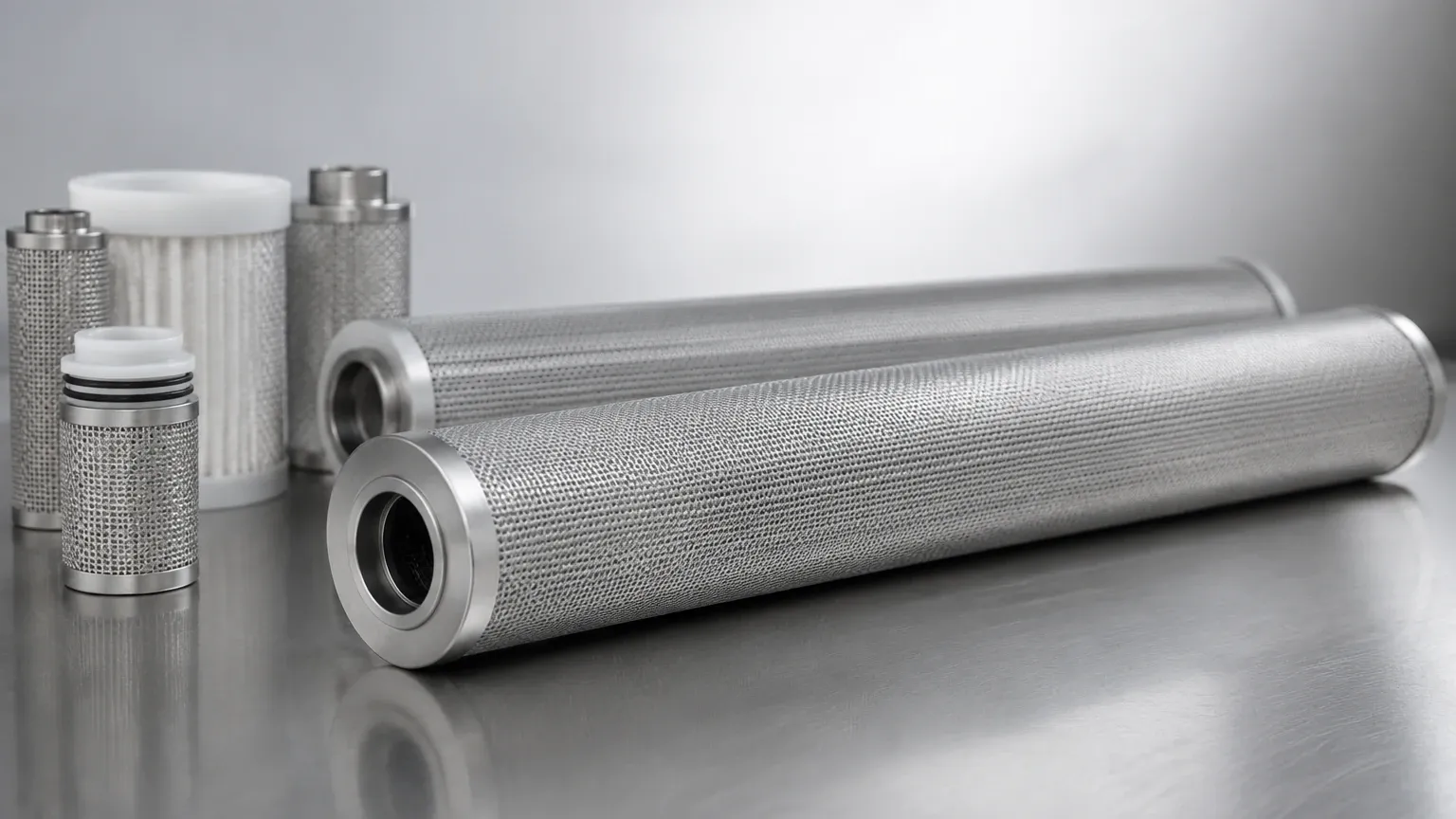
Stainless steel wire mesh filters are ideal for surface filtration. They are constructed from woven wire cloth, typically in 304 or 316L grades. A 5-micron wire mesh filter provides precise pore sizes and is highly resistant to corrosion. Because it is a surface medium, it is easier to clean via backwashing or ultrasonic baths, making it a cost-effective choice for long-term operations.
Sintered Metal Fiber Felt
For applications requiring depth filtration at a 5-micron level, sintered metal fiber felt is often utilized. This material consists of stainless steel fibers that are randomly laid and then sintered together to create a porous, three-dimensional structure. This construction offers a higher dirt-holding capacity than simple wire mesh, as particles are trapped throughout the thickness of the media rather than just on the surface.
Structural Integrity and End Caps
In a 40-inch format, structural rigidity is paramount. To prevent the cartridge from collapsing under high differential pressure, industrial-grade 5-micron filters often feature an internal support core and an external protective cage. The end caps—available in configurations such as Double Open End (DOE), Code 7 (226 O-rings with a fin), or Code 3 (222 O-rings)—must be securely bonded to the filter media, typically through TIG welding in stainless steel models, to ensure a leak-proof seal.
Performance Evaluation Criteria
When evaluating a filter cartridge 5 micron 40 inch for a specific process, engineers must look beyond the basic dimensions and focus on performance data.
Flow Rate and Differential Pressure (Delta P)
The flow rate is the volume of fluid that can pass through the filter per unit of time. It is inversely proportional to the pressure drop (differential pressure). A high-quality 5-micron filter should offer a low initial pressure drop to maximize the available pump head for the rest of the process. As the filter accumulates contaminants, the differential pressure increases; the "terminal pressure drop" is the point at which the cartridge must be cleaned or replaced.
Dirt Holding Capacity
This refers to the total mass of contaminants a filter can retain before reaching its terminal pressure drop. In a 40-inch cartridge, the dirt-holding capacity is significantly higher than in shorter variants, which extends the service interval and reduces downtime. For processes with high solids loading, pleated designs are often preferred as they vastly increase the available surface area within the same 40-inch envelope.
Chemical and Thermal Compatibility
In B2B industrial environments, filters are often exposed to extreme conditions. A stainless steel 5-micron cartridge can typically withstand temperatures exceeding 300°C (572°F) and is compatible with a wide range of solvents, acids, and alkalis that would degrade polymer filters. It is essential to verify that the O-ring or gasket material (Viton, EPDM, PTFE, or Silicone) is also compatible with the process fluid.
Industrial Applications for 5 Micron Filtration
The 5-micron threshold is a "polishing" grade in many industries, sitting between coarse primary filtration and sub-micron sterilization.
Chemical and Petrochemical Processing
In chemical manufacturing, 5-micron 40-inch cartridges are used to remove catalysts, undissolved salts, and pipe scale from process streams. Their ability to handle high temperatures and aggressive solvents makes stainless steel cartridges indispensable for maintaining the purity of intermediate chemical products.
Food and Beverage Production
For the food and beverage industry, 5-micron filtration is often used for the clarification of syrups, oils, and beverages. In these applications, the filter must comply with food-grade standards (such as FDA or EC 1935/2004). Stainless steel construction is preferred here not only for its durability but also because it can withstand Steam-In-Place (SIP) and Clean-In-Place (CIP) sterilization cycles.
Water Treatment and Desalination
In large-scale water treatment, 40-inch filter cartridges serve as the final defense for Reverse Osmosis (RO) membranes. By removing particles down to 5 microns, these filters prevent the rapid fouling of expensive membranes, thereby reducing the frequency of chemical cleanings and extending membrane life.
Maintenance, Cleaning, and Total Cost of Ownership
One of the primary advantages of choosing stainless steel Filter Cartridges in a 5-micron 40-inch specification is the potential for reuse. Unlike disposable depth filters, metal cartridges can be cleaned and returned to service.
Cleaning Methodologies
* Backwashing: Reversing the flow of the fluid to dislodge particles from the surface of the mesh.
* Ultrasonic Cleaning: Using high-frequency sound waves in a cleaning solution to remove fine particulates trapped deep within the sintered fiber or mesh layers.
* Chemical Cleaning: Using specific solvents or acids to dissolve organic or inorganic fouling that cannot be removed mechanically.
Total Cost of Ownership (TCO)
While the initial purchase price of a stainless steel 5-micron 40-inch cartridge is higher than that of a disposable polypropylene version, the TCO is often lower in the long run. The durability of metal allows for hundreds of cleaning cycles, eliminating the recurring cost of replacement filters and reducing the environmental impact associated with waste disposal. Furthermore, the structural strength of metal filters prevents bypass or media migration, which can cause costly downstream damage.
Selecting the Right Supplier and Customization Options
For engineers, the ability to customize a filter cartridge is often as important as the standard specifications. When sourcing a filter cartridge 5 micron 40 inch, it is important to confirm that the manufacturer can provide tailored solutions, such as:
1. Custom End Fittings: Ensuring compatibility with existing filter housings (e.g., specialized flange mounts or threaded connections).
2. Reinforced Cores: For applications involving high-viscosity fluids or extreme pressure surges.
3. Material Certification: Providing 3.1 material certificates, pressure test reports, and filtration efficiency validation.
By focusing on these technical details, procurement teams can ensure they are investing in filtration components that provide reliable, long-term performance in demanding industrial environments. Whether the goal is protecting sensitive equipment or ensuring the purity of a final product, the 5-micron 40-inch filter remains a cornerstone of modern industrial process engineering.
