


Filter Cartridge Melt Blown
In the landscape of industrial liquid filtration, the melt blown filter cartridge represents one of the most widely utilized technologies for depth filtration. For engineers and procurement teams, understanding the technical nuances of the filter cartridge melt blown process, material properties, and performance limitations is essential for optimizing process efficiency and managing operational costs. While these disposable depth filters are ubiquitous in pre-filtration and light-duty industrial applications, their selection must be balanced against technical requirements such as chemical compatibility, thermal stability, and the total cost of ownership compared to permanent solutions like stainless steel Filter Cartridges.
Understanding Melt Blown Technology in Industrial Filtration
The term "melt blown" refers to the specific manufacturing process used to create the filter media. This process involves the extrusion of a thermoplastic polymer—most commonly polypropylene—through a die containing hundreds of small orifices. As the molten polymer emerges, it is hit by high-velocity hot air streams that attenuate the filaments into extremely fine microfibers. These fibers are then collected on a rotating mandrel, where they thermally bond to one another without the need for chemical binders or adhesives.
One of the primary engineering advantages of the melt blown process is the ability to create a "gradient density" structure. By varying the air pressure and fiber collection speed during production, manufacturers can create a cartridge that is less dense on the outer layers and increasingly dense toward the inner core. This architecture allows larger particles to be trapped near the surface while finer particles are captured deeper within the matrix. This depth filtration mechanism significantly increases the dirt-holding capacity of the cartridge compared to surface-type filters, preventing premature blinding and extending the service life between change-outs.
Key Performance Characteristics and Specifications
When evaluating a filter cartridge melt blown for industrial use, several technical specifications dictate its suitability for a specific process. Engineers must look beyond simple micron ratings to understand the true performance profile of the media.
Filtration Accuracy and Efficiency
Melt blown cartridges are typically classified by their micron rating, ranging from as fine as 0.5 microns to 100 microns or more. However, it is critical to distinguish between "nominal" and "absolute" ratings. Most standard melt blown filters are nominally rated, meaning they will trap a high percentage (typically 80% to 90%) of particles at the specified size. For critical applications requiring 99.9% efficiency, absolute-rated melt blown filters or pleated cartridges are required, though these come at a higher price point.
Dirt Holding Capacity (DHC)
The DHC refers to the total mass of contaminants a filter can retain before reaching its terminal pressure drop. Because of the gradient density structure, melt blown filters excel in applications with a wide distribution of particle sizes. A high-quality melt blown cartridge will utilize the entire depth of the media, whereas lower-quality versions may suffer from "face-loading," where the surface becomes blocked while the inner media remains clean.
Pressure Drop (Delta P)
The initial pressure drop across a clean filter cartridge is a function of the media density, fiber diameter, and flow rate. Engineers must ensure that the filtration system is sized so that the initial clean pressure drop does not consume too much of the available pump head, leaving sufficient room for the pressure to increase as the filter loads with solids.
Material Considerations and Chemical Compatibility
The vast majority of melt blown filter cartridges are manufactured from 100% virgin polypropylene (PP). Polypropylene is favored in industrial filtration due to its broad chemical resistance and low cost. It is generally inert and resistant to most acids, bases, and many organic solvents. Furthermore, because the fibers are thermally bonded, there are no resins or surfactants that could leach into the process fluid, which is a critical requirement for pharmaceutical and food and beverage applications.
However, polypropylene has distinct thermal and structural limitations that engineers must consider:
* Temperature Limits: Standard PP melt blown cartridges are typically rated for continuous operation up to 60°C (140°F). While some high-temperature versions exist, the structural integrity of the polymer begins to soften as it approaches its melting point, which can lead to fiber migration or pore bypass under high differential pressure.
* Structural Integrity: Under high-pressure surges or high viscosity loads, a melt blown cartridge may compress. To counteract this, many industrial-grade cartridges feature a rigid internal core (often made of reinforced polypropylene) to prevent the media from collapsing inward.
* Chemical Exceptions: While PP is robust, it is susceptible to degradation by strong oxidizing agents and certain aromatic hydrocarbons. In these environments, alternative materials or stainless steel filtration components may be necessary.
Comparing Melt Blown Cartridges with Stainless Steel Filtration
For many facilities, the choice between a disposable melt blown cartridge and a cleanable stainless steel filter is a matter of balancing initial capital expenditure against long-term operational costs. As a specialist in custom stainless steel filtration, Kaifil often assists engineers in determining which technology is most appropriate for their specific environment.
Disposable vs. Reusable
Melt blown cartridges are designed for single use. Once the terminal pressure drop is reached (typically 2.0 to 2.5 bar), the cartridge is discarded and replaced. This is ideal for processes where the contaminant load is low or where cross-contamination must be strictly avoided. Conversely, stainless steel Filter Cartridges—utilizing wire mesh or sintered metal—are permanent assets. They can be cleaned via backwashing, ultrasonic cleaning, or chemical baths and returned to service.
Temperature and Pressure Extremes
In applications exceeding 80°C or involving high-pressure differentials, melt blown filters often fail. Stainless steel components can withstand temperatures exceeding 500°C and maintain structural integrity under extreme mechanical stress. If a process involves steam sterilization (SIP) or high-viscosity fluids like polymers or heavy oils, stainless steel is often the only viable engineering choice.
Total Cost of Ownership (TCO)
While a melt blown cartridge may cost only a few dollars, the cumulative cost of frequent replacements, labor for change-outs, and disposal fees can be significant. For high-flow systems with constant contaminant loading, the higher initial investment in a stainless steel filtration system often yields a lower TCO over a 24-month period.
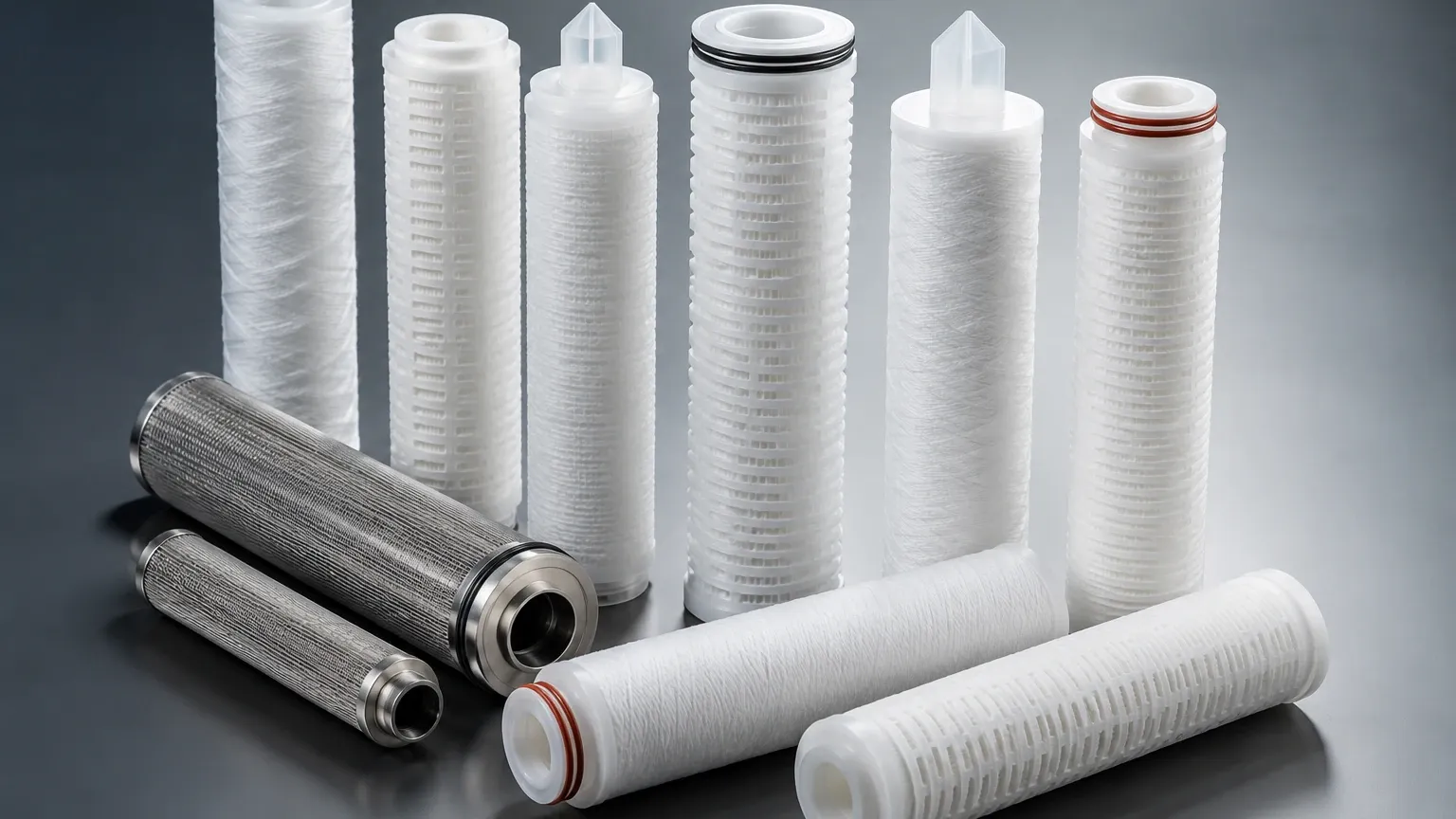
Engineering Selection Guide for Filter Cartridges
Selecting the correct filter cartridge melt blown requires a systematic approach to ensure process stability and fluid purity. Engineers should confirm the following parameters before finalizing a specification:
1. Fluid Characterization: Determine the viscosity, temperature, and pH of the fluid. High-viscosity fluids require larger surface areas or coarser media to maintain acceptable flow rates.
2. Contaminant Profile: Is the contaminant hard and angular (like sand or scale) or soft and gelatinous (like algae or oils)? Melt blown depth filters are particularly effective at capturing deformable, gelatinous particles that would quickly blind a surface filter.
3. Flow Rate Requirements: Calculate the flux rate (gallons per minute per 10-inch equivalent). To maximize the life of a melt blown filter, it is often recommended to oversize the housing, allowing for lower flux rates and more efficient depth loading.
4. End-Cap Configurations: Ensure compatibility with existing filter housings. Common configurations include Double Open End (DOE), Code 7 (226 O-rings with locking fins), and Code 3 (222 O-rings with a flat cap). Proper sealing is essential to prevent bypass, which would render the filtration process ineffective.
Industrial Applications and Industry Standards
Melt blown filtration is a cornerstone technology across various sectors. In Water Treatment, they serve as the primary pre-filtration stage for Reverse Osmosis (RO) membranes, removing silt and suspended solids that would otherwise foul expensive membranes. In the Chemical Industry, they are used for the filtration of reagents, plating solutions, and specialty chemicals where high purity is required.
For the Food and Beverage and Pharmaceutical sectors, it is imperative that the filter cartridge melt blown complies with FDA Title 21 CFR for food contact and meets USP Class VI biological tests for plastics. These certifications ensure that the filter does not introduce harmful extractables into the product stream. In these regulated environments, the traceability of the polymer lot and the cleanliness of the manufacturing facility (often a cleanroom environment) are critical selection criteria for purchasing teams.
Operational Best Practices: Installation and Replacement
To achieve the performance specified by the manufacturer, industrial filters must be managed correctly within the plant.
* Venting: When a new cartridge is installed, the filter housing must be properly vented to remove trapped air. Air pockets can cause "channeling," where the fluid bypasses portions of the filter media, leading to reduced efficiency and premature failure.
* Monitoring Differential Pressure: Relying on a fixed time schedule for filter changes is often inefficient. Installing differential pressure gauges across the filter housing allows operators to replace the filter exactly when it reaches its maximum loading capacity, maximizing the value of each cartridge.
* Avoid Over-Tightening: For DOE cartridges, over-tightening the compression nut can deform the cartridge, leading to bypass. Using cartridges with thermally bonded gaskets or O-ring seals provides a more reliable technical solution for ensuring fluid bypass is eliminated.
For organizations managing complex filtration requirements, the choice of media—whether it be a disposable melt blown cartridge for light-duty pre-filtration or a precision-engineered stainless steel component for demanding industrial cycles—depends on the specific goals of the application. By focusing on technical compatibility and performance data, engineers can ensure that their Filter Cartridges provide the necessary protection for downstream equipment and final product quality.
