


New Pool Filter Cartridges
In the realm of commercial and industrial water treatment, the selection of filtration components is a critical engineering decision that impacts system efficiency, water clarity, and operational costs. While the term "pool" often evokes residential imagery, high-capacity aquatic facilities, public water features, and industrial process water systems require robust Filter Cartridges that adhere to stringent performance standards. Selecting new pool filter cartridges involves more than matching dimensions; it requires a technical understanding of media types, hydraulic dynamics, and material compatibility.
Industrial-grade filtration solutions, such as those engineered by Kaifil, bridge the gap between standard commercial requirements and the high-durability needs of demanding environments. This guide examines the technical specifications and engineering considerations essential for selecting and maintaining high-performance cartridge filters.
Engineering Fundamentals of Modern Filter Cartridges
The primary function of a filter cartridge is to remove suspended solids from a liquid stream through mechanical straining. In aquatic and industrial water applications, this is typically achieved through surface filtration or depth filtration. Most new pool filter cartridges utilize pleated media to maximize the effective filtration area (EFA) within a compact footprint.
Surface vs. Depth Filtration
Surface filtration occurs when particles larger than the media's pore size are trapped on the outer surface. Pleated cartridges are the industry standard for this method because the folds significantly increase the surface area available for particle capture. This design allows for higher flow rates and lower initial pressure drops compared to non-pleated alternatives.
The Role of Effective Filtration Area (EFA)
The EFA is a key metric in determining the service life of a cartridge. A higher EFA reduces the flux—the volume of water passing through a specific area of media—which in turn lowers the velocity of particles hitting the filter. Lower velocity prevents particles from being forced through the pores (media migration) and slows the rate of pressure buildup, extending the time between cleaning or replacement cycles.
Material Selection for Enhanced Durability
The environment in which new pool filter cartridges operate is often chemically aggressive. High concentrations of chlorine, bromine, or ozone, combined with varying pH levels and temperature fluctuations, can degrade inferior materials. Engineering a reliable filtration solution requires careful selection of the media, core, and end caps.
Synthetic Media
Most commercial pool cartridges utilize spun-bonded polyester. This material offers a good balance of chemical resistance and structural integrity. However, in industrial process water or high-temperature applications, advanced polymers or reinforced synthetics may be required to prevent fiber shedding and maintain pore consistency.
Stainless Steel and Metal Mesh
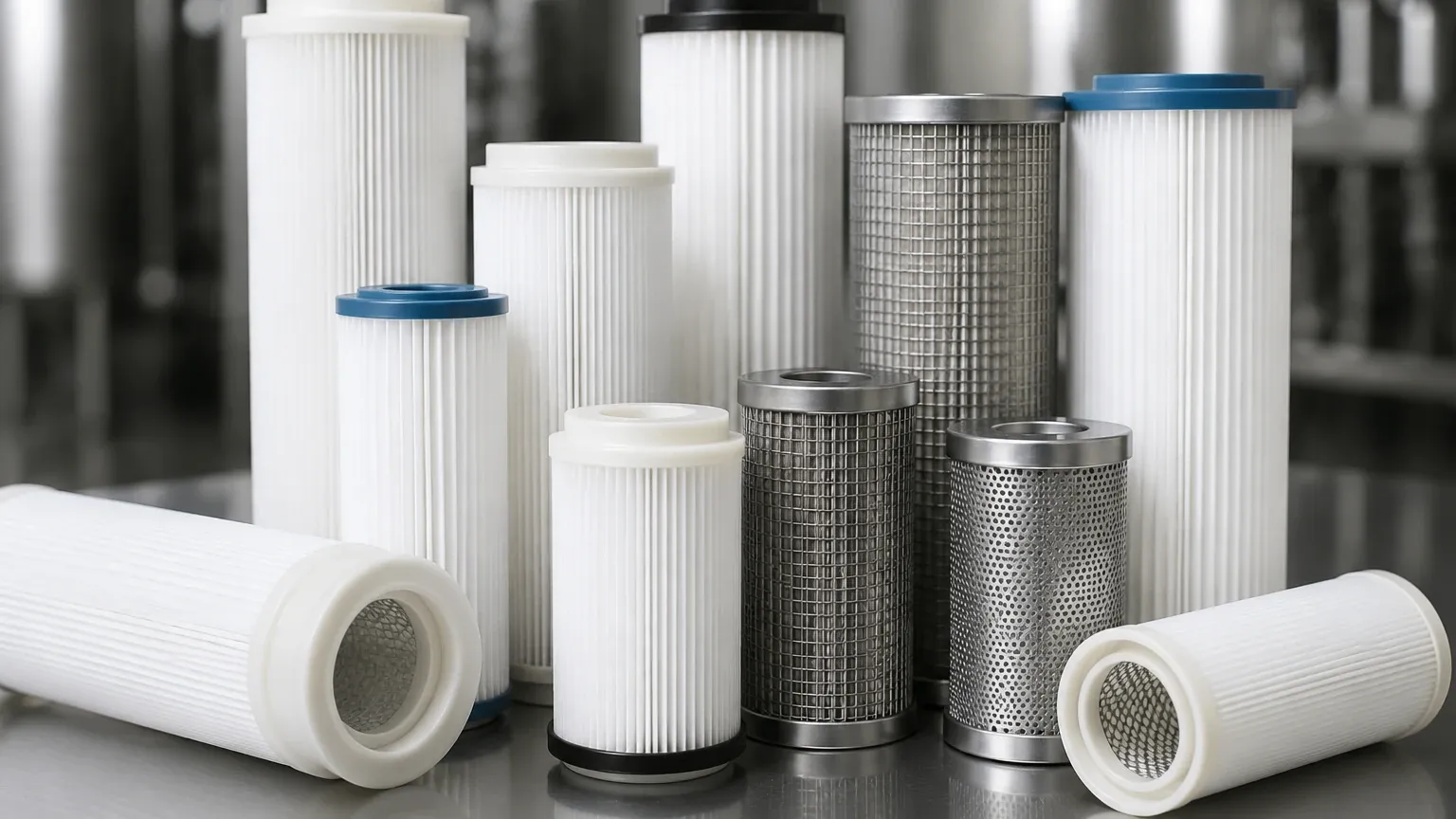
For facilities requiring extreme durability or the ability to withstand high-pressure differentials, stainless steel wire mesh filters provide a superior alternative. Unlike synthetic media, stainless steel cartridges can be ultrasonically cleaned and reused indefinitely. They are particularly effective in pre-filtration stages where heavy sediment loads would quickly blind a standard polyester cartridge. Kaifil specializes in these custom stainless steel solutions, providing the structural rigidity necessary for high-stress industrial environments.
Structural Components
The internal core and outer cage of the cartridge provide the necessary support to withstand differential pressure. In high-flow systems, a reinforced polypropylene or stainless steel core is essential to prevent the media from collapsing inward as it becomes loaded with contaminants.
Performance Metrics: Micron Ratings and Flow Rates
When evaluating new pool filter cartridges, engineers must interpret performance data beyond basic marketing claims. Two of the most critical factors are the micron rating and the rated flow capacity.
Nominal vs. Absolute Micron Ratings
* Nominal Rating: This indicates the filter's ability to retain a major weight percentage of particles of a certain size (typically 60% to 90%). Most pool filters are nominally rated.
* Absolute Rating: This refers to the diameter of the largest hard spherical particle that will pass through the filter under specified test conditions. For critical industrial processes where water quality is non-negotiable, absolute-rated cartridges are preferred to ensure consistent effluent quality.
Understanding Pressure Drop (ΔP)
Every filter introduces a resistance to flow, known as pressure drop. A "clean" pressure drop is the baseline resistance of a new cartridge. As the filter captures debris, the differential pressure increases. It is vital to select Filter Cartridges that offer a low initial ΔP to minimize the energy consumption of the circulation pumps. Most systems are designed to have the cartridges cleaned or replaced when the pressure gauge indicates an increase of 8-10 PSI over the clean starting pressure.
Critical Evaluation Criteria for Procurement
To ensure compatibility and performance, purchasing teams and engineers should confirm several technical parameters before acquiring new pool filter cartridges. Failure to match these specifications can lead to bypassing, where unfiltered water escapes around the cartridge, or mechanical failure of the filtration housing.
1. Dimensional Precision: Precise measurements of the Outer Diameter (OD), Inner Diameter (ID), and overall length are mandatory. Even a few millimeters of variance can prevent a proper seal.
2. End Cap Configuration: Cartridges may feature Double Open Ends (DOE), Single Open Ends (SOE), or specialized fittings like 222 or 226 O-ring configurations. The sealing surface must match the housing's internal hardware to prevent bypass.
3. Chemical Compatibility: Ensure the media and bonding agents (adhesives used to attach end caps) are compatible with the specific chemical treatments used in the water system.
4. Temperature Limits: Standard cartridges are often rated for temperatures up to 100°F (38°C). If the application involves heated process water or thermal sterilization, high-temperature materials must be specified.
Common Risks and Failure Modes
Investing in new pool filter cartridges requires an understanding of potential failure points to avoid system downtime. Industrial filtration experts identify several common risks:
Media Blinding
This occurs when fine oils, lotions, or microscopic algae coat the surface of the media, causing a rapid spike in pressure even if the filter doesn't appear "dirty" with large debris. In these cases, chemical cleaning is required to restore flow, as simple pressure washing will not remove the oily film.
Structural Collapse
If a pump continues to operate against a heavily fouled filter, the differential pressure may exceed the structural limit of the cartridge core. This leads to a collapse, allowing all trapped contaminants to flush back into the system downstream.
Bypassing
Bypassing is often the result of poor-quality end caps or incorrect installation. If the cartridge does not seat firmly against the manifold, water will take the path of least resistance—around the filter rather than through it—rendering the filtration system ineffective.
The Transition to Industrial-Grade Solutions
For many large-scale facilities, the frequent replacement of standard commercial cartridges leads to high operational costs and significant waste. This has driven a shift toward industrial-grade filtration components. Custom-engineered Filter Cartridges from manufacturers like Kaifil offer several advantages:
* Tailored Micron Efficiency: Designing the media to target specific particle sizes found in a particular facility's water profile.
* Enhanced Structural Integrity: Utilizing metal cores and outer shrouds to handle high-surge environments.
* Sustainability: Moving toward cleanable stainless steel elements reduces the environmental impact of disposable synthetic filters.
When specifying new pool filter cartridges for high-demand applications, engineers should prioritize the Total Cost of Ownership (TCO). While industrial-grade or custom-designed cartridges may have a higher initial purchase price, their extended service life, reduced maintenance requirements, and superior protection of downstream equipment often result in significant long-term savings.
Maintenance and Performance Monitoring
To maximize the lifespan of new pool filter cartridges, a proactive maintenance schedule is essential. Performance monitoring should include:
* Differential Pressure Logs: Regularly recording the PSI readings helps identify trends, such as seasonal loading or gradual media degradation.
* Visual Inspection: During cleaning cycles, cartridges should be inspected for "channeling" (holes in the media) or signs of end-cap separation.
* Proper Cleaning Protocols: Using the correct chemical soaks to remove mineral scale (acid wash) or organic oils (degreaser) is vital. Improper cleaning, such as using high-pressure washers too close to the media, can permanently damage the pore structure and reduce filtration efficiency.
In conclusion, selecting the right Filter Cartridges is a technical process that requires balancing filtration fineness with hydraulic requirements and material durability. By focusing on engineering specifications and considering industrial-grade alternatives, facilities can ensure optimal water quality and system reliability.
