


Opal Filter Cartridges
In industrial water treatment and fluid processing, the selection of filtration media is a critical decision that impacts both operational efficiency and long-term maintenance costs. Opal filter cartridges, often recognized for their pleated design and high surface area, serve as a standard solution in various applications ranging from commercial pool filtration to light industrial water processing. However, for engineers and procurement specialists operating in more demanding environments—such as chemical processing, pharmaceutical manufacturing, or high-temperature hydraulic systems—understanding the technical nuances of these cartridges and their heavy-duty alternatives is essential.
This guide examines the technical specifications, performance expectations, and selection criteria for pleated filtration systems, providing a comparative look at standard synthetic options and precision-engineered stainless steel Filter Cartridges designed for industrial rigor.
The Engineering Behind Pleated Cartridge Filtration
The primary advantage of the "Opal" style cartridge is its pleated construction. Unlike depth filters, which rely on the thickness of the media to trap particles, pleated cartridges utilize a surface filtration mechanism. By folding the filter media into a series of pleats, manufacturers significantly increase the effective filtration area (EFA) within a compact cylindrical footprint.
Surface Area and Dirt-Holding Capacity
Increased surface area directly correlates to a lower clean pressure drop and a higher dirt-holding capacity. In a fluid system, as particles accumulate on the surface of the filter, the available flow paths decrease, leading to a rise in differential pressure (ΔP). A pleated design distributes the particulate load across a larger area, which slows the rate of pressure buildup and extends the service life between cleaning or replacement cycles.
Flow Velocity and Efficiency
From an engineering perspective, a larger surface area reduces the "face velocity" of the fluid passing through the media. Lower face velocities enhance filtration efficiency, particularly for fine particles, as it reduces the likelihood of particles being forced through the pores by high-pressure fluid streams. This is a critical consideration when specifying filters for systems where consistent effluent quality is non-negotiable.
Material Selection: Synthetic vs. Metallic Filter Media
Most standard opal filter cartridges utilize synthetic materials such as polyester, polypropylene, or cellulose. While these materials are cost-effective for general water treatment, they have distinct limitations when compared to the stainless steel solutions provided by specialized manufacturers like Kaifil.
Temperature and Chemical Resistance
Synthetic cartridges typically have a maximum operating temperature of around 60°C to 80°C (140°F to 176°F). Beyond this range, the structural integrity of the polymer media and the thermally bonded end caps may fail. In contrast, stainless steel Filter Cartridges constructed from AISI 304 or 316L can withstand temperatures exceeding 300°C, making them the standard choice for steam filtration and high-temperature chemical reactions.
Furthermore, many industrial fluids contain aggressive solvents or corrosive chemicals that would degrade synthetic fibers. Stainless steel offers superior resistance to a wide spectrum of pH levels and organic solvents, ensuring that the filter does not become a source of contamination due to material breakdown.
Structural Integrity
Under high differential pressure, synthetic pleats can experience "bunching" or collapse, which creates bypass routes for contaminants. Industrial-grade metal filters often incorporate internal support cores and outer protective cages made of perforated metal to maintain pleat geometry even under significant pressure spikes or high-viscosity flow conditions.
Performance Metrics: Micron Ratings and Flow Dynamics
When evaluating opal filter cartridges or their industrial equivalents, engineers must distinguish between nominal and absolute micron ratings. This distinction is often the source of performance failures in the field.
1. Nominal Rating: This is an arbitrary value indicating the filter's ability to retain a majority of particles of a specific size. It is not a guarantee of total retention. Many commercial-grade cartridges are nominally rated, which may be insufficient for precision industrial processes.
2. Absolute Rating: This refers to the diameter of the largest hard spherical particle that will pass through the filter under specified test conditions. For critical applications in the pharmaceutical or food and beverage sectors, absolute-rated Filter Cartridges are required to ensure 99.9% or higher efficiency.
Understanding Pressure Drop (ΔP)
The total pressure drop in a filtration system is the sum of the housing pressure drop and the clean media pressure drop. When specifying a replacement for an opal-style cartridge, it is vital to calculate the expected ΔP based on the fluid's viscosity and the desired flow rate. A filter that is too restrictive will increase the energy consumption of the pump and may trigger premature system shutdowns. Conversely, a filter with too high a porosity will fail to meet the required clarity standards.
Operational Challenges and Maintenance Strategies
A significant factor in the total cost of ownership (TCO) is the maintenance strategy: disposable vs. cleanable. Standard opal cartridges are generally treated as consumables. Once the terminal differential pressure is reached, the cartridge is removed and discarded.
The Case for Cleanable Stainless Steel
In many industrial B2B contexts, the waste generated by disposable cartridges is both an environmental and a financial burden. Stainless steel wire mesh filters offer the advantage of being cleanable and reusable. Methods such as ultrasonic cleaning, backwashing, or chemical cleaning can restore the filter's permeability, allowing for years of service. This is particularly beneficial in processes with high solids loading where disposable filters would require daily replacement.
Common Failure Modes
* Seal Bypass: If the O-rings or gaskets are not compatible with the process fluid, they may swell or degrade, allowing unfiltered fluid to bypass the media.
* Fatigue Cracking: In systems with frequent pressure pulsations (such as those involving reciprocating pumps), the pleats can undergo mechanical fatigue. Metallic filters must be engineered with reinforced longitudinal seams to prevent splitting.
* Biofouling: In water treatment, organic growth can quickly blind a filter. While synthetic media may require biocide treatment, stainless steel can be sterilized using high-pressure steam (SIP) or aggressive caustic washes.
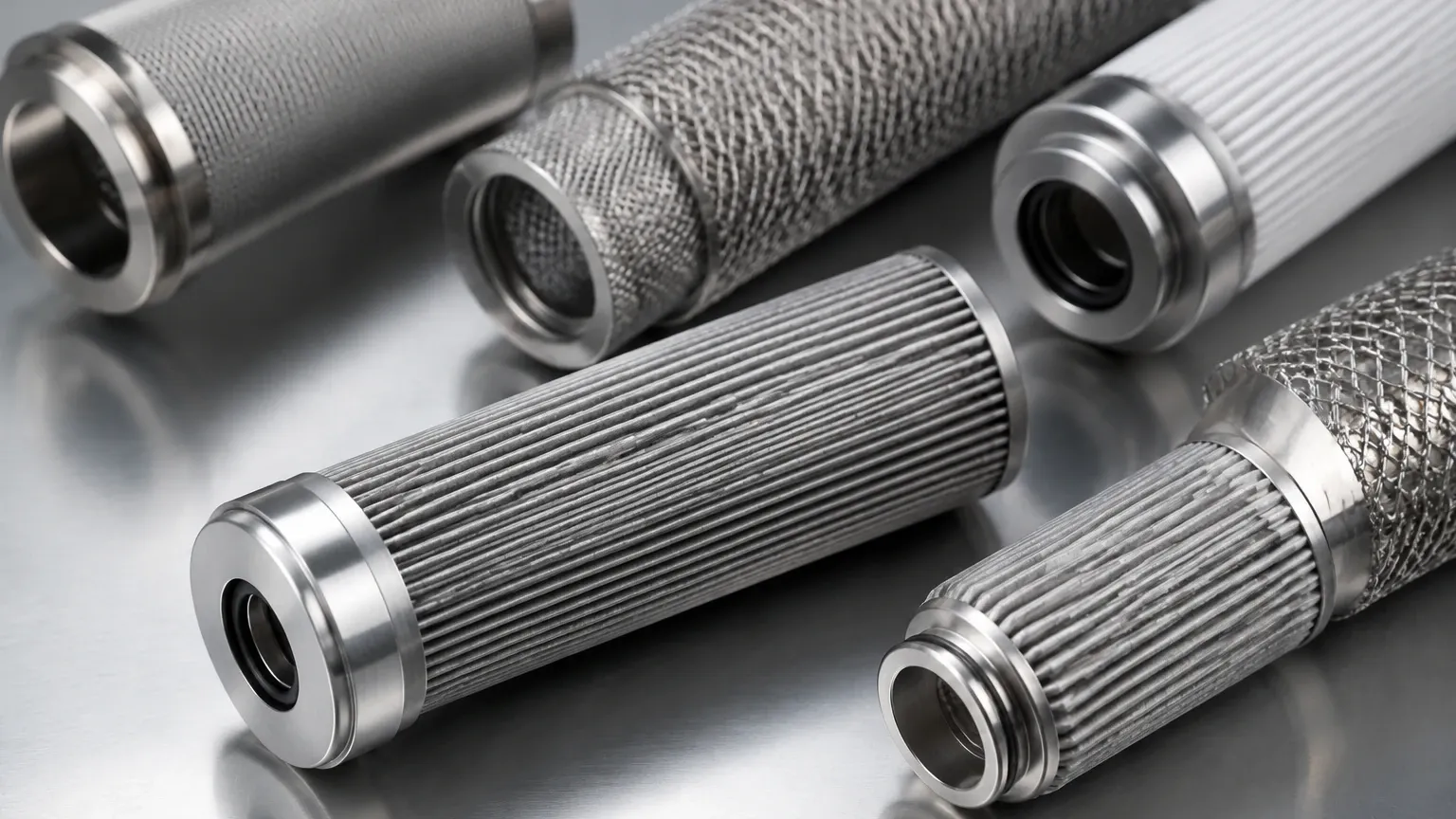
Customization and OEM Integration for Industrial Systems
Off-the-shelf opal filter cartridges often come in standard lengths (e.g., 10", 20", 30") and diameters. However, many industrial systems utilize proprietary housing designs or require specific flow characteristics that standard products cannot satisfy. This is where OEM customization becomes essential.
Custom End Cap Configurations
Industrial filters require secure sealing interfaces to prevent bypass. Customization options include:
* Code 7: Two 226 O-rings with a locking fin.
* Code 0: Two 222 O-rings with a flat cap.
* DOE (Double Open End): Utilizing flat gaskets on both ends.
* Threaded Connections: NPT or BSP threads for high-pressure securement.
Specialized Weave Patterns
For precision filtration, the choice of wire mesh weave is paramount. Plain weave provides straightforward filtration for larger particles, while Dutch weave or Twilled Dutch weave offers a denser structure for fine filtration down to 1-5 microns. Manufacturers like Kaifil can customize these weave patterns to balance mechanical strength with filtration fineness, ensuring the Filter Cartridges are optimized for the specific particle morphology of the application.
Procurement Checklist: What to Verify Before Specification
Before transitioning from a standard opal filter cartridge to a high-performance industrial solution, or when specifying filters for a new project, technical teams should confirm the following parameters:
* Fluid Compatibility: List all chemicals present in the fluid, including trace elements and cleaning agents. This determines if 304, 316L, or a specialized polymer is required.
* Operating Temperature: Confirm both the continuous operating temperature and any potential temperature spikes (e.g., during cleaning cycles).
* Maximum Differential Pressure: Determine the point at which the system will alert the operator to change or clean the filter. Ensure the cartridge's collapse pressure rating is significantly higher than this value.
* Particle Characterization: Is the contaminant deformable (like oil droplets or gels) or hard (like sand or metal shavings)? Hard particles are best handled by surface filtration, while deformable particles may require specialized depth-loading media.
* Compliance Requirements: For food, beverage, or pharmaceutical applications, ensure the materials used are FDA-compliant or meet specific industry certifications.
Conclusion
While opal filter cartridges provide a reliable solution for standard water filtration needs, industrial environments demand a higher level of durability and precision. By understanding the engineering principles of pleated media and the material advantages of stainless steel, purchasing and engineering teams can select filtration components that optimize system uptime and reduce long-term costs. Whether the goal is to replace a standard synthetic cartridge or to develop a custom OEM solution, focusing on technical specifications—such as absolute micron ratings, material compatibility, and structural reinforcement—is the key to successful industrial filtration. For those seeking high-performance alternatives or customized designs, exploring specialized Filter Cartridges ensures that the filtration system remains a robust part of the industrial process.
