


5 Filter
In the landscape of industrial filtration, the term "5 filter" most frequently refers to two critical technical specifications: the 5-layer sintered wire mesh structure and the 5-micron filtration rating. For engineers and procurement specialists, understanding these parameters is essential when selecting components for high-pressure, high-temperature, or high-precision environments. Whether used in polymer melt filtration, hydraulic systems, or pharmaceutical processing, the 5-layer configuration represents a gold standard for balancing mechanical strength with filtration efficiency.
As a specialized manufacturer, Kaifil provides precision-engineered Filter Discs & Packs that utilize these 5-layer sintered structures to meet the rigorous demands of modern industrial processes. This guide examines the engineering principles, performance characteristics, and selection criteria for 5-layer and 5-micron filtration solutions.
Engineering the 5-Layer Sintered Mesh Structure
The 5-layer sintered wire mesh is a composite material created by vacuum sintering five different layers of stainless steel wire cloth. Unlike traditional mesh, which may shift under pressure, the sintering process uses heat and pressure to create molecular bonds at every wire intersection. This results in a porous metal plate that maintains its pore size and structural integrity under extreme conditions.
The Standard Layer Configuration
To understand the functionality of a 5 filter structure, one must examine the specific role of each layer within the composite:
1. Protective Layer: The outermost layer, usually a coarse mesh, protects the delicate filtration layer from mechanical damage during installation and operation.
2. Control Layer (Filtration Layer): This is the core of the filter, determining the filtration accuracy (such as 5 microns). It is composed of a precisely woven mesh that defines the particle retention capability.
3. Dispersion Layer: Positioned behind the control layer, this mesh helps distribute the fluid flow evenly across the filtration surface, preventing localized pressure build-up and optimizing the use of the entire filter area.
4. Support Layer: A heavier mesh that provides the necessary mechanical strength to resist the differential pressure of the system.
5. Reinforcement Layer: The final coarse layer that adds overall rigidity to the disc or pack, ensuring it remains flat and stable within the housing.
By combining these layers, engineers achieve a filter that offers the precision of fine mesh with the durability of a heavy plate.
Performance Characteristics of 5-Micron Filtration
When a "5 filter" refers to a 5-micron rating, it indicates the filter's ability to remove particles as small as 5 micrometers. In industrial B2B applications, it is vital to distinguish between nominal and absolute ratings. An absolute 5-micron rating, common in sintered 5-layer discs, ensures that 99.9% of particles larger than 5 microns are captured.
Permeability and Pressure Drop
One of the primary engineering challenges is maintaining high permeability while achieving a fine 5-micron rating. Sintered 5-layer mesh is designed to provide a high void volume. This characteristic minimizes the initial pressure drop ($ΔP$) across the filter, which reduces energy consumption for pumps and compressors. Because the structure is rigid, the pores do not enlarge under increased pressure, ensuring consistent performance throughout the filter's lifecycle.
Dirt-Holding Capacity
Compared to single-layer screens, the multi-layer 5 filter approach offers superior dirt-holding capacity. The dispersion and support layers allow for a more complex flow path, which can trap a higher volume of contaminants before the terminal pressure drop is reached. This directly translates to longer intervals between cleaning or replacement cycles, reducing the total cost of ownership (TCO).
Applications for Multi-Layer Filter Discs & Packs
Filter Discs & Packs are utilized across diverse industries where fluid purity is non-negotiable. The 5-layer sintered construction is particularly valued in sectors where the operating environment would destroy standard fabric or non-sintered mesh filters.
Chemical and Petrochemical Processing
In chemical manufacturing, filters must withstand aggressive solvents and high temperatures. Sintered 316L stainless steel 5-layer discs are resistant to corrosion and can operate in temperatures exceeding 400°C. They are commonly used for catalyst recovery and the filtration of corrosive liquids.
Polymer and Plastic Extrusion
In the production of synthetic fibers and plastic films, "5 filter" packs are used to remove gels and impurities from polymer melts. The high-pressure environment of an extruder requires the mechanical rigidity that only a sintered 5-layer structure can provide. These packs ensure the final product is free of optical defects and structural weaknesses.
Pharmaceutical and Food Production
For pharmaceutical applications, cleanliness and material stability are paramount. Stainless steel filter discs do not shed fibers or leach chemicals into the product stream. The 5-micron precision is often used in the final stages of liquid medicine production to ensure clarity and safety.
Material Selection and Engineering Considerations
Selecting the right material for a 5 filter component involves more than just choosing a micron rating. Engineers must consider the chemical compatibility and mechanical stresses of the specific application.
Stainless Steel Grades: 304 vs. 316L
* AISI 304: Suitable for general industrial applications with moderate corrosion risk. It offers excellent mechanical properties and cost-effectiveness.
* AISI 316L: The preferred choice for marine environments, pharmaceutical processes, and high-acid chemical applications. The addition of molybdenum provides superior resistance to pitting and crevice corrosion.
Mechanical Stress and Differential Pressure
Before purchasing, technical teams should confirm the maximum allowable differential pressure. While the 5-layer sintered mesh is incredibly strong, exceeding its design limits can lead to "media migration" or structural collapse. For ultra-high-pressure applications, additional support layers or specialized rimming (such as aluminum or stainless steel borders) can be added to the filter discs to enhance their sealing and structural capacity.
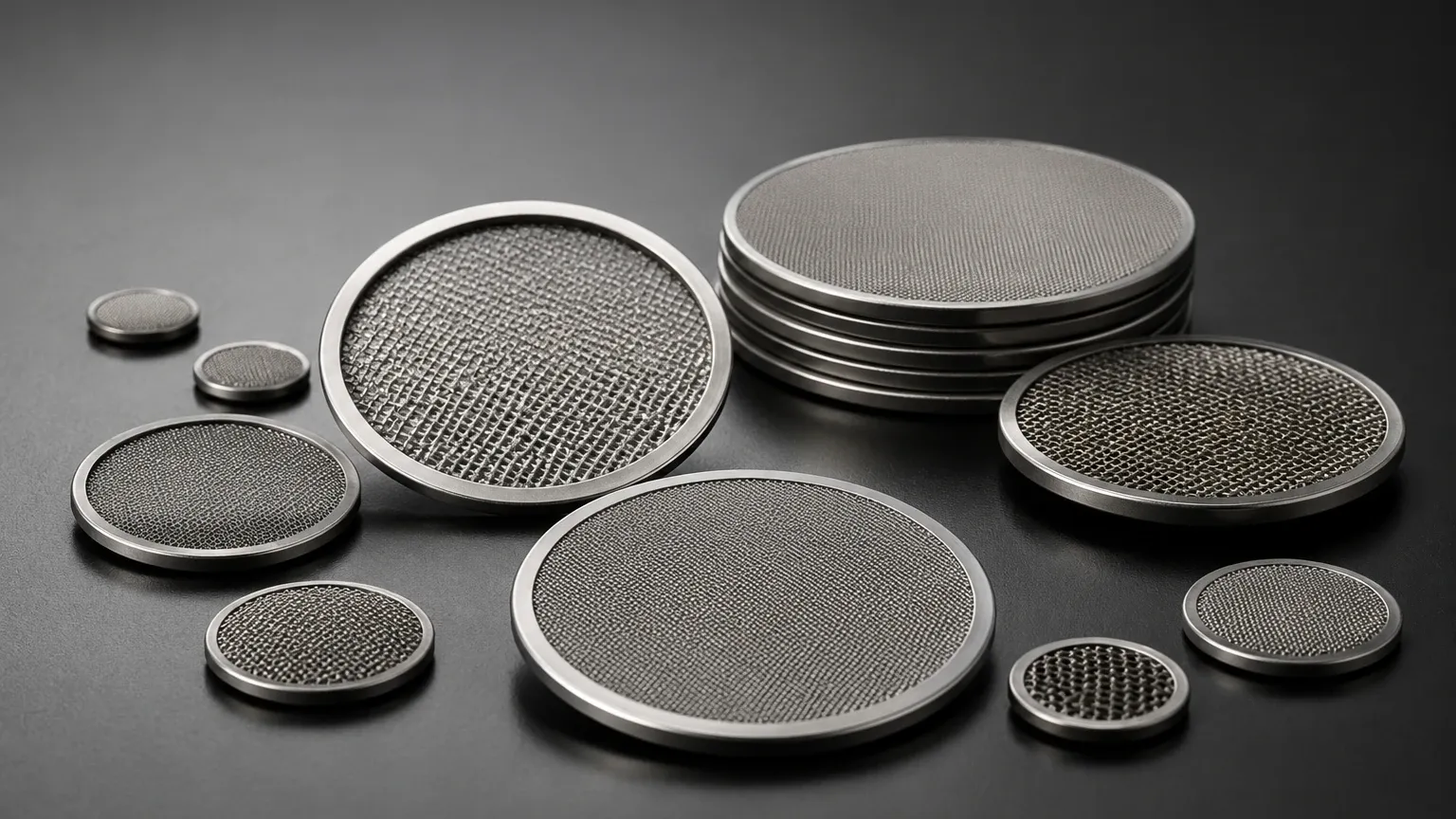
Customization Options for Industrial Packs
Industrial filtration is rarely a one-size-fits-all solution. Customization is often required to fit existing housings or to meet specific flow dynamics. When ordering Filter Discs & Packs, several variables can be tailored:
* Shape and Geometry: While circular discs are standard, filters can be manufactured in oval, rectangular, or ring shapes (doughnut filters).
* Layer Composition: While 5 layers are standard, some applications may require 2, 3, or even 7 layers of mesh to achieve the desired balance of flow and strength.
* Rimming and Edging: To prevent bypass and ensure a tight seal, filter packs can be spot-welded or bound with metal rims. This is especially important in high-vibration environments.
* Surface Treatment: Options like electropolishing can be applied to improve the corrosion resistance and cleanability of the stainless steel surface.
Maintenance, Cleaning, and Replacement Cycles
One of the most significant advantages of a stainless steel 5 filter over disposable alternatives is cleanability. For B2B operations, the ability to reuse components significantly impacts the long-term budget.
Cleaning Methods
Because the 5-layer sintered mesh is a solid metallic structure, it can be cleaned using aggressive methods that would destroy other filters:
* Backwashing: Reversing the flow of fluid to dislodge particles from the control layer.
* Ultrasonic Cleaning: Using high-frequency sound waves in a cleaning solution to remove fine particles trapped deep within the mesh.
* Chemical Cleaning: Using acids or alkalis to dissolve organic or inorganic deposits, provided the chemical is compatible with the stainless steel grade.
* Thermal Cleaning (Burn-off): In polymer applications, the filters can be heated in a vacuum oven to burn off residual plastic.
Determining Replacement Cycles
While reusable, these filters are not infinite. Replacement should be considered if the "clean" pressure drop begins to rise over time, indicating that the pores are becoming permanently blinded. Additionally, any signs of physical deformation or mesh separation should trigger an immediate replacement to prevent downstream contamination.
Conclusion: Selecting the Right 5 Filter Solution
The "5 filter"—whether defined by its 5-layer sintered strength or its 5-micron precision—is a cornerstone of industrial fluid management. By choosing a sintered stainless steel construction, engineers gain a component that offers high filtration accuracy, exceptional mechanical durability, and the economic benefits of cleanability.
When evaluating suppliers for Filter Discs & Packs, it is essential to partner with a manufacturer that understands the nuances of mesh weaving, vacuum sintering, and precision fabrication. Kaifil’s expertise in custom stainless steel filtration ensures that each disc or pack is engineered to meet the specific pressure, temperature, and chemical requirements of your industrial application, providing a reliable barrier against contaminants and protecting the integrity of your process.
