


Disc Filter 100 Micron
In industrial filtration, selecting the correct micron rating is the most critical step in protecting downstream equipment and ensuring product purity. A disc filter 100 micron represents a specific tier of filtration—often categorized as fine-to-medium filtration—that bridges the gap between coarse straining and high-precision microfiltration. For engineers and procurement specialists, understanding the technical nuances of 100-micron stainless steel discs is essential for optimizing flow rates, minimizing pressure drops, and extending the service life of industrial systems.
Industrial Filter Discs & Packs are utilized across a spectrum of demanding environments, from polymer melt extrusion to hydraulic fluid conditioning. At the 100-micron level, the filtration media must balance physical robustness with precise aperture control. This guide examines the engineering considerations, material science, and application-specific variables that define the performance of 100-micron disc filters.
Understanding the 100 Micron Filtration Level
The term "micron" (micrometer) refers to one-millionth of a meter. A 100-micron rating means the filter is designed to capture particles larger than 0.1 millimeters. To put this in perspective, a human hair is typically between 50 and 90 microns in diameter. Therefore, a 100-micron filter acts as a robust barrier against visible sediment, scale, and larger particulate matter.
Mesh Count and Wire Diameter
In the context of stainless steel wire mesh, a 100-micron opening typically corresponds to a specific mesh count. For a plain weave stainless steel mesh, a 100-micron aperture is generally achieved with approximately 140 to 150 mesh (wires per inch), depending on the wire diameter used.
Engineers must distinguish between "nominal" and "absolute" ratings. A nominal 100-micron rating suggests the filter will stop a high percentage of particles at that size, whereas an absolute rating guarantees that no particle larger than 100 microns will pass through the media. For critical applications like pharmaceutical processing or high-pressure hydraulics, absolute ratings are often required to prevent system failure or contamination.
Material Selection and Engineering Durability
The performance of a disc filter 100 micron is heavily dependent on the alloy from which it is manufactured. Stainless steel is the industry standard due to its mechanical strength and resistance to environmental stressors.
Stainless Steel 304 vs. 316L
* Grade 304: This is the most common stainless steel used for general industrial filtration. It offers excellent strength and basic corrosion resistance, making it suitable for water treatment, food processing (in non-acidic environments), and hydraulic oil filtration.
* Grade 316L: For applications involving high salinity, acidic chemicals, or pharmaceutical precursors, 316L is the preferred choice. The addition of molybdenum enhances its resistance to pitting and crevice corrosion. The "L" denotes low carbon, which improves weldability and prevents sensitization during the spot-welding process used to create multi-layer filter packs.
Thermal and Chemical Stability
Unlike polymer-based filters, stainless steel 100-micron discs can withstand extreme temperatures, often exceeding 400°C (750°F) in oxidizing atmospheres and even higher in inert environments. This thermal stability is vital in polymer extrusion, where the filter must remain structural while submerged in molten plastics. Furthermore, the chemical inertness of stainless steel ensures that the filter does not leach contaminants into the filtrate, a requirement that is non-negotiable in the food and beverage industry.
Design Variations: Single Layer vs. Multi-Layer Filter Packs
A disc filter 100 micron can be supplied as a single-layer mesh disc or as part of a complex, multi-layer assembly known as a filter pack. The choice between these designs depends on the operating pressure and the nature of the contaminants.
Single Layer Discs
Single-layer discs are typically used in low-pressure applications or as a final polishing stage where the particulate load is minimal. They are cost-effective and easy to clean but lack the structural rigidity required for high-differential pressure environments.
Multi-Layer Filter Packs
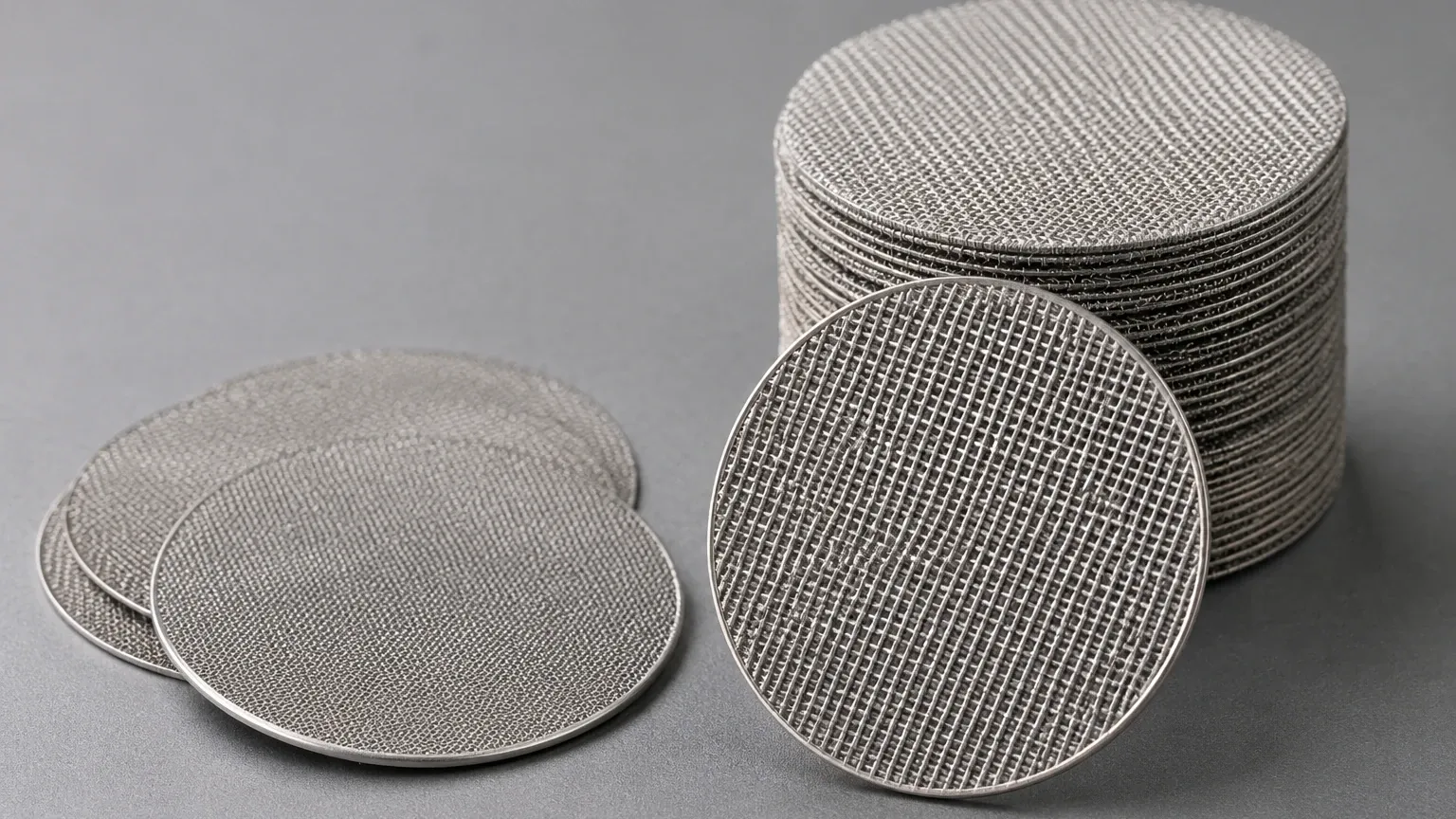
In high-pressure systems, such as plastic recycling or chemical synthesis, 100-micron mesh is often combined with other layers to form Filter Discs & Packs. A typical three-to-five-layer construction might include:
1. Drainage/Support Layer: A coarse mesh (e.g., 20 mesh) that provides structural rigidity.
2. Filtration Layer: The primary 100-micron mesh that performs the separation.
3. Protective Layer: A secondary mesh that prevents the 100-micron layer from being damaged by high-velocity flow or mechanical abrasion.
These layers are often spot-welded together or bound by an aluminum, copper, or stainless steel rim (edging). Edging not only prevents the fraying of wire ends but also ensures a tighter seal within the filter housing, preventing bypass—a common failure point in industrial filtration.
Performance Evaluation: Flow Rate and Pressure Drop
When integrating a disc filter 100 micron into a system, engineers must calculate the clean pressure drop ($ΔP$). This is the resistance the filter offers to the fluid flow when it is free of contaminants.
Open Area and Porosity
The "open area" percentage of a 100-micron mesh determines its flow capacity. A higher open area results in a lower initial pressure drop but may sacrifice the mechanical strength of the mesh. For example, using a thinner wire increases the open area but makes the disc more susceptible to deformation under pressure.
Dirt Holding Capacity
100-micron filters are often selected for their balance between efficiency and dirt-holding capacity. Because the openings are relatively large compared to sub-micron filters, they can accumulate a significant volume of solids before reaching the terminal pressure drop (the point at which the filter must be cleaned or replaced). This reduces the frequency of system downtime, which is a major factor in the total cost of ownership (TCO).
Industrial Applications for 100 Micron Discs
The versatility of the 100-micron rating makes it a staple in various sectors. Its primary role is to remove "macro-contaminants" that could damage sensitive downstream components.
Polymer and Fiber Extrusion
In the production of plastics and synthetic fibers, 100-micron filter packs are used to remove un-melted resin gels and foreign particles from the melt. This ensures the quality of the final product and prevents the clogging of fine spinnerets or extrusion dies.
Hydraulic and Lubrication Systems
Hydraulic fluids must be kept clean to prevent wear on pumps and valves. A 100-micron disc often serves as a suction strainer or a primary filter to catch metal shavings and scale that could cause catastrophic component failure.
Food and Beverage Processing
In the production of juices, syrups, and oils, 100-micron filters are used to remove pulp, seeds, or larger sediments. Because these filters are made of food-grade stainless steel, they can be easily sterilized and reused, aligning with hygiene standards like FDA or EHEDG.
Water Treatment and Irrigation
For industrial cooling water or agricultural irrigation, 100-micron discs protect spray nozzles and heat exchangers from clogging due to sand, grit, and organic debris found in raw water sources.
Maintenance, Cleaning, and Service Life
One of the primary advantages of stainless steel Filter Discs & Packs over disposable media is their cleanability. A disc filter 100 micron can often be restored to near-original performance through various cleaning methods.
Cleaning Techniques
* Ultrasonic Cleaning: This is the most effective method for 100-micron mesh. High-frequency sound waves create cavitation bubbles that dislodge particles trapped deep within the mesh weave.
* Backwashing: In automated systems, reversing the flow of the filtrate can flush out accumulated solids. This is common in water treatment applications.
* Chemical Cleaning: For organic build-up or scale, soaking the discs in compatible solvents or mild acids (specifically for 316L) can dissolve contaminants without damaging the metal structure.
* Burn-off/Pyrolysis: In the polymer industry, filters are often placed in high-temperature ovens to burn off residual plastic, leaving the stainless steel mesh ready for reuse.
Determining Replacement Cycles
While reusable, stainless steel filters eventually succumb to mechanical fatigue or "blinding" (permanent clogging). Engineers should monitor the rate at which pressure increases after each cleaning cycle. If the time between cleanings shortens significantly, it indicates that the mesh structure is compromised or that sub-micron particles have become permanently embedded in the weave, necessitating replacement.
Key Considerations for OEM Procurement
When sourcing a disc filter 100 micron for a specific project, providing a manufacturer with precise specifications is vital to ensure performance. Standard "off-the-shelf" discs may not meet the tolerances required for specialized machinery.
Essential Specifications to Confirm:
1. Exact Diameter and Tolerances: Even a 0.5mm deviation can lead to bypass in a high-pressure housing.
2. Layer Sequence: For multi-layer packs, the orientation of the mesh layers (e.g., plain weave vs. dutch weave) affects both filtration and drainage.
3. Edge Treatment: Specify whether the disc requires a raw cut edge, a spot-welded edge, or a metal rim (aluminum, copper, or stainless steel).
4. Quantity and Batch Consistency: In OEM production, consistency across thousands of units is required to ensure uniform system performance across a product line.
By focusing on these technical parameters, engineering teams can ensure that their choice of a 100-micron filter provides the necessary protection, durability, and cost-efficiency required for modern industrial operations. Whether used as a standalone component or integrated into complex Filter Discs & Packs, the 100-micron stainless steel disc remains a cornerstone of reliable industrial filtration.
