


Disc Filter 3
In the landscape of industrial filtration, precision and durability are the primary metrics for evaluating component performance. The term "disc filter 3" often refers to a specific size—typically a 3-inch diameter—or a 3-layer construction within the broader category of Filter Discs & Packs. These components are essential in applications ranging from chemical processing and polymer extrusion to hydraulic systems and pharmaceutical manufacturing.
For engineers and procurement professionals, selecting the correct disc filter involves more than just matching a diameter. It requires a deep understanding of material science, mesh geometry, and the mechanical stresses the filter will encounter during its operational lifecycle. This guide explores the technical considerations of 3-inch and 3-layer stainless steel filter discs to assist in optimized selection and system design.
Understanding the Specifications of a Disc Filter 3
When specifying a disc filter 3, the "3" generally identifies one of two critical engineering parameters: the physical diameter of the disc or the number of layers in a laminated filter pack.
Dimensional Precision (3-Inch Diameter)
A 3-inch (approximately 76.2mm) disc is a standard size for many medium-flow industrial housings. In these applications, the outer diameter (OD) tolerance is critical. A disc that is slightly undersized may allow for fluid bypass around the edges, compromising the integrity of the downstream product. Conversely, an oversized disc will not seat properly in the filter holder. Kaifil utilizes precision stamping and laser cutting technologies to ensure that these discs maintain tight tolerances, often within +/- 0.1mm, ensuring a perfect seal in high-pressure environments.
Structural Configuration (3-Layer Construction)
In many high-viscosity or high-pressure applications, a single layer of wire mesh is insufficient. A 3-layer disc filter configuration typically consists of:
1. The Filtration Layer: A fine mesh in the center designed to capture particles at the target micron rating.
2. The Support Layer: A coarser mesh on the downstream side to prevent the fine mesh from deforming under pressure.
3. The Protective Layer: A mesh on the upstream side to protect the filtration media from mechanical damage during installation or backwashing.
Material Selection and Chemical Compatibility
The performance of a disc filter 3 is heavily dependent on the alloy used in its construction. Stainless steel is the industry standard due to its balance of mechanical strength and corrosion resistance. However, the specific grade must be matched to the process fluid.
AISI 304 Stainless Steel
Grade 304 is the most common material for general industrial use. It offers excellent strength and is suitable for food and beverage applications or water treatment where extreme chemical corrosion is not a primary concern. It is cost-effective but may be susceptible to pitting in high-chloride environments.
AISI 316 and 316L Stainless Steel
For chemical processing and pharmaceutical applications, 316L is the preferred choice. The addition of molybdenum enhances resistance to acetic acids, sulfuric acids, and chlorides. The "L" denotes low carbon content, which is essential if the filter discs are to be spot-welded or sintered, as it prevents carbide precipitation that could lead to intergranular corrosion at the weld points.
Specialty Alloys
In extreme cases involving high-temperature oxidation or highly aggressive acids, materials such as Monel, Inconel, or Hastelloy may be required. These alloys maintain their structural integrity at temperatures exceeding 500°C, where standard stainless steels might begin to scale or lose tensile strength.
Engineering Performance: Micron Ratings and Flow Rates
The primary function of a disc filter 3 is to remove contaminants while maintaining an acceptable pressure drop ($ΔP$). The efficiency of this process is governed by the weave type and the resulting pore size.
Absolute vs. Nominal Filtration
Engineers must distinguish between nominal and absolute micron ratings. A nominal rating refers to the ability of the mesh to retain a certain percentage of particles of a given size. An absolute rating, common in precision wire mesh filters, indicates that no particle larger than the specified micron size can pass through the mesh. For critical applications like hydraulic fluid filtration or pharmaceutical ingredient clearing, absolute ratings are mandatory.
Weave Types
* Plain Weave: The simplest structure, where wires cross over and under each other. It provides high flow rates but is limited in its ability to achieve very fine micron ratings.
* Twill Weave: Allows for thicker wires and finer meshes by passing wires over two and under two. This is ideal for heavy-duty 3-inch discs that require high mechanical strength.
* Dutch Weave (and Reverse Dutch): Uses different diameters for warp and weft wires to create a dense, tortuous path. This weave is excellent for fine filtration and high-pressure resistance.
Structural Design: Single Layer vs. Multi-layer Filter Packs
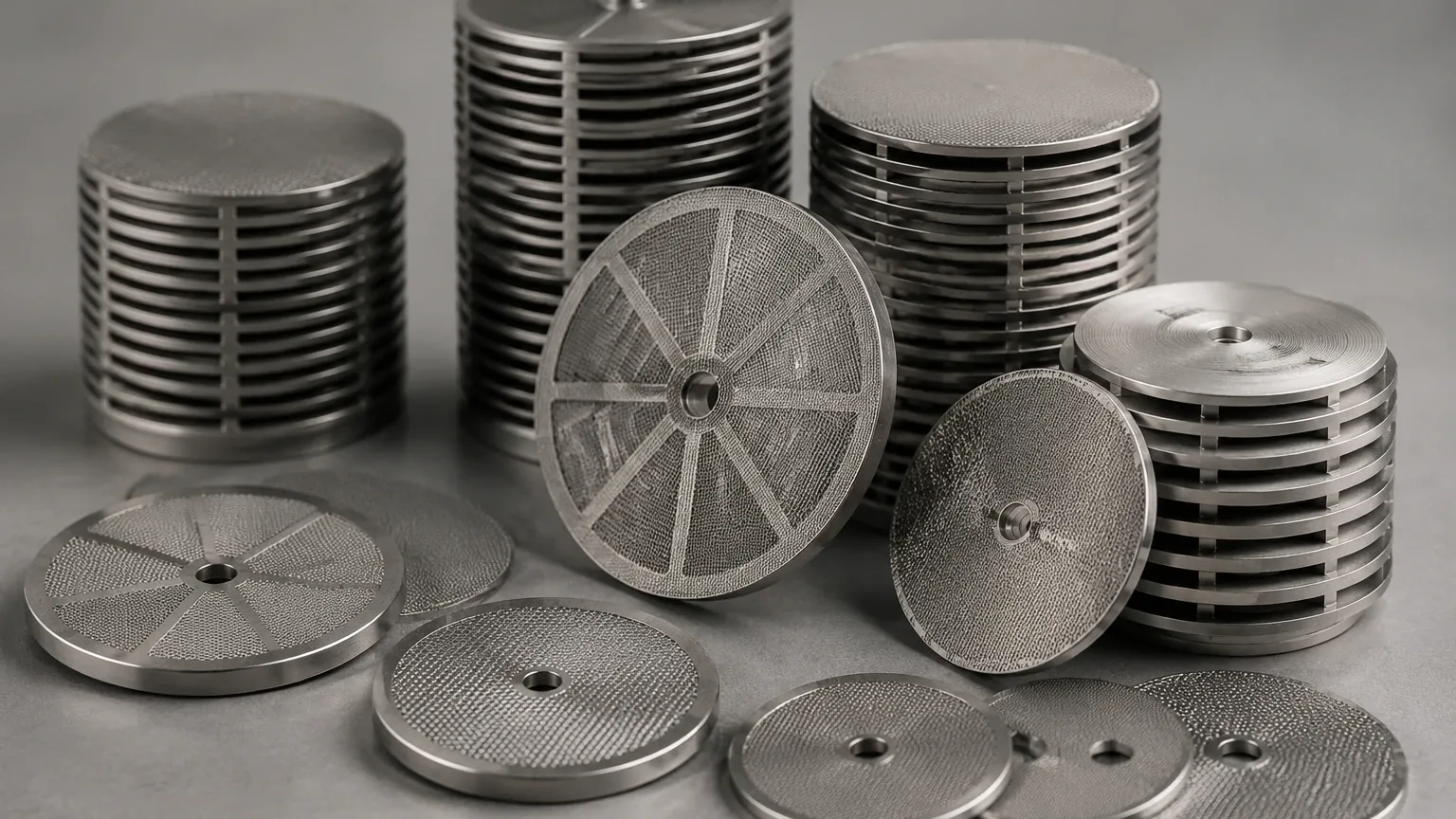
While a single-layer disc is suitable for low-pressure gas filtration or simple straining, most industrial processes utilize multi-layer Filter Discs & Packs. The 3-layer disc filter 3 is a common middle ground that balances filtration depth with flow efficiency.
Sintered vs. Spot-Welded Packs
* Spot-Welded Discs: The layers are held together by precision welds at the edges or in the center. This is a cost-effective method for many applications but may leave small gaps between layers where fine particles can become trapped and difficult to clean.
* Sintered Discs: The layers are bonded together through a high-temperature vacuum process that fuses the contact points of the wires without melting them. This creates a monolithic structure that is incredibly rigid and cannot delaminate, even under extreme pressure or back-pulsing. Sintered 3-layer discs are the gold standard for polymer melt filtration and high-pressure hydraulic systems.
Edge Treatment
To prevent fraying and ensure a bypass-free seal, the edges of the disc filter 3 can be treated in several ways. Common options include aluminum or stainless steel rims (edge binding), which provide a flat surface for gaskets to seat against. Alternatively, the edges can be plasma-welded or left raw if the disc is to be compressed into a precision-machined recess.
Applications in High-Pressure and High-Temperature Environments
The disc filter 3 is frequently deployed in environments where synthetic or plastic filters would fail.
Polymer and Resin Extrusion
In the production of plastics, molten polymer is forced through screen changers at high pressures. A 3-layer sintered disc provides the necessary rigidity to withstand the viscosity of the melt while removing "gels" or un-melted particulates that would otherwise cause defects in the final product.
Hydraulic and Lubrication Systems
Precision machinery relies on clean oil to prevent wear on valves and actuators. Disc filters are often used as "last chance" filters located just before critical components. Their compact size (3-inch diameter) allows them to be integrated into manifold blocks or valve assemblies.
Chemical and Petrochemical Processing
Stainless steel discs are used to filter catalysts, additives, and raw chemical feedstocks. Their ability to be cleaned and reused makes them a sustainable alternative to disposable cartridge filters in high-volume chemical lines.
Maintenance and Replacement Cycles for Industrial Filter Discs
One of the primary advantages of stainless steel disc filters is their cleanability. Unlike polymer-based media, metal mesh can be cleaned using ultrasonic baths, chemical solvents, or high-temperature burnout ovens.
Determining the End of Life
The replacement cycle for a disc filter 3 is typically determined by the terminal pressure drop. As the pores become blinded by contaminants, the pressure required to maintain the flow rate increases. Once the $ΔP$ reaches a pre-defined limit (often 15-25 psi depending on the system), the discs must be cleaned or replaced.
Repeated cleaning cycles will eventually cause "media migration" or structural fatigue, especially in spot-welded packs. Sintered packs offer a much longer service life because the fixed pore structure does not shift during cleaning. Engineers should monitor the integrity of the mesh after each cleaning to ensure no wires have broken, which could lead to downstream contamination.
Key Considerations Before Purchasing Custom Filter Discs
Before finalizing a purchase order for a disc filter 3, engineers should confirm several technical details with the manufacturer to ensure the component is fit for purpose:
1. Fluid Characteristics: What is the viscosity, temperature, and pH of the fluid? This dictates the material (304 vs 316L) and the required support structure.
2. Contaminant Profile: What is the nature of the solids being removed? Hard, abrasive particles require a more durable mesh than soft, deformable gels.
3. Operating Pressure: Will the filter be subjected to constant pressure or cyclic pulses? This determines whether a sintered or spot-welded pack is necessary.
4. Sealing Requirements: Does the housing require an edge-bound disc with a specific rim material to prevent bypass?
5. Cleaning Protocol: How will the filters be cleaned? Ensure the mesh and edge binding are compatible with the cleaning chemicals and temperatures used.
By addressing these factors, purchasing teams can reduce the total cost of ownership (TCO) by selecting a filter that lasts longer and performs more reliably than a generic alternative.
Conclusion
The disc filter 3 represents a critical intersection of precision engineering and industrial utility. Whether utilized as a single-layer screen or a complex 3-layer sintered pack, these components provide the necessary barrier against contamination in the world’s most demanding industries. By focusing on material integrity, weave precision, and structural design, Kaifil provides Filter Discs & Packs that meet the rigorous standards of modern engineering. Selecting the right disc is not merely a matter of size; it is a strategic decision that impacts the efficiency, safety, and quality of the entire production process.
