


Disc Filter O Ring
In industrial filtration systems, the integrity of a process depends not only on the micron rating of the mesh but also on the reliability of the seal. For engineers and technical procurement teams, the disc filter o ring is a critical component that ensures fluid or gas passes through the intended media rather than bypassing it. When utilizing Filter Discs & Packs, the selection of the correct sealing interface is as vital as the metallurgy of the stainless steel wire cloth itself.
This guide explores the technical considerations, material properties, and engineering challenges associated with disc filter o-rings in high-performance industrial applications.
The Role of O-Rings in Filter Discs and Packs
Filter discs and multi-layer packs are used extensively in polymer extrusion, hydraulic systems, pharmaceutical processing, and chemical refining. These components are often installed in recessed housings or between flanges where a tight seal is required to prevent "leak-by" or bypass. Bypass occurs when the process fluid takes the path of least resistance around the edge of the filter rather than through the mesh pores, effectively rendering the filtration system useless.
In many designs, the disc filter o ring is seated within a groove in the filter housing or integrated directly into the rim of the filter pack. The O-ring functions as a mechanical gasket that, when compressed, creates a barrier between the upstream (dirty) side and the downstream (clean) side of the system. For multi-layer packs, especially those that are spot-welded or bound with an aluminum or stainless steel rim, the O-ring provides the necessary elasticity to compensate for microscopic surface irregularities in the metal hardware.
Material Selection for Industrial Filtration Seals
Selecting the material for a disc filter o ring requires a deep understanding of the chemical environment, temperature fluctuations, and pressure differentials. Because Kaifil specializes in stainless steel filtration solutions for demanding environments, the O-rings paired with these filters must match the durability of the metal components.
1. Viton (FKM)
Viton is the industry standard for high-temperature applications and environments involving aggressive chemicals, oils, and fuels. It maintains its sealing properties at temperatures up to 200°C (392°F) and resists degradation from many acids and solvents that would cause other elastomers to swell or crack.
2. EPDM (Ethylene Propylene Diene Monomer)
EPDM is preferred for water treatment, steam applications, and processes involving polar solvents or ketones. It offers excellent resistance to weathering and ozone, making it suitable for outdoor filtration installations. However, it is generally incompatible with petroleum-based oils and lubricants.
3. Silicone (VMQ)
In food and beverage or pharmaceutical applications, silicone O-rings are often selected due to their high purity and wide temperature range. They are flexible and provide an excellent seal at low pressures, though they generally have lower mechanical strength and abrasion resistance compared to FKM or Nitrile.
4. PTFE (Polytetrafluoroethylene)
For extreme chemical resistance where elastomers fail, PTFE-encapsulated O-rings or solid PTFE gaskets are used. While PTFE lacks the elasticity of rubber, it is virtually inert to almost all industrial chemicals. When used with Filter Discs & Packs, PTFE seals ensure that the filtration assembly can withstand the most corrosive environments.
Critical Design Parameters for Effective Sealing
When designing or specifying a disc filter o ring, engineers must consider the mechanical interaction between the seal and the filter assembly. Several factors influence the performance of the seal:
* Compression Rate: For a static seal, a compression rate of 15% to 30% is typically recommended. Insufficient compression leads to bypass, while over-compression can cause the elastomer to undergo "compression set," where it loses its ability to spring back, eventually leading to failure.
* Groove Geometry: The gland or groove that houses the O-ring must be sized to allow for "void volume." Elastomers are essentially incompressible fluids; if the groove is too small, the O-ring will have nowhere to expand when compressed, potentially damaging the filter rim or the housing.
* Surface Finish: The metal surfaces of the filter pack rim and the housing must meet specific roughness requirements (typically 32 to 64 micro-inches Ra). A surface that is too rough will provide leak paths, while a surface that is too smooth may prevent the O-ring from properly seating.
* Durometer (Hardness): Most industrial O-rings are rated at 70 Shore A. However, in high-pressure hydraulic applications, a harder durometer (90 Shore A) may be necessary to prevent the O-ring from extruding into the gap between the filter disc and the housing wall.
Identifying and Preventing Common Failure Modes
Understanding why a disc filter o ring fails is essential for optimizing maintenance cycles and preventing unscheduled downtime. In industrial filtration, failure usually manifests in three ways:
Chemical Swell
If the O-ring material is incompatible with the process fluid, it will absorb the fluid and increase in volume. This can lead to the O-ring being pinched during installation or obstructing the flow path of the filter. Engineers should always consult chemical compatibility charts before selecting a seal for a new process.
Thermal Degradation
Operating beyond the temperature limit of the elastomer causes it to harden and become brittle. Once the O-ring loses its elasticity, it can no longer maintain the seal against the filter pack, especially during thermal cycling where the metal components expand and contract at different rates.
Installation Damage
In many disc filter housings, the O-ring must pass over threads or sharp edges during assembly. If the O-ring is nicked or cut, even a microscopic tear can expand under pressure, leading to a significant bypass. Using proper lubrication (compatible with the process) and chamfered edges on the housing can mitigate this risk.
Integration with Custom Filter Discs and Packs
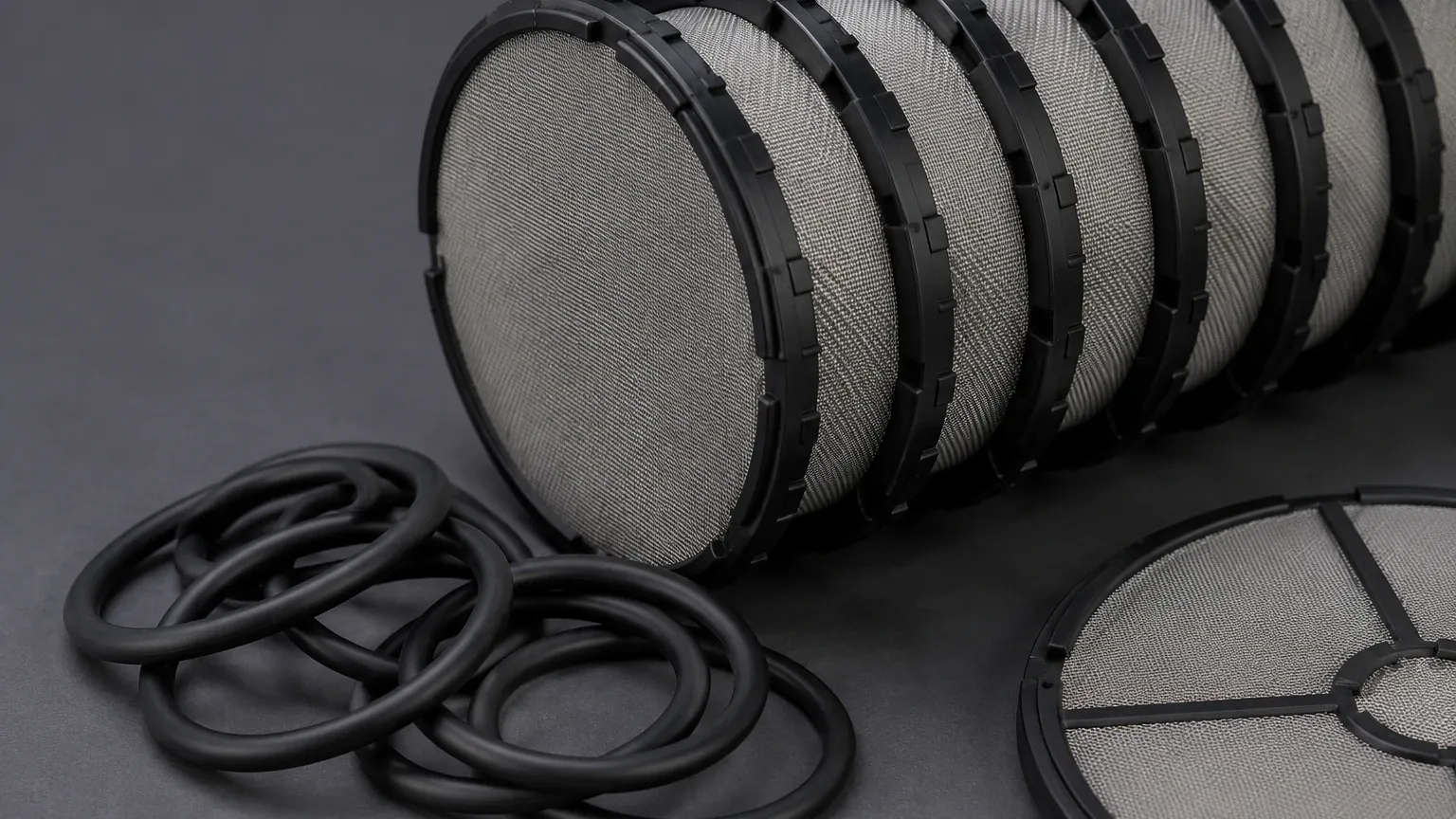
At Kaifil, the manufacturing of Filter Discs & Packs often involves custom configurations where the sealing method is integrated into the filter design. For example, in multi-layer spot-welded packs, the outer rim can be engineered to act as a seating surface for a specific O-ring profile.
For high-pressure polymer filtration, "rimmed" filter discs are common. These feature a metal edge (often aluminum or copper) that is swaged around the mesh layers. The disc filter o ring sits against this rim, providing a metal-to-elastomer-to-metal seal that can withstand the high viscosities and pressures required in plastic extrusion. In these scenarios, the tolerances of the rim thickness are just as important as the O-ring dimensions to ensure a uniform seal across the entire circumference.
Best Practices for Selection and Procurement
When sourcing components for a filtration system, technical professionals should confirm the following details with their manufacturer to ensure the disc filter o ring and filter disc function as a cohesive unit:
1. Operating Pressure and Differential Pressure: Ensure the O-ring durometer can handle the maximum expected pressure drop across the filter disc as it becomes loaded with contaminants.
2. Regulatory Compliance: For food, beverage, or medical applications, verify that the O-ring material is FDA-compliant or meets USP Class VI standards.
3. Dimensional Tolerances: Confirm that the ID (Inner Diameter) and CS (Cross Section) of the O-ring match the groove specifications of the housing and the outer diameter of the filter pack.
4. Replacement Intervals: The O-ring should generally be replaced every time the filter disc is removed for cleaning or replacement. Reusing an O-ring that has already undergone compression set significantly increases the risk of bypass.
Conclusion
The disc filter o ring may be a small component compared to the complex metallurgy of stainless steel filter packs, but its role in industrial performance is absolute. By carefully matching the elastomer material to the chemical and thermal demands of the process, and ensuring the mechanical design allows for proper compression, engineers can maximize the efficiency of their filtration systems.
Whether you are designing a new hydraulic system or optimizing a chemical processing line, the synergy between high-quality Filter Discs & Packs and the correct sealing solution is the key to achieving precise filtration and long-term operational reliability. Kaifil continues to support global industries by providing the technical expertise and custom manufacturing capabilities necessary to solve these critical sealing and filtration challenges.
