


Fritted Filter Discs
In the landscape of industrial separation technology, fritted filter discs represent a pinnacle of precision and structural integrity. These components, often categorized under the broader umbrella of Filter Discs & Packs, are engineered to provide consistent filtration performance in environments where traditional wire mesh or cloth filters might fail due to mechanical stress, high temperatures, or chemical degradation.
For engineers and procurement specialists, understanding the technical nuances of fritted filter discs is essential for optimizing process efficiency and ensuring the longevity of filtration systems. This article explores the manufacturing principles, material characteristics, and selection criteria necessary for implementing these components in demanding industrial applications.
Understanding Fritted Filter Discs in Industrial Filtration
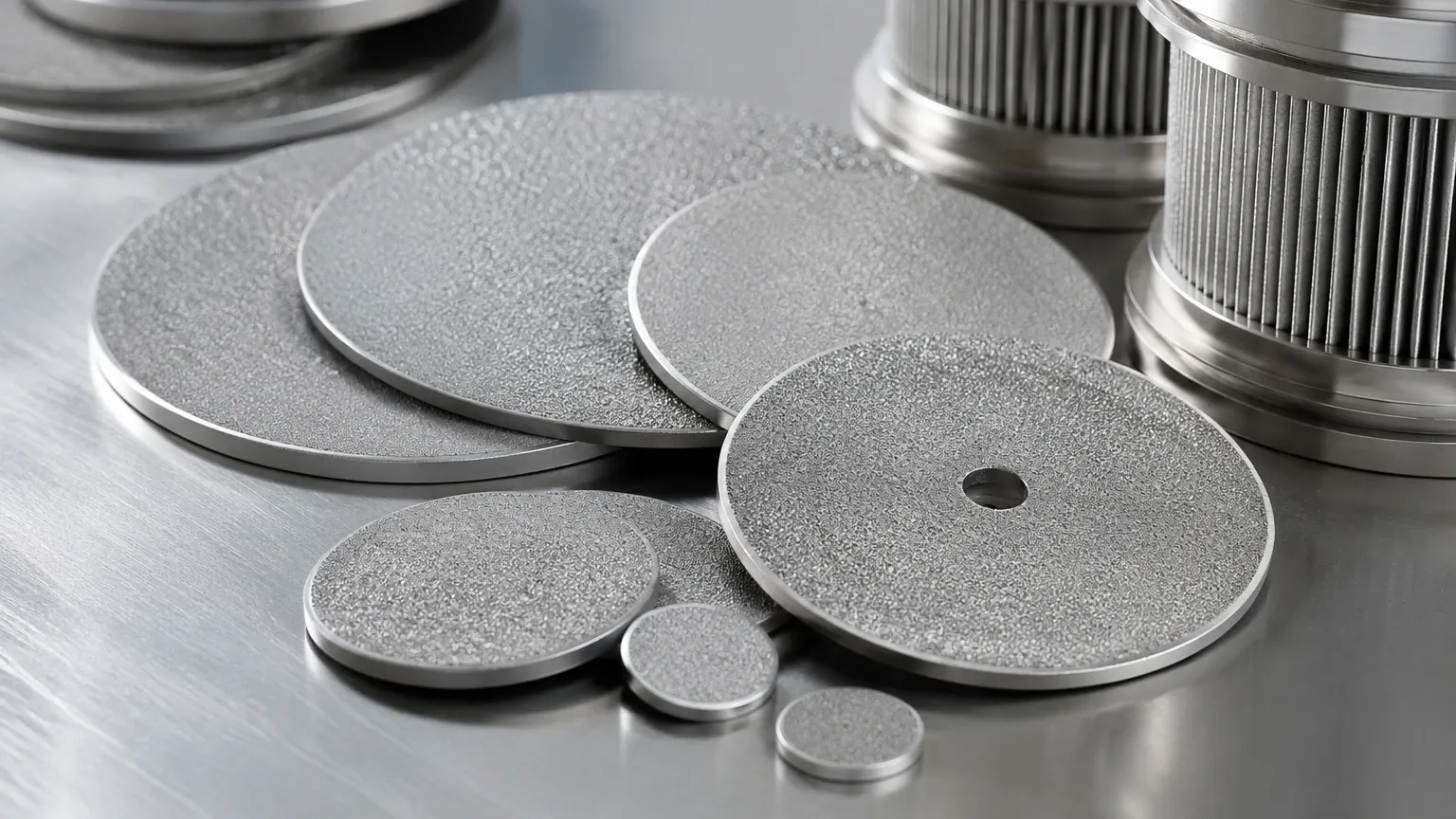
Fritted filter discs, specifically those manufactured from metallic powders or fibers, are porous structures created through a process known as sintering. Unlike woven wire mesh, which relies on the intersection of individual wires to create openings, a fritted disc is a monolithic porous body. The term "fritted" historically referred to fused glass particles, but in modern industrial contexts, it describes sintered metal components that exhibit a tortuous path for fluid flow.
These discs are characterized by their rigid structure and high depth-filtration capabilities. Because the pores are formed by the interstitial spaces between fused metal particles, they offer a high degree of structural stability. This makes them ideal for applications involving high differential pressures or back-pulsing cleaning cycles, where the filter media must maintain its shape and pore size without migration or deformation.
Material Science and Manufacturing: The Sintering Process
The performance of fritted filter discs is fundamentally determined by the sintering process. Sintering involves heating metal powder (typically stainless steel, nickel-based alloys, or titanium) to a temperature just below its melting point while applying controlled pressure. This causes the particles to bond at their contact points through atomic diffusion, creating a solid, porous matrix.
Powder Selection and Pore Control
By carefully selecting the particle size and shape of the metal powder, manufacturers like Kaifil can precisely control the resulting porosity and micron rating of the disc. Finer powders result in smaller pores and higher filtration accuracy, while coarser powders provide higher permeability and lower pressure drops.
Alloy Considerations
1. Stainless Steel 316L: The industry standard for most chemical and industrial applications due to its excellent corrosion resistance and mechanical strength.
2. Inconel and Hastelloy: Utilized in extreme environments involving high-temperature oxidation or highly acidic/alkaline fluids.
3. Titanium: Preferred for its high strength-to-weight ratio and exceptional resistance to seawater and chlorine-based chemicals.
Technical Specifications and Performance Metrics
When evaluating fritted filter discs for a specific system, engineers must look beyond simple dimensions. The following performance metrics are critical to the success of the filtration process:
Micron Rating: Absolute vs. Nominal
Fritted discs are often rated by their ability to capture particles of a specific size. An absolute rating indicates the diameter of the largest spherical particle that can pass through the filter under specific test conditions. A nominal rating refers to a broader efficiency, often capturing a high percentage (e.g., 98%) of particles at that size. Because of the tortuous path within fritted media, they often provide higher efficiency than single-layer mesh filters of the same rating.
Porosity and Permeability
Porosity refers to the percentage of void space within the disc, typically ranging from 30% to 50% for sintered metal. Higher porosity generally leads to higher permeability—the measure of how easily a fluid can pass through the media. However, there is a trade-off: higher porosity can reduce the mechanical strength of the disc. Balancing these two factors is a key engineering challenge in custom filter design.
Pressure Drop (ΔP)
The initial pressure drop across a clean fritted filter disc is a function of the fluid’s viscosity, flow rate, and the disc’s thickness and permeability. Engineers must ensure that the system's pump capacity can handle the expected ΔP as the filter accumulates contaminants (the "dirt-holding capacity").
Application Environments for Fritted Filtration Components
Fritted filter discs are used across a diverse range of industries where reliability is non-negotiable. Their ability to withstand thermal shock and mechanical vibration makes them suitable for the following sectors:
Chemical Processing and Petrochemicals
In these industries, filters are often exposed to aggressive solvents and high-pressure catalysts. Fritted discs are used for catalyst recovery, preventing expensive materials from escaping the process stream, and for the filtration of high-temperature polymers.
Pharmaceutical and Biotechnology
The smooth surface finish and ability to be sterilized (via steam-in-place or autoclaving) make stainless steel fritted discs ideal for pharmaceutical manufacturing. They are used in the production of active pharmaceutical ingredients (APIs) and for gas sparging, where fine bubbles are introduced into a bioreactor.
Food and Beverage Production
Compliance with food safety standards is paramount. Sintered metal discs provide a non-shedding filtration medium that ensures no metallic fibers or particles contaminate the product. They are frequently used in steam filtration and the carbonation of beverages.
Aerospace and Hydraulics
In hydraulic systems, fritted filter discs protect sensitive valves and actuators from particulate contamination. Their high collapse pressure rating ensures that even under extreme surge conditions, the filter remains intact and continues to protect downstream components.
Engineering Selection: Factors for Successful Implementation
Selecting the right fritted filter discs requires a comprehensive analysis of the operating environment. Before finalizing a specification, the following factors should be confirmed:
1. Fluid Compatibility: Ensure the alloy is resistant to the chemical composition of the process fluid at the maximum operating temperature. Corrosion can lead to pore enlargement or structural failure.
2. Flow Velocity: High velocities can lead to premature clogging or erosion of the filter surface. Sizing the disc area appropriately is essential to maintain laminar flow where possible.
3. Contaminant Characteristics: Is the contaminant hard, soft, deformable, or fibrous? The nature of the solids will dictate whether a surface-loading or depth-loading fritted structure is required.
4. Operating Temperature: While stainless steel can handle high temperatures, thermal expansion must be accounted for in the housing design to prevent bypass or mechanical binding.
5. Cleaning Requirements: Determine if the disc will be a consumable item or if it will be cleaned and reused. Fritted discs are often cleaned using ultrasonic baths, chemical solvents, or back-flushing.
Maintenance, Cleaning, and Service Life Optimization
One of the primary advantages of metal fritted filter discs over polymer-based alternatives is their cleanability. However, improper cleaning can damage the internal pore structure or leave residual contaminants that compromise the next batch.
Ultrasonic Cleaning
This is the most effective method for removing fine particles trapped deep within the sintered matrix. High-frequency sound waves create cavitation bubbles that dislodge contaminants from the tortuous paths.
Chemical Cleaning
For organic build-up or scale, chemical soaking in acids, caustics, or specialized solvents can dissolve the blockage. It is vital to ensure the cleaning agent does not attack the base metal of the disc.
Monitoring Service Life
Service life is typically monitored via pressure differential. A consistent rise in ΔP indicates normal loading. However, a sudden drop in pressure may indicate a breach in the disc or a failure of the seals, while a rapid spike may indicate a process upset or a change in the incoming fluid quality.
Customization and OEM Solutions
Every industrial process has unique requirements that standard off-the-shelf components may not meet. Customization is often necessary regarding thickness, diameter, and specialized mounting hardware. Manufacturers like Kaifil specialize in providing tailored solutions, from material selection to the integration of the disc into complex Filter Discs & Packs assemblies.
When working with an OEM partner, engineers should provide detailed CAD drawings or specific performance parameters to ensure the final product integrates seamlessly into existing hardware. Custom edge treatments, such as welding or framing, can also be applied to improve the ease of installation and prevent bypass at the edges of the disc.
Conclusion
Fritted filter discs are essential components for high-performance industrial filtration. Their sintered construction offers a unique combination of precision, durability, and chemical resistance that is difficult to match with other media. By focusing on the technical fundamentals—material science, pore control, and application-specific engineering—technical teams can select filtration solutions that not only protect their equipment but also optimize the overall efficiency of their industrial processes.
