


How Does a Disc Filter Work
In industrial filtration, precision and durability are paramount. Among the various configurations available to engineers, the disc filter remains a cornerstone for applications requiring high-pressure resistance, chemical stability, and fine micron ratings. Understanding the mechanics of these components is essential for optimizing process efficiency and ensuring the longevity of downstream equipment. This guide provides a technical overview of how a disc filter works, the engineering behind its construction, and the factors that influence its performance in demanding B2B environments.
The Fundamental Principles of Disc Filtration
To answer the question, how does a disc filter work, one must first look at the physical interaction between the fluid medium and the filter media. At its core, a disc filter is a surface or depth filtration component designed to remove solid particles from liquids or gases.
When a contaminated fluid stream is directed toward the filter disc, the mesh acts as a mechanical barrier. Particles larger than the pore size of the mesh are intercepted on the upstream surface, while the cleaned fluid passes through to the downstream side. In industrial settings, these discs are often integrated into housings, extruders, or valve assemblies where they must withstand significant differential pressure.
Unlike disposable polymer filters, stainless steel disc filters utilize a rigid structure. The filtration process typically follows these stages:
1. Interception: Larger particles are caught directly by the wire mesh strands.
2. Inertial Impaction: Heavier particles, unable to follow the fluid streamlines around the wires, strike the mesh and become trapped.
3. Cake Formation: As particles accumulate on the surface, they form a "filter cake," which can actually increase filtration efficiency by creating a secondary layer of finer pores, though this also increases the pressure drop across the disc.
Component Architecture: Filter Discs & Packs
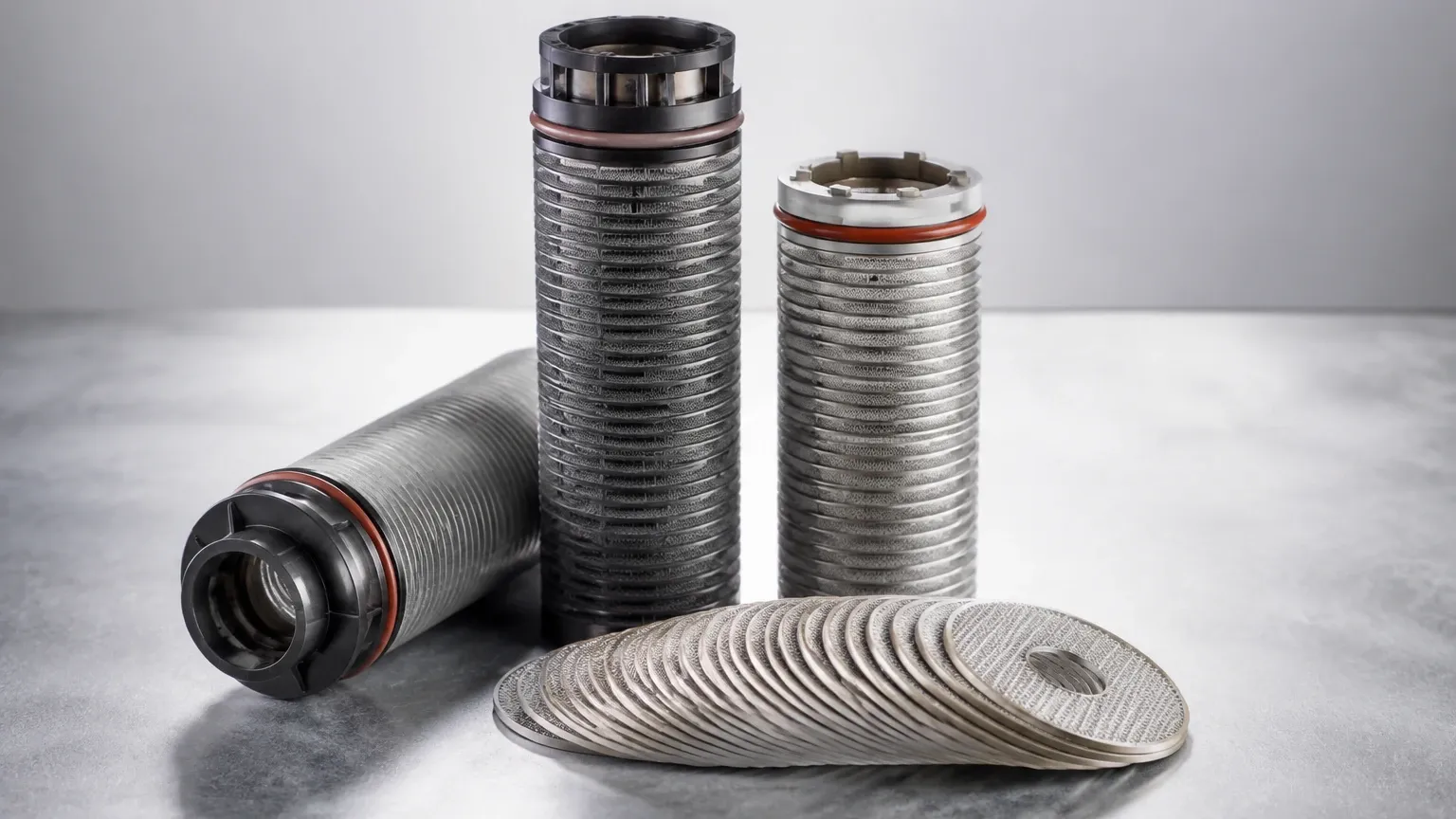
The effectiveness of a disc filter is largely determined by its construction. While a single layer of wire mesh may suffice for simple straining, most industrial applications require more complex Filter Discs & Packs to achieve the desired balance of strength and precision.
Single-Layer vs. Multi-Layer Discs
Single-layer discs are typically used for coarse filtration or as support structures. However, in high-pressure environments like polymer extrusion or hydraulic systems, multi-layer packs are preferred. These packs consist of several layers of wire mesh stacked together.
Spot-Welded and Rimmed Designs
To ensure structural integrity, multi-layer packs are often joined using specific techniques:
* Spot Welding: The layers are welded at strategic points to prevent shifting under high flow velocities.
* Aluminum or Stainless Steel Rimming: A metal binding or "rim" is applied to the circumference of the disc. This provides a clean edge, prevents fraying of the wire mesh, and creates a reliable sealing surface within the filter housing.
By combining different mesh counts—such as placing a fine filtration layer between two coarser support layers—engineers can create a robust component that offers fine micron retention without sacrificing mechanical stability.
Material Engineering and Mesh Types
The material selection is a critical factor in how a disc filter performs under thermal and chemical stress. Kaifil specializes in stainless steel solutions, primarily utilizing Grade 304 and Grade 316L.
Stainless Steel Grade Selection
* Grade 304: Suitable for general industrial use, providing excellent strength and basic corrosion resistance.
* Grade 316L: The "L" denotes low carbon content, which improves weldability and resistance to intergranular corrosion. This grade is essential for pharmaceutical, food and beverage, and chemical processing where exposure to chlorides or acidic environments is common.
Weave Patterns and Their Impact
The way the wires are woven determines the flow characteristics and the "how does a disc filter work" dynamic in terms of particle retention:
* Plain Weave: The simplest pattern, offering high open areas and low pressure drops. Ideal for high-flow, low-viscosity liquids.
* Dutch Weave: This pattern uses heavier warp wires and finer weft wires driven closely together. It creates a dense, strong mesh with very fine pore sizes, making it the standard for high-pressure filtration and fine micron requirements.
* Twill Weave: Allows for thicker wires in a given mesh count, increasing the overall mechanical strength of the disc.
Key Performance Indicators in Industrial Filtration
When evaluating disc filters for a specific process, engineers must focus on several technical metrics that define performance.
Micron Rating: Absolute vs. Nominal
The micron rating defines the size of particles the filter can remove.
* Nominal Rating: An approximate value indicating that the filter will retain a majority of particles at that size (e.g., 90%).
* Absolute Rating: A more stringent measurement, indicating the largest spherical particle that can pass through the mesh under laboratory conditions. For critical applications in the pharmaceutical or aerospace sectors, absolute ratings are often mandatory.
Pressure Drop ($ΔP$)
As fluid passes through the mesh, energy is lost due to friction and the physical barrier. This is measured as the pressure drop. A well-designed disc filter minimizes the initial $ΔP$ to reduce energy consumption. As the filter becomes loaded with contaminants, the pressure drop increases. Monitoring this change is the primary method for determining when a filter pack requires cleaning or replacement.
Dirt Holding Capacity
This refers to the total mass of contaminants a filter can retain before reaching its terminal pressure drop. Multi-layer packs generally offer higher dirt-holding capacities than single-layer discs because the internal layers can trap smaller particles that bypass the surface layer.
Industrial Applications and Operating Environments
Because of their versatility, stainless steel filter discs are found in a wide array of industrial sectors. Their ability to operate at temperatures exceeding 500°C and withstand thousands of PSI makes them indispensable.
Polymer and Plastic Extrusion
In the plastics industry, "screen changers" use multi-layer filter packs to remove un-melted resins or foreign contaminants from the polymer melt. The discs must withstand extreme viscosity and pressure while ensuring the final product is free of imperfections.
Chemical and Petrochemical Processing
Disc filters are used to protect sensitive catalysts and valves from particulate damage. Their resistance to corrosive chemicals ensures that the filtration media does not degrade and introduce metallic contaminants into the process stream.
Food and Beverage Production
In these applications, hygiene is as important as filtration accuracy. Stainless steel discs are favored because they are easy to sterilize and do not shed fibers or particles into the food product, unlike fabric or paper filters.
Customization and Selection Considerations
Selecting the right filter disc is not a one-size-fits-all process. Engineers must confirm several variables before finalizing a specification:
1. Flow Velocity: Higher velocities may require reinforced support layers to prevent the mesh from deforming (cupping or tearing).
2. Chemical Compatibility: Beyond the fluid itself, consider cleaning agents (such as caustic washes) that the disc will encounter during maintenance cycles.
3. Housing Constraints: The thickness of the disc or pack must be precisely controlled to ensure a proper seal within the existing hardware. This is where rimmed discs often provide a technical advantage.
4. Operating Temperature: While stainless steel handles heat well, extreme thermal cycling can lead to material fatigue. Selecting the correct alloy and welding technique is vital for long-term reliability.
Kaifil works closely with technical teams to develop customized designs that address these specific variables, ensuring that the filtration solution is matched to the unique demands of the application.
Maintenance, Cleaning, and Longevity
One of the primary advantages of stainless steel disc filters is that they are often cleanable and reusable. This significantly reduces the total cost of ownership compared to disposable alternatives.
Cleaning Methods
* Ultrasonic Cleaning: High-frequency sound waves create cavitation bubbles that dislodge fine particles from deep within the mesh pores.
* Backwashing: Reversing the flow of fluid can sometimes clear surface-level contaminants, though this is less effective for Dutch weave meshes.
* Chemical Cleaning: Soaking the discs in solvents or acids can dissolve organic or mineral buildup.
* Burn-off (Pyrolysis): For polymer extrusion, discs are often heated in specialized ovens to carbonize and remove plastic residues.
Replacement Cycles
Despite their durability, disc filters are subject to mechanical wear and eventual blinding (permanent clogging). Engineers should establish replacement protocols based on the number of cleaning cycles or when the post-cleaning pressure drop remains higher than the baseline for a new disc.
Conclusion
Understanding how a disc filter works is the first step in optimizing any industrial filtration system. By selecting the appropriate material, weave pattern, and pack configuration, facilities can achieve high levels of purity while maintaining operational efficiency. Whether used in chemical processing, hydraulic systems, or food production, the stainless steel disc filter remains a reliable and cost-effective solution for precision particle separation. For engineers and purchasing teams, focusing on the technical specifications—such as absolute micron ratings and structural integrity—ensures that the chosen filtration component will perform as expected in the most demanding environments.
