


Beer Brewing Filters
In the industrial production of beer, filtration is a critical unit operation that directly influences the final product's clarity, biological stability, and shelf life. While the brewing process relies on biological and chemical transformations, the physical separation of solids from liquids ensures that the resulting beverage meets the rigorous standards required for commercial distribution. Selecting the appropriate beer brewing filters involves understanding the complex interplay between flow rates, particle size distribution, and the mechanical properties of the filter media.
For engineers and production managers, the choice of filtration technology is not merely a matter of clarity; it is an economic decision that impacts yield, energy consumption, and maintenance cycles. High-performance stainless steel filtration components provide the durability and precision necessary to handle the high temperatures and caustic cleaning environments common in modern breweries.
The Role of Filtration in the Brewing Lifecycle
Filtration occurs at several distinct stages of the brewing process, each requiring different technical specifications for the filter media. Understanding these stages is essential for selecting the correct Main Page resources and equipment for a facility.
Wort Clarification (Hot Side)
After mashing, the liquid wort must be separated from the spent grains. This is typically achieved in a lauter tun using a false bottom, often constructed from precision wedge wire or perforated stainless steel plates. These components act as the primary beer brewing filters, supporting the grain bed which itself serves as a deep-bed filter. On the hot side, filters must withstand temperatures near boiling and maintain structural integrity under the weight of several tons of wet grain.
Cold Stage Filtration
Following fermentation and maturation, the beer contains suspended yeast, proteins, and polyphenols. If left unmanaged, these particles can cause "chill haze" or sediment in the bottle. Cold stage filtration typically utilizes stainless steel mesh or pleated cartridges to remove these particulates. This stage is often divided into primary (coarse) filtration and secondary (polishing) filtration to optimize the lifespan of the more expensive fine-filter elements.
Sterile Filtration and Stabilization
Before packaging, many breweries employ sterile filtration to remove spoilage organisms like lactobacillus or wild yeast. This process often replaces pasteurization, as it preserves the delicate flavor profile of the beer while ensuring a shelf-stable product. These filters require absolute micron ratings and must be capable of withstanding integrity testing to guarantee performance.
Engineering Considerations for Stainless Steel Filter Selection
When specifying beer brewing filters, engineering teams must evaluate several technical parameters to ensure the chosen solution is compatible with their specific process flow.
Material Compatibility and Hygiene
In the food and beverage industry, 304 and 316L stainless steel are the industry standards. 316L, in particular, offers superior resistance to chloride-induced pitting, which is vital when using chlorinated sanitizers or processing beers with specific mineral profiles. Stainless steel is non-reactive, ensuring that the filter media does not impart off-flavors or leach metallic ions into the beer.
Micron Ratings: Nominal vs. Absolute
Engineers must distinguish between nominal and absolute micron ratings. A nominal rating indicates the filter's ability to retain the majority of particles of a specific size, whereas an absolute rating guarantees the retention of nearly 100% of particles at that size. For yeast removal, an absolute rating is typically required to ensure biological stability, while nominal ratings are often sufficient for early-stage trub removal.
Pressure Drop and Flow Rates
The differential pressure ($ΔP$) across a filter is a key indicator of its performance and remaining service life. As beer brewing filters capture particulates, the $ΔP$ increases. Engineering a system with sufficient surface area is critical to maintaining a low initial pressure drop, which reduces the mechanical stress on the pump and extends the interval between cleaning cycles.
Types of Beer Brewing Filters and Their Applications
Different filter geometries and constructions offer unique advantages depending on the solids load and the desired throughput of the brewing line.
Stainless Steel Wire Mesh Filters
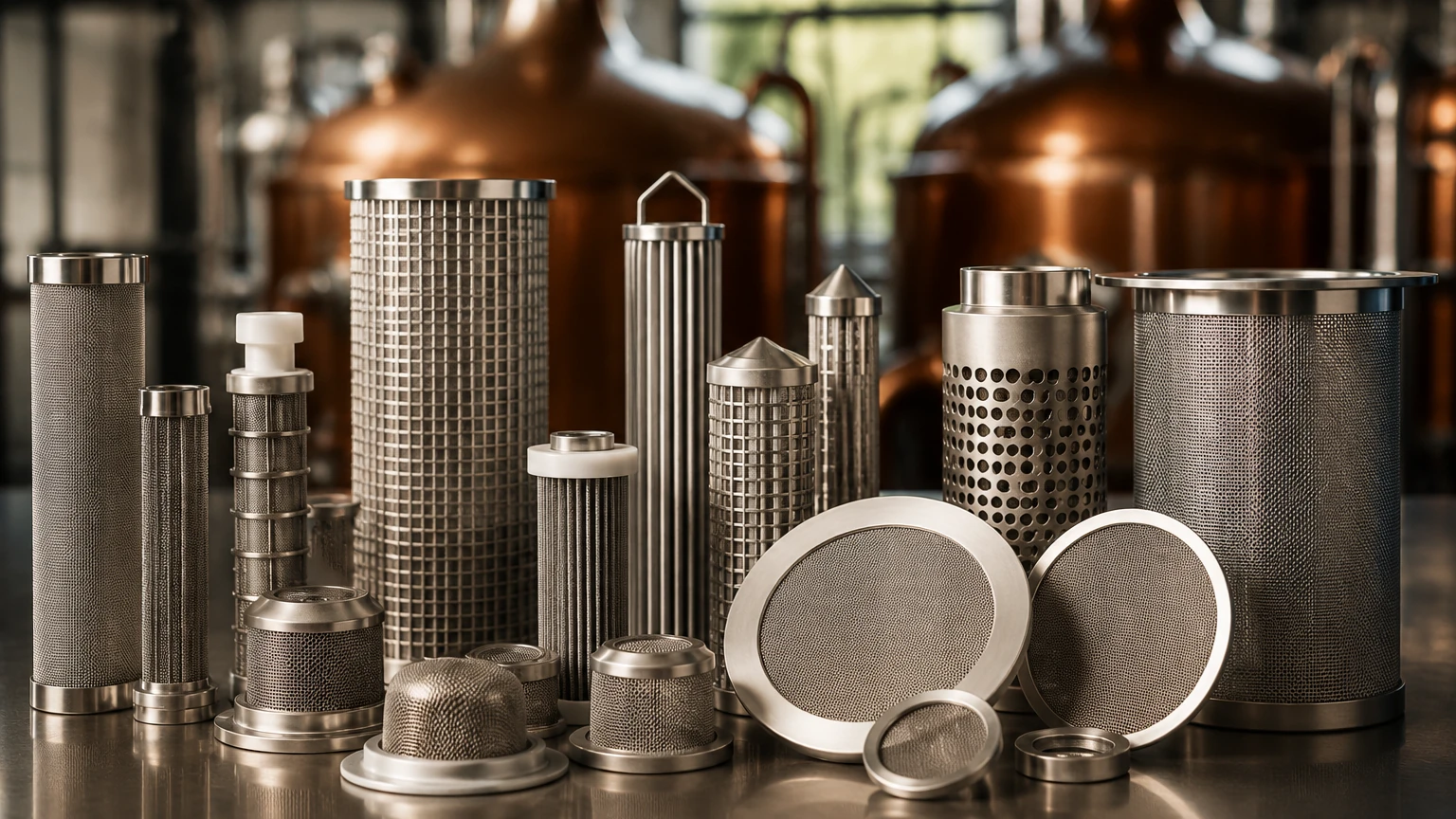
Wire mesh filters are highly versatile and can be manufactured in various weave patterns, such as plain, twilled, or Dutch weaves. These filters are commonly used in whirlpool applications to capture hop material and trub. Their robust nature allows them to be cleaned and reused thousands of times, providing a lower total cost of ownership compared to disposable depth filters.
Sintered Metal Filters
For applications requiring extreme durability and high-pressure resistance, sintered metal filters are often employed. These are created by fusing layers of wire mesh or metal powder under heat and pressure. The resulting structure is incredibly rigid and offers precise pore size control, making it ideal for steam filtration (to ensure sterile steam for CIP) or for carbonation stones where fine gas dispersion is required.
Pleated Filter Cartridges
To maximize surface area within a compact footprint, pleated stainless steel cartridges are used in polishing stages. The pleating process increases the available filtration area by several times compared to a standard cylindrical filter. This design is particularly effective for removing fine proteins and residual yeast in high-gravity brewing operations where throughput is a priority.
Maintenance and Clean-in-Place (CIP) Protocols
One of the primary advantages of using stainless steel beer brewing filters is their compatibility with Clean-in-Place (CIP) systems. Unlike polymer-based filters, stainless steel can withstand the aggressive chemical and thermal cycles required to ensure a sterile brewing environment.
Chemical Resistance
Brewery CIP cycles typically involve caustic soda (sodium hydroxide) to dissolve organic proteins and acid washes (nitric or phosphoric acid) to remove inorganic scale (beerstone). Stainless steel filters maintain their structural integrity and surface finish even after repeated exposure to these chemicals at temperatures exceeding 80°C.
Backwashing and Regeneration
Many industrial beer brewing filters are designed for backwashing, where the flow is reversed to dislodge accumulated solids from the surface of the filter media. This mechanical regeneration extends the time between manual teardowns and reduces the labor costs associated with filter maintenance. For engineers, designing a system with automated backwash triggers based on $ΔP$ sensors is a standard method for optimizing production efficiency.
Common Risks in Brewery Filtration
Improper filter selection or maintenance can lead to several operational risks that impact both product quality and the bottom line.
1. Oxygen Pickup: If filter housings are not properly purged or if seals are compromised, oxygen can enter the beer during filtration. This leads to rapid oxidation, resulting in "cardboard" off-flavors and reduced shelf life.
2. Flavor Stripping: Using a filter with an excessively tight micron rating can occasionally remove desirable colloidal components that contribute to the beer's mouthfeel and head retention. Finding the balance between clarity and character is a key engineering challenge.
3. Media Migration: In low-quality or non-metallic filters, there is a risk of the filter media itself shedding fibers or particles into the beer. Stainless steel wire mesh and sintered components eliminate this risk due to their fixed-pore structure and metallic bonding.
4. Pressure Spikes: Rapidly opening valves can cause hydraulic shocks (water hammer) that may deform or burst delicate filter elements. Incorporating soft-start pumps and pressure relief valves is essential for protecting the filtration infrastructure.
Customization and OEM Solutions
Every brewery has a unique layout and specific production goals. Off-the-shelf filtration solutions often require compromises in piping or flow rates. Custom-engineered beer brewing filters allow for the integration of filtration components directly into existing equipment, such as custom-sized hop spiders, specialized lauter tun screens, or bespoke cartridge housings.
When working with a manufacturer like Kaifil, engineers can specify exact dimensions, flange types, and mesh configurations to match their system's requirements. This level of customization ensures that the filtration system does not become a bottleneck in the production process and that it can be easily integrated into the facility's existing automation and CIP loops.
Total Cost of Ownership (TCO) Analysis
While the initial capital expenditure for stainless steel beer brewing filters may be higher than for disposable alternatives, the long-term economic benefits are significant. A TCO analysis should include:
* Replacement Costs: Stainless steel filters can last for years, whereas depth filters or bags must be replaced frequently.
* Waste Disposal: Reducing the volume of spent filter media lowers disposal costs and aligns with brewery sustainability initiatives.
* Product Loss: Precision-engineered filter housings minimize the "dead volume" of beer left in the system at the end of a run, maximizing yield.
* Labor: Automated, backwashable systems significantly reduce the man-hours required for filter changes and manual cleaning.
Conclusion
Filtration is a cornerstone of professional brewing, serving as the final gatekeeper of quality before the product reaches the consumer. By selecting high-quality beer brewing filters constructed from durable stainless steel, breweries can achieve the precise balance of clarity, flavor preservation, and biological stability. Whether it is a coarse mesh for trub separation or a fine pleated cartridge for final polishing, the engineering specifications of these components are vital to the success of the brewing operation. For those seeking to optimize their filtration processes, consulting technical resources on the Main Page can provide the necessary data to make informed procurement and design decisions.
