


Liquid Gas Coalescer
In industrial process engineering, the separation of entrained liquid droplets from a gas stream is a critical requirement for maintaining equipment integrity and process efficiency. A liquid gas coalescer is a specialized filtration device designed to merge small liquid droplets into larger ones, allowing them to be removed from the gas flow through gravitational settling. This technology is fundamental in protecting downstream equipment such as compressors, turbines, and burners, as well as ensuring the purity of the final product in chemical, petrochemical, and pharmaceutical applications.
For engineers and procurement professionals, understanding the technical nuances of coalescer design—ranging from material selection to fluid dynamics—is essential for optimizing system performance. As a manufacturer specializing in high-precision stainless steel filtration, Kaifil provides the engineering expertise required to develop robust solutions for these demanding environments. More information on the broader range of industrial filtration components can be found on the Main Page.
The Fundamental Principles of Coalescence
The operation of a liquid gas coalescer relies on three primary physical mechanisms: direct impingement, inertial interception, and Brownian diffusion. These mechanisms work in concert to capture sub-micron and micron-sized droplets that would otherwise remain suspended in the gas stream.
Direct Impingement and Interception
Direct impingement occurs when larger droplets, typically those greater than 10 microns, follow the gas streamlines but collide with the filter media fibers due to their size. Inertial interception applies to mid-sized droplets (1 to 10 microns) that have sufficient mass to deviate from the gas streamlines when the flow changes direction around a fiber, causing them to strike the media.
Brownian Diffusion
For extremely fine aerosols (less than 0.1 microns), Brownian diffusion is the dominant capture mechanism. These tiny droplets move erratically due to collisions with gas molecules. This random motion increases the probability that the droplets will come into contact with the coalescing fibers. Once the droplets contact the media, they adhere to the fibers through van der Waals forces.
The Coalescing Cycle
Once captured, the droplets move along the fibers and accumulate at the intersections of the media. As more liquid is collected, the droplets merge (coalesce) into larger drops. When these drops reach a sufficient mass where the gravitational force exceeds the drag force of the gas flow, they drain to the bottom of the coalescer housing for collection and removal. This continuous process ensures that the gas exiting the element is significantly drier than the inlet gas.
Engineering Considerations for Coalescer Media
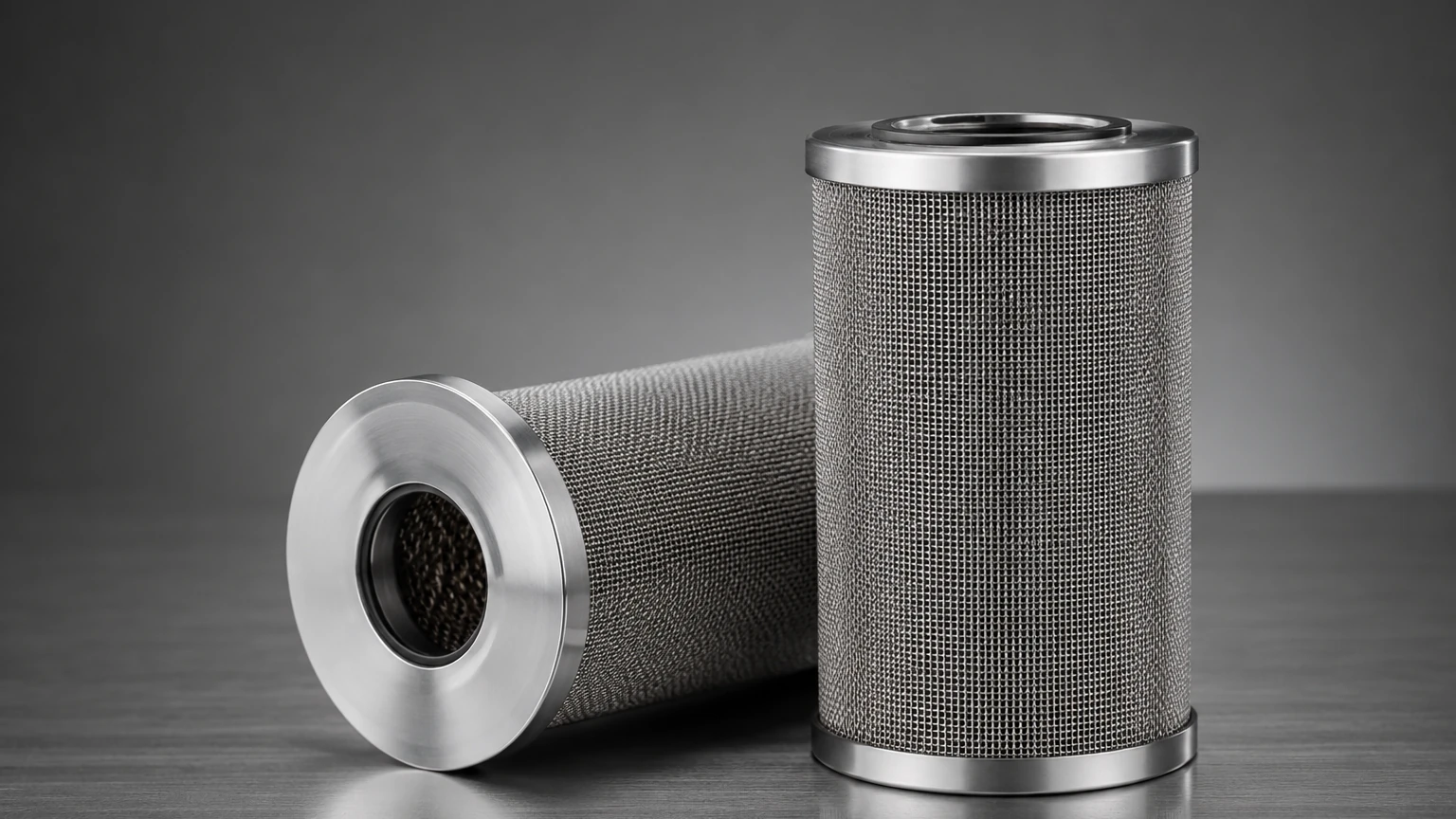
The choice of media is the most critical factor in the performance of a liquid gas coalescer. In industrial settings, stainless steel wire mesh and sintered metal fibers are often preferred due to their mechanical strength and chemical resistance.
Stainless Steel Wire Mesh
Stainless steel wire mesh provides a structured environment for coalescence. By layering different mesh counts and wire diameters, engineers can create a gradient density that maximizes capture efficiency while minimizing pressure drop. Stainless steel is particularly valued in high-temperature or corrosive environments where polymer-based media would fail.
Sintered Metal Fibers
For applications requiring high efficiency in capturing sub-micron aerosols, sintered metal fibers offer a high porosity and a large surface area. The sintering process bonds the fibers together, creating a rigid structure that prevents media migration—a common failure mode in lower-quality filters where fibers can break off and contaminate the downstream flow.
Surface Tension and Wettability
The surface properties of the media also play a role. In some cases, the media may be treated to be oleophobic or hydrophobic to facilitate the rapid drainage of the coalesced liquid. However, in many high-pressure industrial gas applications, the mechanical design of the stainless steel matrix is sufficient to manage the liquid loading without specialized coatings.
Key Performance Indicators (KPIs) in Liquid-Gas Separation
When evaluating a liquid gas coalescer for a specific application, engineers must focus on several key performance metrics to ensure the system meets the process requirements.
Removal Efficiency
Efficiency is typically expressed as the percentage of liquid removed at a specific droplet size. High-performance coalescers can achieve 99.9% efficiency for droplets as small as 0.3 microns. It is important to distinguish between "bulk" separation (removing large slugs of liquid) and "fine" coalescence (removing aerosols).
Differential Pressure (Clean and Saturated)
Pressure drop across the coalescer element directly impacts the energy consumption of the system. In a liquid gas coalescer, there are two stages of pressure drop: the "clean" pressure drop (when the media is dry) and the "saturated" pressure drop (once the media has reached equilibrium with the liquid loading). A well-designed system will maintain a stable saturated pressure drop over a long service life.
Liquid Loading Capacity
This refers to the volume of liquid the coalescer can handle per unit of gas flow without experiencing "carryover." Carryover occurs when the gas velocity is so high that it re-entrains the coalesced droplets from the downstream side of the media, defeating the purpose of the filter.
Industrial Applications of Coalescing Technology
Liquid gas coalescers are utilized across a broad spectrum of industries where gas purity is paramount. Each application presents unique challenges regarding temperature, pressure, and chemical compatibility.
Natural Gas Processing
In the midstream sector, coalescers are used to remove water and hydrocarbon condensates from natural gas. This protects compressors from liquid slugging and prevents the formation of hydrates, which can block pipelines. Coalescers are also vital before amine treating units to prevent foaming caused by liquid contaminants.
Compressed Air Systems
Industrial compressed air often contains oil aerosols from the compressor lubrication system. A liquid gas coalescer is essential for removing these aerosols to protect pneumatic tools, sensitive instruments, and downstream processes in food and beverage or pharmaceutical manufacturing.
Chemical and Petrochemical Refining
In refineries, coalescers are used to recover valuable catalysts or to remove moisture from feedstock gases. Because these processes often involve aggressive chemicals, the use of 316L stainless steel or other high-alloy materials in the coalescer construction is standard practice to ensure longevity.
Power Generation
Gas turbines require extremely clean fuel gas to prevent corrosion and erosion of the turbine blades. Coalescers remove moisture and heavy hydrocarbons from the fuel gas, ensuring efficient combustion and extending the maintenance intervals of the turbine.
Selection Guide: Confirming Technical Requirements
Before purchasing or specifying a liquid gas coalescer, engineers should confirm several technical parameters to ensure the selected component is fit for purpose. Relying on generic specifications can lead to premature failure or insufficient separation.
1. Gas Composition and Density: The molecular weight and density of the gas at operating pressure and temperature significantly affect the settling velocity of the droplets.
2. Liquid Characteristics: Knowledge of the liquid's surface tension, viscosity, and density is required to calculate the drainage rate and the expected saturated pressure drop.
3. Flow Rate Variations: Coalescers are sensitive to flow velocity. A system designed for a constant flow may fail if there are significant surges, as high velocities can lead to re-entrainment.
4. Operating Pressure and Temperature: These factors dictate the mechanical design of the housing and the material selection for the internal elements. High-pressure applications require robust stainless steel supports to prevent element collapse.
5. Contaminant Nature: Is the liquid purely aqueous, organic, or a mixture? Are there solid particles present? If solids are present, a pre-filter may be necessary to prevent the coalescer media from plugging.
Maintenance and Total Cost of Ownership
While the initial purchase price is a factor, the total cost of ownership (TCO) of a liquid gas coalescer is largely determined by its service life and the protection it affords to downstream equipment.
Monitoring Differential Pressure
Continuous monitoring of the differential pressure (DP) is the most effective way to determine the health of a coalescer. A sudden rise in DP usually indicates solid particulate fouling, while a sudden drop could indicate media rupture or bypassing.
Replacement Cycles
Unlike simple particulate filters, coalescers can often operate for extended periods if the gas stream is relatively clean of solids. However, in applications with high liquid loading or heavy hydrocarbons, the media may eventually become "blinded" or fouled. Using high-quality stainless steel elements from a manufacturer like Kaifil ensures that the components can withstand the rigors of industrial cleaning processes if the application allows for it, though many high-efficiency coalescing elements are designed for periodic replacement to maintain peak performance.
Avoiding Common Risks
The primary risk in coalescer operation is bypass. If the seals between the coalescer element and the housing are not perfectly airtight, the gas will take the path of least resistance, carrying liquid contaminants directly into the downstream system. Precision-machined end caps and high-quality elastomeric or metallic seals are essential to prevent this failure mode.
The Role of Customization in Filtration Success
Off-the-shelf solutions often fail to meet the specific needs of complex industrial processes. Customization in the design of the liquid gas coalescer—specifically the internal wire mesh structure and the housing configuration—allows for optimized performance tailored to specific flow conditions.
Kaifil’s approach involves working closely with engineering teams to understand the unique constraints of their application. By leveraging advanced manufacturing techniques for stainless steel filtration components, it is possible to develop coalescers that offer a superior balance of efficiency, durability, and low pressure drop. Whether it is a specialized micron rating or a unique form factor for an existing housing, custom-engineered solutions are often the most cost-effective choice over the long term.
In conclusion, the liquid gas coalescer is an indispensable tool in the industrial arsenal for maintaining gas purity. By focusing on the scientific principles of coalescence, selecting the appropriate stainless steel materials, and carefully defining the operating parameters, engineers can ensure reliable and efficient separation performance in even the most demanding environments.
