


Titanium Heat Exchcanger
In the landscape of industrial thermal management, the selection of materials is as critical as the mechanical design itself. For applications involving highly corrosive fluids, high-pressure environments, or extreme temperature gradients, the titanium heat exchcanger has emerged as a standard-setting solution. While stainless steel and copper-nickel alloys serve many industrial needs, titanium offers a unique set of chemical and physical properties that ensure longevity and efficiency where other metals fail.
For engineers and procurement specialists, understanding the technical nuances of titanium equipment—and the filtration systems required to protect them—is essential for optimizing the total cost of ownership (TCO) and maintaining process integrity. This guide explores the engineering considerations, material advantages, and the vital role of pre-filtration in maintaining high-performance heat transfer systems.
The Material Science of Titanium in Thermal Systems
The primary driver for selecting a titanium heat exchcanger is the metal’s exceptional resistance to corrosion. Titanium is inherently reactive; however, when exposed to oxygen, it instantly forms a tenacious, microscopic, and self-healing oxide film (TiO2). This passive layer is remarkably stable across a wide range of pH levels and temperatures, providing immunity to many aggressive media.
Corrosion Resistance Profiles
In industrial settings, titanium is particularly valued for its resistance to chlorides. While 300-series stainless steels are susceptible to pitting and stress corrosion cracking (SCC) in saline environments, titanium remains virtually unaffected. This makes it the material of choice for marine cooling systems, desalination plants, and chemical processing involving brine or chlorinated solvents.
Furthermore, titanium exhibits excellent resistance to oxidizing acids, such as nitric acid and chromic acid, as well as organic acids. In the chemical processing industry, where heat transfer often involves volatile or hazardous reagents, the reliability of the heat exchanger shell and tubes is a safety requirement as much as a functional one.
Strength-to-Weight Ratio and Thermal Efficiency
Titanium possesses a high strength-to-weight ratio, allowing for the design of thinner tube walls without compromising the pressure rating of the vessel. Thinner walls translate to lower thermal resistance, which can partially offset titanium’s lower thermal conductivity compared to copper alloys. When combined with high-velocity flow designs that promote turbulence, titanium systems can achieve highly efficient heat transfer rates in a compact footprint.
Engineering Classifications and Grades
Not all titanium is identical. The selection of the specific grade depends on the chemical composition of the process fluids and the mechanical stresses involved.
1. Grade 1 and 2 (CP Titanium): Commercially pure (CP) titanium is the most common choice for heat exchangers. Grade 2 offers an excellent balance of strength and ductility, making it easy to form into tubes and plate components. It is the workhorse of the power generation and desalination industries.
2. Grade 7: This grade contains a small addition of palladium (0.12% to 0.25%), which significantly enhances corrosion resistance in reducing environments and acidic conditions where the standard oxide film might be compromised.
3. Grade 12: Alloyed with molybdenum and nickel, Grade 12 provides better strength than CP grades and superior resistance to crevice corrosion at high temperatures, often used in specialized chemical reactors.
When designing a titanium heat exchcanger, engineers must also consider the galvanic compatibility of the system. If titanium is coupled with less noble metals like carbon steel or copper in an electrolytic fluid, the other metal will corrode rapidly. Proper insulation or the use of compatible alloys throughout the fluid circuit is mandatory.
The Critical Role of Upstream Filtration
While the titanium surfaces themselves are highly durable, the efficiency of a heat transfer system is highly dependent on the cleanliness of the fluid. Particulate matter, scale, and biological debris can significantly degrade performance through a process known as fouling. To protect a titanium heat exchcanger, high-performance filtration is not an option; it is a necessity.
Preventing Fouling and Scaling
Fouling occurs when solids settle on the heat transfer surfaces, creating an insulating layer that reduces the heat transfer coefficient. This forces the system to work harder, increasing energy consumption and potentially leading to localized overheating. Kaifil specializes in custom stainless steel filtration solutions that are designed to remove these contaminants before they reach the heat exchanger.
For example, in open-loop cooling systems using river or seawater, large debris can block tube inlets, while finer silts can erode the protective oxide layer of the titanium over time through impingement. Utilizing precision wire mesh filters or stainless steel filter cartridges ensures that only clean fluid enters the heat exchanger, preserving the integrity of the titanium tubes.
Mitigating Erosion and Cavitation
High-velocity fluids carrying abrasive particles can lead to erosion-corrosion. Although titanium is more resistant to this than most metals, the constant bombardment of sand or metal shavings can eventually wear down the material. By integrating custom-engineered filtration components, such as those provided by Kaifil, operators can maintain the fluid velocity required for efficiency without the risk of mechanical wear on the internal components of the titanium heat exchcanger.
Design Configurations: Shell-and-Tube vs. Plate
Choosing the right configuration for a titanium heat exchcanger depends on the application's pressure, temperature, and maintenance requirements.
Shell-and-Tube Heat Exchangers
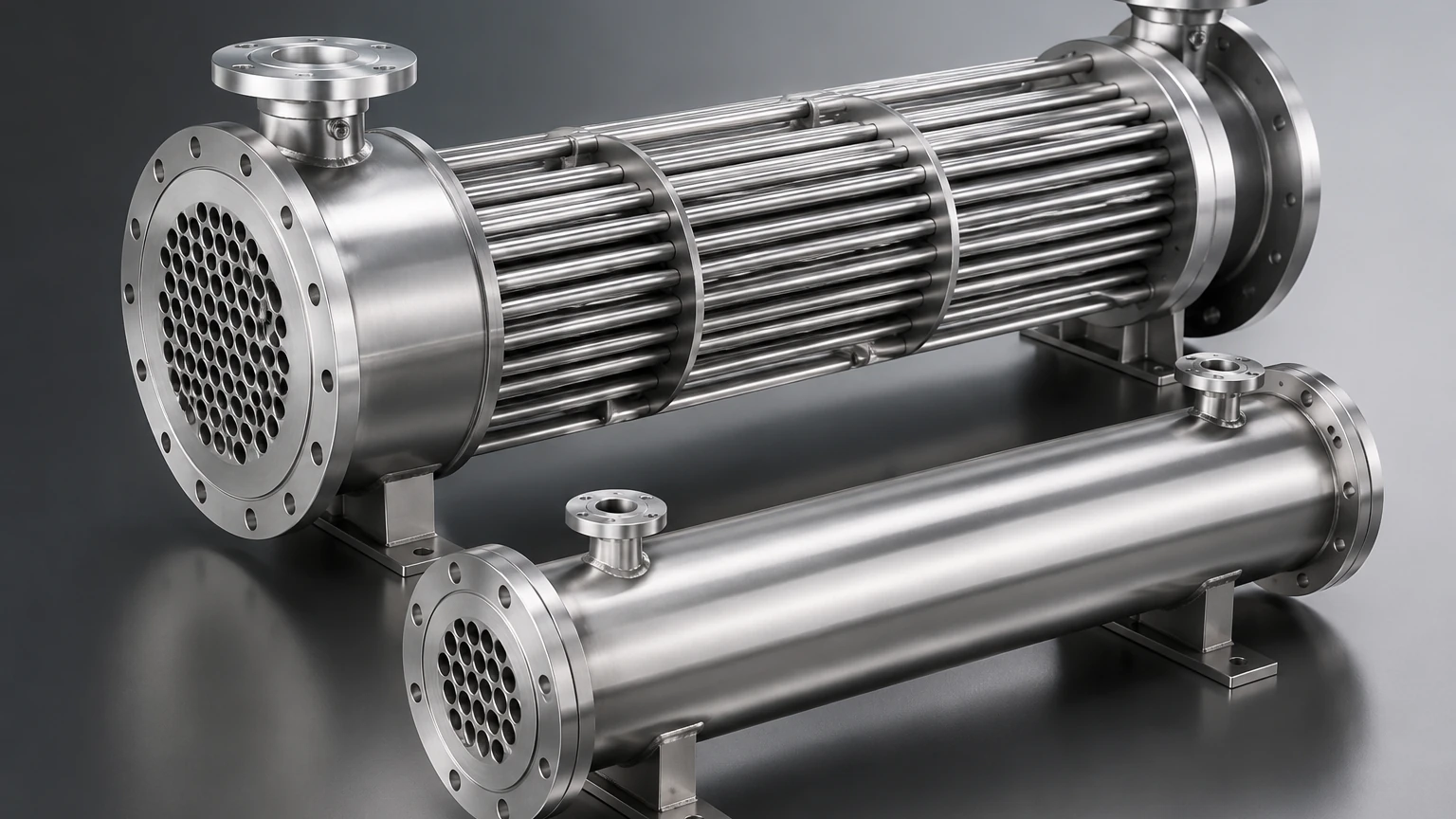
This is the most robust design, capable of handling high pressures and extreme temperature differentials. In a titanium shell-and-tube unit, the titanium tubes are typically expanded or welded into a tubesheet. Because titanium welding requires an inert atmosphere (usually argon shielding) to prevent embrittlement, the manufacturing process requires specialized expertise and cleanroom conditions. These units are ideal for high-volume chemical processing and heavy industrial cooling.
Plate Heat Exchangers (PHE)
Titanium plate heat exchangers consist of a series of thin, corrugated titanium plates pressed together. This design offers a very high surface area for heat transfer in a very small volume. PHEs are highly efficient and can be easily disassembled for cleaning. They are frequently used in the food and beverage industry and for HVAC applications in coastal environments where seawater is used as the cooling medium. However, PHEs have lower pressure limits than shell-and-tube designs and require high-quality gaskets that are compatible with the process fluid.
Maintenance and Operational Longevity
One of the primary selling points of a titanium heat exchcanger is its low maintenance requirement. Unlike copper-based systems that may require frequent chemical cleaning to remove corrosion products, titanium remains clean. However, biological fouling (biofouling) can still occur in marine applications. Microorganisms can attach to the titanium surface, creating a biofilm.
Cleaning Protocols
Titanium is compatible with a wide range of cleaning agents. It can be cleaned with nitric acid to remove scale or with chlorine to kill biological growth without damaging the metal. It is important to avoid using hydrochloric acid or other reducing acids unless the specific grade of titanium (like Grade 7) is designed to handle them. Mechanical cleaning, such as using soft brushes or sponge balls (in Taprogge-style systems), is also effective and safe for titanium tubes.
Inspection Cycles
Regular inspections should focus on the integrity of the gaskets (in plate designs) and the tubesheets. While the titanium itself is unlikely to fail, the joints between titanium and other materials are potential points of weakness. Ultrasonic testing and eddy current testing are standard non-destructive methods used to verify the wall thickness of titanium tubes during scheduled turnarounds.
Selection Criteria for Engineers and Purchasing Teams
When specifying a titanium heat exchcanger, technical professionals should confirm several key parameters to ensure the equipment meets the application's demands:
* Fluid Chemistry: Provide a full breakdown of the fluid composition, including chloride concentration, pH, and the presence of any oxidizing or reducing agents.
* Thermal Duty: Define the required heat load (kW or BTU/hr), inlet/outlet temperatures, and maximum allowable pressure drop.
* Filtration Requirements: Determine the micron rating required to protect the heat exchanger. High-quality filtration components, such as those found on the Main Page of professional manufacturers, should be matched to the narrowest passage in the heat exchanger.
* Design Standards: Ensure the unit is designed and fabricated according to relevant codes, such as ASME Section VIII, Division 1, or TEMA (Tubular Exchanger Manufacturers Association) standards.
* Total Cost of Ownership (TCO): While the initial capital expenditure (CAPEX) for titanium is higher than for stainless steel, the reduction in downtime, maintenance costs, and the extended service life (often 20+ years) usually results in a lower TCO.
Conclusion
The titanium heat exchcanger represents a pinnacle of engineering for demanding industrial environments. Its ability to withstand the most corrosive fluids while providing efficient heat transfer makes it an indispensable asset in modern chemical, marine, and power industries. However, the success of a titanium system is not solely dependent on the metal itself. It requires a holistic approach to system design, including the integration of precision filtration to prevent fouling and erosion.
By selecting the correct grade of titanium and protecting the system with high-quality stainless steel or metal mesh filters, industrial operators can ensure peak performance and long-term reliability. For those seeking to optimize their filtration and fluid management systems, it is beneficial to Review product options and application support to find customized solutions that align with the specific needs of high-performance heat transfer equipment.
