


Sintered Metal Filter Elements
In high-pressure and high-temperature industrial environments, the integrity of filtration components is critical to process stability and product purity. Sintered metal filter elements represent a pinnacle of filtration engineering, offering a combination of mechanical strength, chemical resistance, and precise pore size control that polymer-based or standard woven filters cannot match. These components are manufactured through a process called sintering, where metal powders or multiple layers of wire mesh are fused together under high heat and pressure without reaching the melting point. This creates a rigid, porous structure capable of withstanding extreme operational stresses.
For engineers and procurement teams, selecting the right Sintered Metal Filters requires a deep understanding of material properties, fluid dynamics, and the specific demands of the application. Whether used in chemical processing, pharmaceutical manufacturing, or hydraulic systems, these elements must be evaluated based on their ability to maintain filtration efficiency while managing differential pressure and long-term durability.
The Engineering Fundamentals of Sintered Metal Filtration
The performance of sintered metal filter elements is rooted in the diffusion bonding process. Unlike traditional mesh filters that rely on a simple weave, sintered elements are formed into a monolithic structure. During sintering, the atoms in the metal particles or wires migrate across boundaries, fusing the contact points into a single solid piece. This results in a filter media that does not migrate, shed fibers, or lose its pore geometry under high flow rates or pressure surges.
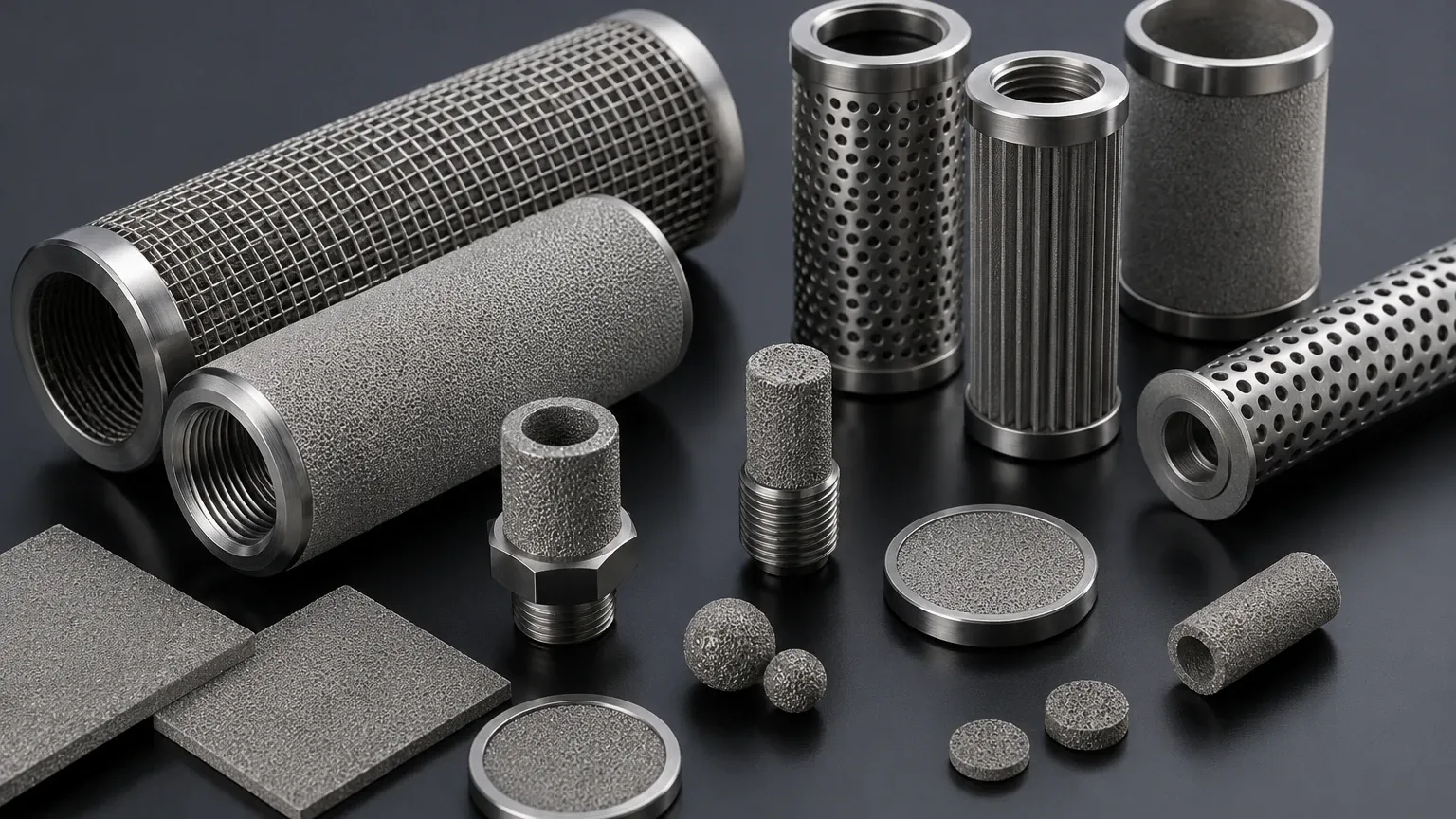
There are two primary types of sintered media used in industrial elements: sintered metal powder and sintered woven wire mesh. Sintered powder elements offer a tortuous path for fluids, providing excellent depth filtration and high dirt-holding capacity. Sintered mesh elements, often constructed from multiple layers (ranging from two to over five layers), provide precise surface filtration and are easier to clean via backwashing. The choice between powder and mesh depends largely on the nature of the contaminants—deformable particles often require the depth of powder media, while hard, spherical particles are best handled by surface-filtering mesh.
Key Performance Metrics for Sintered Metal Filter Elements
When evaluating sintered metal filter elements for a specific system, engineers must look beyond simple micron ratings. The following metrics are essential for determining the suitability of a filter:
Filtration Efficiency and Micron Rating
Filtration efficiency is typically categorized as either nominal or absolute. For critical applications, such as catalyst recovery or pharmaceutical sterile air filtration, absolute-rated elements are required. These are tested to ensure that 99.9% of particles at the specified micron size are captured. Sintered metal allows for extremely fine filtration, often reaching down to 0.5 microns in liquid and even finer in gas applications.
Permeability and Pressure Drop
Permeability refers to the ease with which a fluid passes through the filter medium. A high-quality sintered element must balance fine filtration with low initial differential pressure (ΔP). A high ΔP at the start of a cycle indicates either an undersized filter or a medium with poor permeability, which leads to increased energy consumption and shorter service intervals. Engineers must calculate the flux rate (flow per unit area) to ensure the filter operates within its optimal performance envelope.
Mechanical Strength and Collapse Pressure
One of the primary advantages of sintered metal is its structural integrity. In hydraulic systems or high-viscosity polymer filtration, filters may be subjected to high differential pressures. Sintered elements are designed with specific collapse ratings, often exceeding 100 bar (1,450 psi) depending on the reinforcement layers and housing design. This ensures the filter does not deform or rupture, preventing downstream contamination.
Material Selection for Harsh Industrial Environments
The material of construction is the first line of defense against corrosion and thermal degradation. While stainless steel is the standard, the specific grade must be matched to the process chemistry.
* 316L Stainless Steel: The most common material for sintered metal filter elements. The "L" stands for low carbon, which improves weldability and resistance to intergranular corrosion. It is suitable for most organic solvents, food and beverage applications, and mildly corrosive chemicals.
* 304 Stainless Steel: Used for less demanding applications where cost is a primary factor and high corrosion resistance is not required.
* Hastelloy (C-276, C-22): Selected for highly aggressive environments involving strong acids, wet chlorine, or high-temperature oxidation. Hastelloy elements maintain their structural properties where stainless steel would quickly fail.
* Inconel and Monel: These nickel-based alloys are used in extreme temperature applications or in the presence of hydrofluoric acid and sea water, respectively.
* Titanium: Chosen for its high strength-to-weight ratio and exceptional resistance to chlorides and oxidizing acids. Titanium sintered filters are frequently found in aerospace and specialized chemical processing.
Design and Customization: Beyond Standard Specifications
Industrial filtration rarely follows a "one-size-fits-all" approach. Customization is often necessary to integrate a filter element into an existing system or to meet unique process requirements. Customization options for sintered metal filter elements include:
Geometric Configuration
Elements can be manufactured as cylindrical cartridges, flat discs, conical shapes, or pleated structures. Pleating a sintered mesh element significantly increases the available surface area, which lowers the flux rate and extends the time between cleaning cycles. This is particularly useful in gas filtration where high flow rates are common.
End Fittings and Connections
To ensure a leak-proof seal, the choice of end fittings is critical. Common configurations include Double Open End (DOE), Single Open End (SOE) with 222 or 226 O-ring codes, NPT/BSP threaded connections, and flange mounts. The sealing material—whether EPDM, Viton, PTFE, or Kalrez—must be chemically compatible with the process fluid.
Reinforcement and Support
For high-pressure applications, the sintered media may be supported by an internal perforated core or an external cage. In multi-layer mesh designs, coarser layers are often sintered to the fine filtration layer to provide mechanical support without significantly impeding flow.
Maintenance, Cleaning, and Total Cost of Ownership
One of the most compelling reasons to invest in sintered metal filter elements is their cleanability. Unlike disposable polymer cartridges, metal elements can be regenerated multiple times, significantly reducing the total cost of ownership (TCO) over the life of the equipment.
Cleaning Methodologies
* Backpulsing/Backwashing: This is the most common in-situ cleaning method. By reversing the flow of the fluid, particles trapped on the surface of the filter are dislodged and flushed out. This is highly effective for sintered mesh elements.
* Ultrasonic Cleaning: For deep-seated contaminants in powder-sintered elements, ultrasonic baths use high-frequency sound waves to create cavitation bubbles that scrub the internal pore structures.
* Chemical Cleaning: Soaking elements in specific solvents, acids, or caustic solutions can dissolve organic or inorganic scaling that physical cleaning cannot reach.
* Thermal Cleaning (Burn-off): In applications like polymer filtration, elements are placed in high-temperature ovens or fluidized beds to carbonize and remove organic residues.
Determining Replacement Cycles
The decision to replace an element should be based on the "permanent pressure drop." After each cleaning cycle, the initial ΔP will eventually begin to rise. Once the cleaned ΔP reaches a predetermined threshold (often 2-3 times the original clean ΔP), the element has reached the end of its functional life and should be replaced to prevent process inefficiency.
Identifying Common Risks in Sintered Filter Implementation
While sintered metal filter elements are robust, improper selection or operation can lead to failure. Engineers should be aware of the following risks:
1. Fatigue Failure: In systems with frequent pressure pulsations (such as those caused by certain pump types), the metal can undergo fatigue. Ensuring the filter is properly supported and sized can mitigate this.
2. Bypass Leakage: Even the best filter element is useless if the fluid can bypass the media. This usually occurs due to improper installation, damaged O-rings, or incorrect end-fitting selection. Regular inspection of seals is mandatory.
Media Blinding: This occurs when the pore size is too close to the particle size, causing particles to wedge themselves into the pores in a way that cannot be cleaned. Selecting a slightly finer or coarser grade, or changing the media type (mesh vs. powder), can often solve this.
4. Galvanic Corrosion: When a sintered metal filter is used in a system with dissimilar metals in the presence of an electrolyte, galvanic corrosion can occur. It is essential to ensure that the filter housing and the element are compatible or electrically isolated.
Conclusion: Selecting a Strategic Filtration Partner
Sintered metal filter elements are high-performance components that require precise manufacturing and engineering. When sourcing these products, it is vital to work with a manufacturer that understands the nuances of material science and fluid dynamics. A reliable partner like Kaifil provides the technical expertise necessary to navigate material selection, customization, and performance validation.
By focusing on the technical requirements of the application—temperature, pressure, chemical compatibility, and particle characteristics—engineers can implement filtration solutions that not only protect downstream equipment but also optimize process efficiency. For those looking to upgrade their current filtration systems or develop new OEM solutions, reviewing the available configurations of sintered metal filter elements is the first step toward achieving long-term operational success.
