


Strainer 0.5 Mm
In industrial fluid handling and processing, the precision of a filtration system is often defined by its ability to consistently remove particles of a specific size while maintaining system flow and pressure. A strainer 0.5 mm—equivalent to a 500-micron rating—occupies a critical position in the hierarchy of industrial filtration. It serves as the primary line of defense for sensitive downstream equipment, such as high-pressure nozzles, heat exchangers, and centrifugal pumps, where particles larger than half a millimeter could cause catastrophic mechanical failure or significant process downtime.
Selecting the correct Strainers & Baskets requires a deep understanding of fluid dynamics, material science, and the mechanical stresses inherent in high-volume industrial environments. This guide examines the technical specifications, engineering considerations, and application-specific requirements for 0.5 mm straining solutions.
Technical Specifications of 0.5 mm Filtration
The term "0.5 mm strainer" refers to the clear opening or aperture size within the filtration media. In the context of industrial manufacturing, achieving a precise 0.5 mm opening involves choosing between different media types, primarily woven wire mesh and perforated metal plates.
Woven Wire Mesh vs. Perforated Plate
For a 0.5 mm requirement, engineers must decide between these two common constructions:
1. Woven Wire Mesh: A 0.5 mm aperture typically corresponds to approximately a 35-mesh screen (depending on the wire diameter). Wire mesh offers a higher percentage of open area (POA), which facilitates higher flow rates and lower initial pressure drops. However, mesh is inherently more delicate than perforated plate and often requires a heavier backup basket for structural support.
2. Perforated Metal: Manufacturing a perforated plate with 0.5 mm holes is a precision process. While perforated plates are significantly more robust and easier to clean through backwashing or manual scraping, they generally offer a lower POA compared to mesh. This can result in a higher clean pressure drop across the strainer.
Material Integrity: SS304 vs. SS316L
Material selection is paramount when specifying a strainer 0.5 mm. Stainless steel is the industry standard due to its mechanical strength and corrosion resistance.
* Grade 304: Suitable for general industrial applications, including water treatment and non-corrosive chemical processing. It provides excellent structural integrity at a cost-effective price point.
* Grade 316L: Specified for environments involving high chloride concentrations, marine applications, or pharmaceutical and food-grade processes. The "L" (low carbon) designation is crucial for components that require welding, as it prevents sensitisation and subsequent intergranular corrosion.
Engineering Considerations for Strainer Selection
When integrating a 0.5 mm strainer into a piping system, engineers must evaluate several performance metrics to ensure the component does not become a bottleneck or a point of failure.
Percentage Open Area (POA) and Flow Velocity
The POA determines how much of the strainer surface is actually available for fluid passage. For a 0.5 mm aperture, the POA can vary from 30% to over 60% depending on the wire diameter or the pitch of the perforations. A higher POA reduces the velocity of the fluid as it passes through the media, which minimizes turbulence and reduces the rate of impingement erosion on the mesh or plate.
Differential Pressure (Delta P)
Every strainer introduces a pressure drop into the system. For a strainer 0.5 mm, the clean pressure drop must be calculated based on fluid viscosity, density, and flow rate. As the strainer collects debris, the differential pressure increases. Engineers should specify a "terminal pressure drop"—the point at which the strainer must be cleaned or replaced to prevent the media from collapsing or the pump from cavitating.
Dirt-Holding Capacity
The geometry of the basket or strainer element significantly impacts how much particulate matter it can hold before the pressure drop becomes unacceptable. Deep-draw baskets or pleated designs increase the surface area, effectively extending the service interval between cleanings. For high-solids applications, a standard cylindrical basket may be insufficient, necessitating a multi-element or pleated configuration.
Applications for 0.5 mm Strainers
The 0.5 mm threshold is widely used across various sectors due to its balance between fine filtration and high flow capacity.
Chemical and Petrochemical Processing
In chemical manufacturing, a 0.5 mm strainer is often used to protect flow meters and control valves. Even small amounts of grit or polymer build-up can jam precision instruments. Stainless steel construction ensures compatibility with a wide range of solvents and reagents, while the 0.5 mm aperture is fine enough to capture most pipe scale and welding slag.
Food and Beverage Industry
Process water and liquid ingredients often require straining to ensure product purity and protect downstream homogenizers. A 0.5 mm stainless steel basket is frequently used in the dairy and juice industries to remove large pulp particles or coagulated proteins. In these applications, the strainer must feature sanitary finishes (typically Ra < 0.8 μm) to prevent bacterial growth in the crevices of the mesh.
Water Treatment and Cooling Systems
Cooling towers and heat exchangers are susceptible to fouling from biological growth and environmental debris. A strainer 0.5 mm acts as an effective secondary filter after coarse intake screens, removing smaller particulates that could otherwise settle in the narrow channels of a plate heat exchanger, leading to reduced thermal efficiency and localized corrosion.
Customization and OEM Solutions
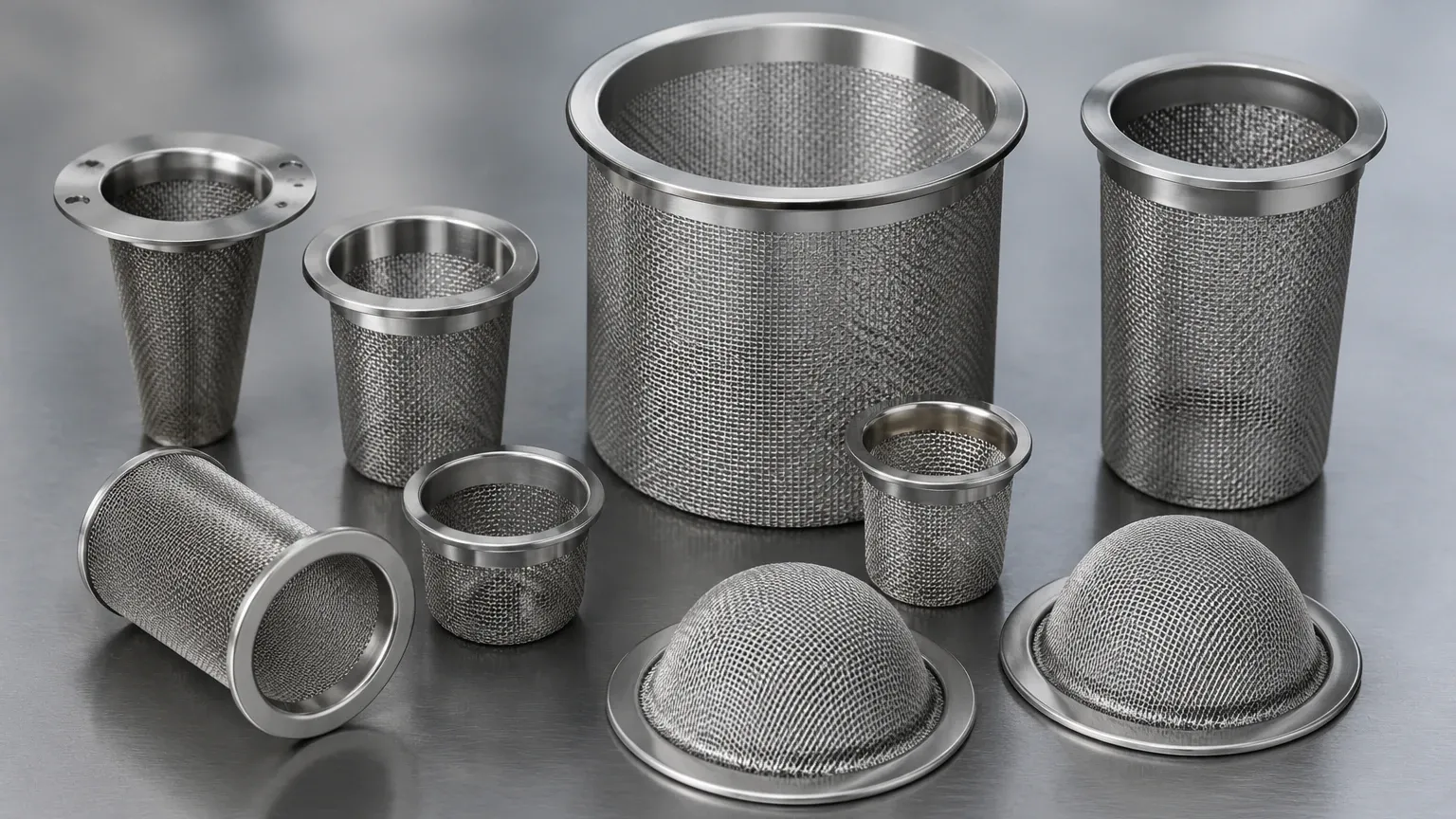
Standard off-the-shelf strainers often fail to meet the specific spatial or mechanical requirements of complex industrial skids. Customization is a core requirement for many engineering teams. Manufacturing partners like Kaifil specialize in developing bespoke Strainers & Baskets tailored to unique operational parameters.
Structural Reinforcement
For high-pressure applications, a 0.5 mm mesh screen may be sintered to a perforated metal core. This "composite" approach combines the precision of fine mesh with the mechanical rigidity of heavy-gauge plate, allowing the strainer to withstand high differential pressures without deformation.
Connection Types and Housing Integration
Custom strainers can be designed with specific flange ratings (ANSI, DIN, JIS), NPT threads, or quick-disconnect fittings to match existing infrastructure. Furthermore, the internal basket handle and sealing mechanism (such as O-rings or flat gaskets) can be customized based on the chemical nature of the fluid and the temperature of the process.
Maintenance and Operational Longevity
The total cost of ownership (TCO) for a strainer 0.5 mm is heavily influenced by its ease of maintenance. A well-engineered strainer should allow for rapid removal and cleaning to minimize downtime.
Cleaning Protocols
* Manual Cleaning: Baskets should be designed with lifting handles and smooth internal surfaces to facilitate the removal of trapped debris. For 0.5 mm mesh, ultrasonic cleaning is often recommended to remove fine particulates lodged within the wire intersections.
* Backwashing: In automated systems, the structural integrity of the 0.5 mm media must be sufficient to withstand the reverse flow of the backwash cycle without fatigue.
Signs of Wear and Replacement
Engineers should regularly inspect 0.5 mm strainers for signs of "wire migration" or mesh blinding. Wire migration occurs when the woven strands shift due to high-velocity flow, resulting in apertures larger than the specified 0.5 mm. Blinding occurs when near-sized particles become wedged in the openings, permanently reducing the POA. If the differential pressure returns to a higher-than-normal level immediately after cleaning, it is a clear indicator that the media has reached the end of its functional life.
Conclusion
Specifying a strainer 0.5 mm involves more than just selecting a hole size; it requires a comprehensive evaluation of the process environment, fluid characteristics, and mechanical requirements. Whether utilizing a perforated plate for its robustness or a woven mesh for its high flow capacity, the goal remains the same: reliable protection of downstream assets and maintenance of process integrity.
By focusing on high-quality materials like 304 and 316L stainless steel and considering the long-term implications of pressure drop and dirt-holding capacity, purchasing teams can ensure they select a filtration solution that offers both performance and durability. For specialized industrial requirements, working with a manufacturer capable of producing custom Strainers & Baskets is the most effective way to achieve optimized filtration results.
