


Strainer 20 Mesh
In industrial fluid handling, the selection of the correct filtration media is a critical engineering decision that impacts the longevity of downstream equipment, the quality of the final product, and the overall efficiency of the process. Among the various specifications available for industrial Strainers & Baskets, the 20 mesh configuration stands out as one of the most versatile and frequently specified standards for coarse to medium-grade filtration.
A strainer 20 mesh component is designed to capture particles larger than approximately 841 microns. This level of filtration is essential in protecting pumps, valves, and heat exchangers from damage caused by scale, debris, and foreign particulates. Understanding the technical nuances of this mesh size—including its aperture, open area, and structural limitations—is vital for engineers and procurement teams seeking to optimize their filtration systems.
Technical Specifications of 20 Mesh Filtration
The term "mesh" refers to the number of openings per linear inch of the wire cloth. Therefore, a 20 mesh screen contains 20 openings in one inch. However, the mesh count alone does not define the filtration performance; the wire diameter is equally important as it determines the actual aperture size and the structural strength of the basket.
Aperture and Particle Retention
For a standard industrial 20 mesh screen using a wire diameter of 0.016 inches (0.40 mm), the resulting aperture is 0.034 inches or 860 microns. If a heavier wire of 0.020 inches (0.50 mm) is used for high-pressure applications, the aperture narrows to 0.030 inches or 760 microns. On average, a strainer 20 mesh is considered to have a nominal rating of 841 microns.
Engineers must confirm the particle size distribution (PSD) of the contaminants in their fluid stream. If the goal is to protect a nozzle with a 1.5 mm orifice, a 20 mesh strainer provides a significant safety margin. However, if the downstream requirement is for high-purity pharmaceutical processing, 20 mesh may only serve as a pre-filter for finer stages.
Percentage of Open Area
The open area is the ratio of the area of the openings to the total area of the screen. This value is critical for calculating flow resistance and pressure drop. A typical 20 mesh screen with 0.016-inch wire provides approximately 46% to 50% open area. A higher open area reduces the initial pressure drop ($ΔP$) but may compromise the mechanical rigidity of the basket under high differential pressures. When selecting Strainers & Baskets, it is essential to balance the flow requirements with the structural demands of the application.
Material Engineering Considerations
Industrial strainers are subjected to diverse chemical environments and thermal stresses. The choice of material for a strainer 20 mesh assembly directly influences the total cost of ownership and the replacement cycle.
Stainless Steel 304 vs. 316
* Type 304 Stainless Steel: This is the standard material for most general-purpose industrial applications. It offers excellent strength and good corrosion resistance in water and mild chemical environments.
* Type 316/316L Stainless Steel: For applications involving chlorides, marine environments, or acidic chemical processing, 316 stainless steel is preferred. The addition of molybdenum provides superior resistance to pitting and crevice corrosion.
Specialty Alloys
In highly aggressive environments, such as those found in petrochemical refining or specialized chemical synthesis, standard stainless steels may fail. In these cases, 20 mesh strainers can be fabricated from Monel, Hastelloy, or Duplex stainless steels to ensure structural integrity and prevent bypass caused by material degradation.
Structural Design and Configuration
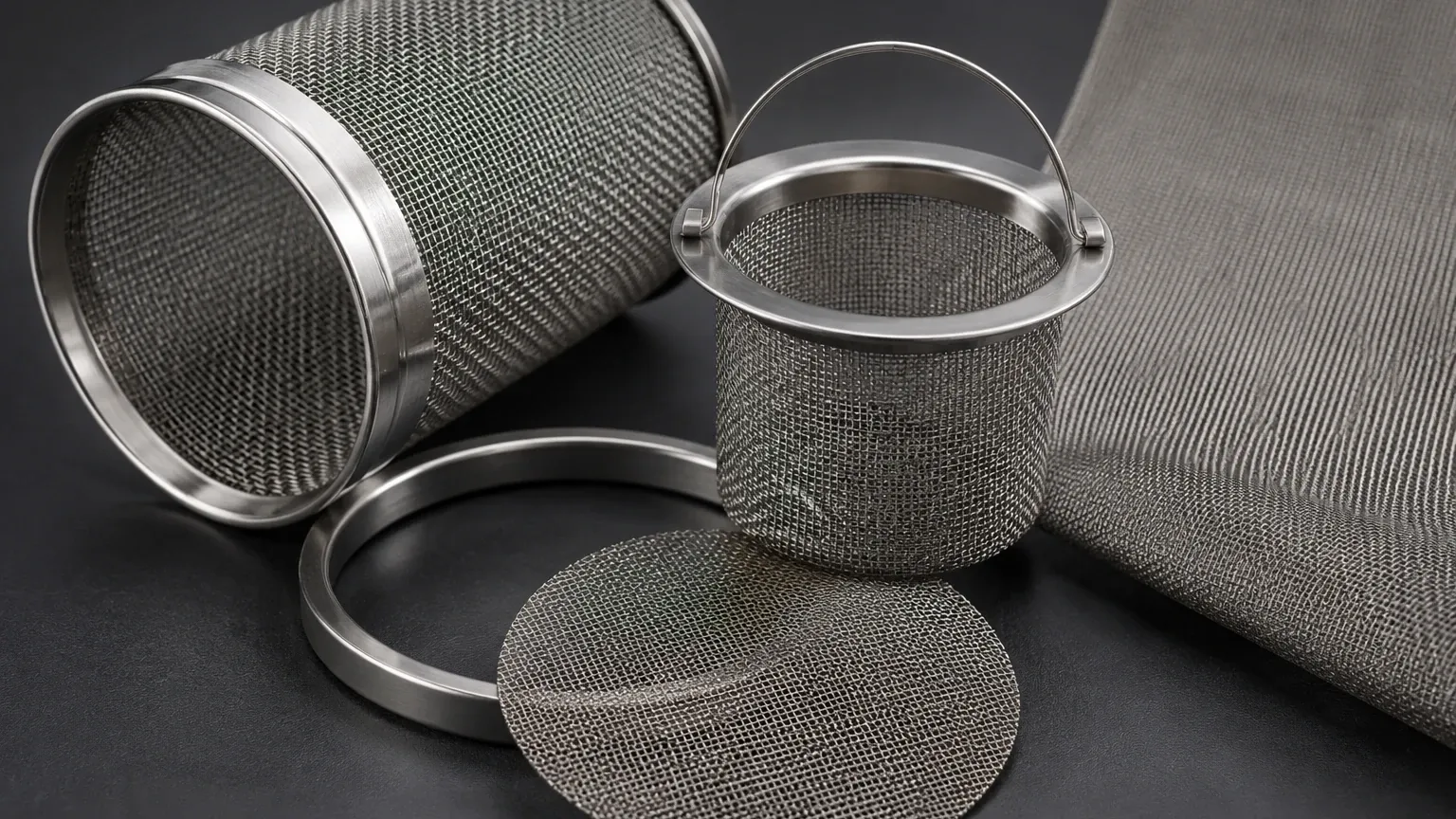
A 20 mesh screen is rarely used as a standalone component in high-flow industrial settings. It is typically integrated into a robust mechanical housing. The configuration of the strainer 20 mesh depends on the installation footprint and the nature of the solids being removed.
1. Simplex and Duplex Basket Strainers
Basket strainers are designed for applications where a high volume of solids is expected. The 20 mesh liner is often supported by a perforated metal basket (typically with 1/8" or 1/4" holes) to prevent the mesh from collapsing under pressure. Duplex strainers allow for continuous operation by diverting flow to a second basket while the first is being cleaned.
2. Y-Strainers
Y-strainers are more compact and are typically used in pressurized lines where the amount of material to be removed is relatively small. A 20 mesh screen in a Y-strainer is effective for protecting steam traps and control valves from pipe scale.
3. Temporary and Cone Strainers
During the commissioning of new piping systems, "witch's hat" or cone strainers with 20 mesh are often installed to catch construction debris like welding slag. These are intended for short-term use and are removed once the system has stabilized.
Performance Evaluation: Flow and Pressure Drop
One of the most common mistakes in filter selection is undersizing the strainer, leading to excessive pressure drop and potential pump cavitation. The flow coefficient ($C_v$) of a strainer 20 mesh unit must be evaluated against the system's pump curve.
* Clean Pressure Drop: The initial $ΔP$ across a clean 20 mesh basket should ideally not exceed 2 PSI (0.14 bar). If the calculated drop is higher, a larger strainer body or a different basket geometry may be required.
* Terminal Pressure Drop: This is the maximum allowable pressure difference before the strainer must be cleaned. For most industrial applications, this is set between 10 and 15 PSI. Exceeding this limit risks deforming the 20 mesh screen or forcing contaminants through the media.
Applications of 20 Mesh Strainers
The 841-micron retention capability of a strainer 20 mesh makes it suitable for a wide range of industrial sectors:
* Water Treatment: Protecting membrane systems (RO/UF) by removing large particulates that could foul or abrade the membranes.
* Food and Beverage: Straining pulp from fruit juices or removing large aggregates in dairy processing to ensure a consistent texture.
* Chemical Processing: Filtering raw chemical feedstocks to prevent clogs in spray nozzles or reactor inlets.
* HVAC and Cooling Towers: Removing scale and biological growth from cooling water loops to maintain heat exchanger efficiency.
* Oil and Gas: Protecting sensitive flow meters and instrumentation from sand and debris in pipeline transport.
Customization and Engineering Support
Off-the-shelf solutions do not always meet the rigorous demands of specialized industrial processes. Customization is often necessary to ensure that the strainer 20 mesh fits perfectly within existing infrastructure and meets specific performance metrics.
Key customization options include:
* Reinforced Liners: Adding internal or external support cages for high-viscosity fluids.
* Magnetic Inserts: Integrating magnets within the 20 mesh basket to capture fine ferrous particles that might otherwise pass through the 841-micron openings.
* Custom Dimensions: Tailoring the height, diameter, and flange connections of the basket to fit non-standard housings.
* Handle and Lifting Options: Designing ergonomic handles or heavy-duty lifting lugs for large baskets to facilitate safer and faster maintenance cycles.
Maintenance and Operational Best Practices
To ensure the longevity of a strainer 20 mesh system, a proactive maintenance schedule is required. Engineers should consider the following:
1. Differential Pressure Monitoring: Install DP gauges across the strainer. This provides real-time data on the loading state of the 20 mesh screen and prevents emergency shutdowns.
2. Cleaning Procedures: Stainless steel 20 mesh is highly durable and can be cleaned using backwashing, ultrasonic baths, or manual scrubbing with a soft brush. Avoid using wire brushes that could damage the weave or alter the aperture size.
3. Gasket Inspection: Whenever a basket is removed for cleaning, the seals and gaskets should be inspected for wear. A compromised seal can lead to bypass, rendering the 20 mesh screen ineffective.
4. Spare Parts Inventory: Always maintain a stock of replacement 20 mesh baskets. Even the highest quality stainless steel components will eventually succumb to fatigue or accidental damage during cleaning.
Conclusion
The 20 mesh strainer remains a cornerstone of industrial filtration due to its optimal balance of flow capacity and particle retention. By understanding the technical specifications—from wire diameter to pressure drop calculations—engineers can select a filtration solution that enhances system reliability and reduces maintenance costs. Whether used as a primary filter in water treatment or a protective screen in chemical processing, a well-engineered strainer 20 mesh provides the robust performance required for modern industrial applications.
When evaluating options for your next project, consider the manufacturing expertise and material quality that go into high-performance Strainers & Baskets. Precision in the weaving process and structural integrity in the basket design are the defining factors between a standard component and a reliable industrial solution.
