


Strainer 5 Gallon Bucket
In industrial processing, the 5-gallon bucket serves as a ubiquitous unit for storage, transport, and small-batch mixing. However, the efficiency of these processes often depends on the ability to remove contaminants or ensure particle size uniformity. A strainer 5 gallon bucket system is a critical component in fields ranging from specialty chemical production to food processing and industrial coatings. Unlike consumer-grade alternatives, industrial-grade Strainers & Baskets must be engineered to withstand chemical exposure, mechanical stress, and rigorous cleaning cycles.
Selecting the appropriate strainer requires a deep understanding of fluid dynamics, material compatibility, and the specific filtration requirements of the application. This guide explores the engineering considerations, material science, and performance metrics essential for technical professionals and purchasing teams when integrating bucket strainers into industrial workflows.
Engineering Fundamentals of Bucket Strainers
The primary function of a bucket strainer is to provide a coarse or fine filtration barrier at the point of entry or exit of a 5-gallon container. While the concept is simple, the engineering behind a high-performance strainer involves balancing flow rate with filtration efficiency.
Flow Dynamics and Pressure Drop
Most 5-gallon bucket straining operations are gravity-fed. In these scenarios, the available head pressure is low. Engineers must consider the "open area" of the mesh—the percentage of the total surface area that allows fluid to pass. A higher mesh count (finer filtration) typically results in a lower open area, which can lead to slow processing times or "blinding" (clogging) if the particulate load is high.
To mitigate this, industrial strainers often utilize a deep-basket design. By increasing the surface area of the mesh through depth, the strainer can maintain a higher flow rate even as particulates begin to accumulate at the bottom of the basket.
Structural Integrity
Industrial environments subject equipment to significant physical demands. A strainer 5 gallon bucket must maintain its shape under the weight of the fluid and the trapped solids. High-quality strainers feature reinforced rims, often made from heavy-gauge stainless steel, to ensure they sit securely on the bucket's edge without slipping or deforming. For applications involving high-viscosity fluids like resins or heavy oils, the basket may require internal or external support structures, such as perforated metal backing, to prevent the fine wire mesh from bursting or stretching.
Material Selection: Stainless Steel vs. Synthetics
While plastic or nylon strainers are common in light-duty applications, industrial processes almost exclusively demand stainless steel. The choice of material impacts the longevity, chemical resistance, and sterilization capabilities of the filtration component.
The Advantages of Stainless Steel
Stainless steel provides several critical advantages in a B2B context:
1. Chemical Compatibility: Stainless steel (specifically grades 304 and 316) is resistant to a wide array of solvents, acids, and alkaline solutions that would degrade synthetic fibers.
2. Temperature Resistance: Many industrial fluids are processed at elevated temperatures to reduce viscosity. Stainless steel maintains its structural properties at temperatures far exceeding the melting points of common plastics.
3. Durability and Reusability: Unlike disposable mesh bags, a stainless steel strainer is a long-term asset. It can be cleaned using high-pressure spray, ultrasonic baths, or chemical solvents, offering a lower total cost of ownership (TCO) over time.
Grade 304 vs. Grade 316
* Type 304: The standard industrial grade, offering excellent corrosion resistance for most food-grade and general chemical applications.
* Type 316: Contains molybdenum, which provides superior resistance to chlorides and marine environments. This is often the preferred choice for pharmaceutical and high-purity chemical processing where even minor pitting corrosion must be avoided.
Micron Ratings and Mesh Selection
The effectiveness of a strainer 5 gallon bucket is defined by its filtration accuracy, usually measured in microns or mesh count. Selecting the wrong mesh size can result in either poor product quality (if too coarse) or excessive downtime (if too fine).
Understanding Mesh and Microns
* Mesh Count: Refers to the number of openings per linear inch. A 20-mesh strainer has relatively large openings, while a 400-mesh strainer is extremely fine.
* Micron Rating: Refers to the actual size of the particles the mesh can intercept. For context, a human hair is approximately 70 microns.
Engineers must determine the "allowable particle size" for their specific process. For example, in the automotive coating industry, even a 50-micron particle can cause surface defects, necessitating a 325-mesh or finer strainer. Conversely, in the initial filtration of raw honey or bulk food oils, a 60-mesh (250 micron) strainer may be sufficient to remove large debris without impeding the flow of the viscous product.
Wire Diameter and Weave Types
The diameter of the wire used in the mesh also plays a role. Thicker wires provide more durability but reduce the open area. Common weave types include:
* Plain Weave: The most common, where wires cross over and under each other alternately.
* Twilled Weave: Used for finer meshes, where wires cross over two and under two, allowing for a heavier wire to be used for a given mesh count.
Design Variations for Industrial Applications
Not all 5-gallon bucket strainers are designed the same. The geometry of the strainer should be matched to the specific task.
Hat-Style vs. Drop-In Baskets
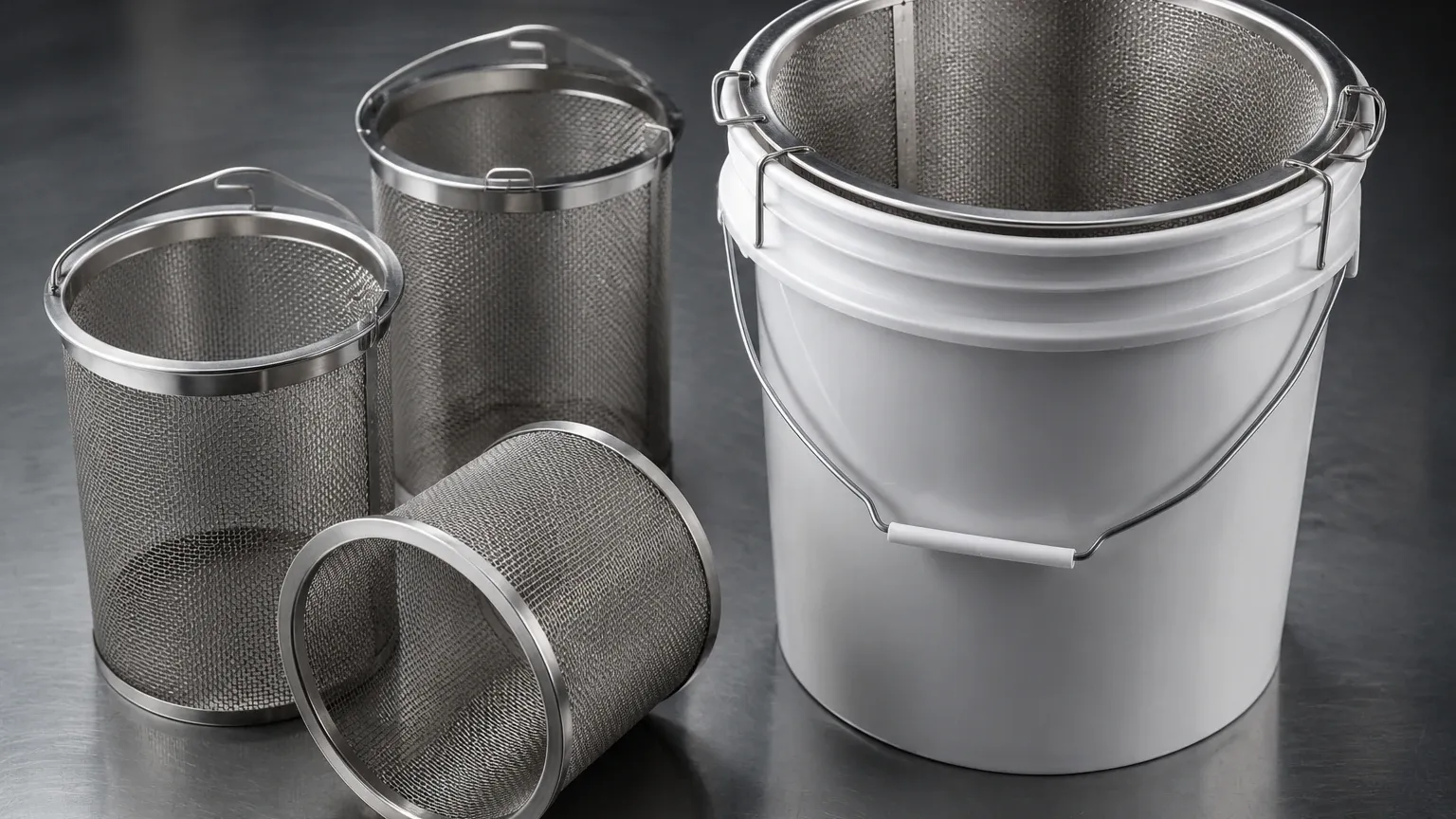
* Hat-Style (Flanged): These feature a wide flange that rests on the rim of the bucket. They are ideal for pouring liquids directly into the bucket. The flange prevents the strainer from falling in, even under the weight of a heavy pour.
* Drop-In Baskets: These are designed to sit deeper within the bucket and may include handles for easy retrieval. These are often used for soaking parts or for applications where the fluid level in the bucket needs to rise above the bottom of the strainer.
Custom Features for OEM Solutions
For manufacturers of industrial equipment, custom-designed Strainers & Baskets are often required to fit proprietary bucket dimensions or to integrate with automated filling lines. Customization options include:
* Reinforced Handles: For lifting heavy loads of filtered solids.
* Gaskets: To provide a liquid-tight seal between the strainer and the bucket rim.
* Multi-Stage Filtration: Incorporating two different mesh sizes within a single basket to provide graduated filtration, which prevents the fine mesh from clogging prematurely.
Common Risks and Performance Limitations
While robust, a strainer 5 gallon bucket system is not without potential failure points. Engineers should be aware of the following risks:
Blinding and Clogging
Blinding occurs when particles that are exactly the size of the mesh openings become lodged, or when a layer of fine solids (a "filter cake") builds up on the surface. If not monitored, this can stop the flow entirely. In gravity-fed systems, the only solution is to stop the process and clean the strainer. If the process involves a pump, blinding can lead to a rapid increase in pressure, potentially damaging the mesh or the pump itself.
Bypass
Bypass occurs when fluid escapes around the edges of the strainer rather than passing through the mesh. This is usually caused by an ill-fitting rim or a deformed flange. In industrial settings, bypass can lead to contaminated batches and expensive product recalls. Ensuring a precision fit between the strainer and the 5-gallon bucket is paramount.
Mechanical Fatigue
Repeated cleaning and handling can lead to mechanical fatigue, particularly at the points where the mesh is joined to the frame. High-quality industrial strainers utilize advanced welding techniques, such as resistance welding or TIG welding, to ensure that the mesh-to-frame bond can withstand the vibrations and thermal expansion common in industrial environments.
Maintenance and Cleaning Procedures
To maximize the lifespan of a stainless steel bucket strainer, a standardized maintenance protocol is recommended. Because these components are often used with adhesives, resins, or food products, cleaning must be thorough to prevent cross-contamination.
1. Immediate Rinsing: Strainers should be rinsed immediately after use before the filtered material has a chance to dry or harden on the mesh.
2. Backwashing: Directing a high-pressure stream of water or air from the "clean" side of the mesh (the outside) to the "dirty" side (the inside) is the most effective way to dislodge trapped particles.
3. Ultrasonic Cleaning: For very fine meshes (200+ mesh), ultrasonic cleaning is often the only way to remove microscopic particles from the intersections of the wires.
4. Inspection: Regularly inspect the mesh for signs of fraying, holes, or separation from the rim. Even a single broken wire can compromise the filtration integrity of the entire unit.
Purchasing Considerations for Engineers
When sourcing a strainer 5 gallon bucket, technical buyers should confirm several key details with the manufacturer to ensure the product meets the application's demands:
* Exact Dimensions: 5-gallon buckets can vary slightly in diameter depending on the manufacturer (plastic vs. metal pails). Confirm the inner and outer diameter of the strainer flange.
* Material Certification: For pharmaceutical or food applications, request material test reports (MTRs) to verify the stainless steel grade and ensure compliance with FDA or other regulatory standards.
* Weight Capacity: If the strainer is intended to catch heavy solids (such as metal shavings or thick sludge), confirm the maximum load the basket can support without deformation.
* Total Cost of Ownership: Evaluate the cost of a high-quality stainless steel strainer against the recurring cost of disposable filters. In most high-volume industrial settings, the durability of stainless steel provides a significant ROI within the first few months of operation.
Conclusion
The strainer 5 gallon bucket is a vital tool for maintaining product purity and process efficiency in industrial environments. By focusing on engineering fundamentals—such as material grade, mesh precision, and structural design—technical professionals can select a filtration solution that minimizes downtime and maximizes performance. Whether for standard applications or custom OEM requirements, high-quality Strainers & Baskets provide the reliability needed to handle the rigors of modern manufacturing and chemical processing.
