


Strainer Basket Metal
In industrial fluid handling systems, the integrity of downstream equipment—such as pumps, valves, heat exchangers, and spray nozzles—depends heavily on the efficiency of primary filtration. The use of a strainer basket metal component is often the first line of defense against particulate contamination. Unlike disposable filter cartridges, metal strainer baskets are designed for durability, high-volume flow, and repeated cleaning, making them a cornerstone of sustainable and cost-effective industrial processing.
Selecting the correct strainer basket involves more than simply matching dimensions. It requires an engineering-based understanding of material science, fluid dynamics, and the specific mechanical stresses of the application. This guide examines the technical considerations essential for engineers and procurement teams when evaluating metal strainer baskets for industrial use.
The Role of Metal Strainer Baskets in Industrial Filtration
Industrial strainers are generally classified into two categories: Y-strainers and basket strainers. While Y-strainers are typically used for high-pressure applications with lower dirt-loading requirements, basket strainers are preferred when high flow rates and significant solids retention are necessary. The "basket" design provides a larger surface area for debris collection, which minimizes pressure drop and extends the time between cleaning cycles.
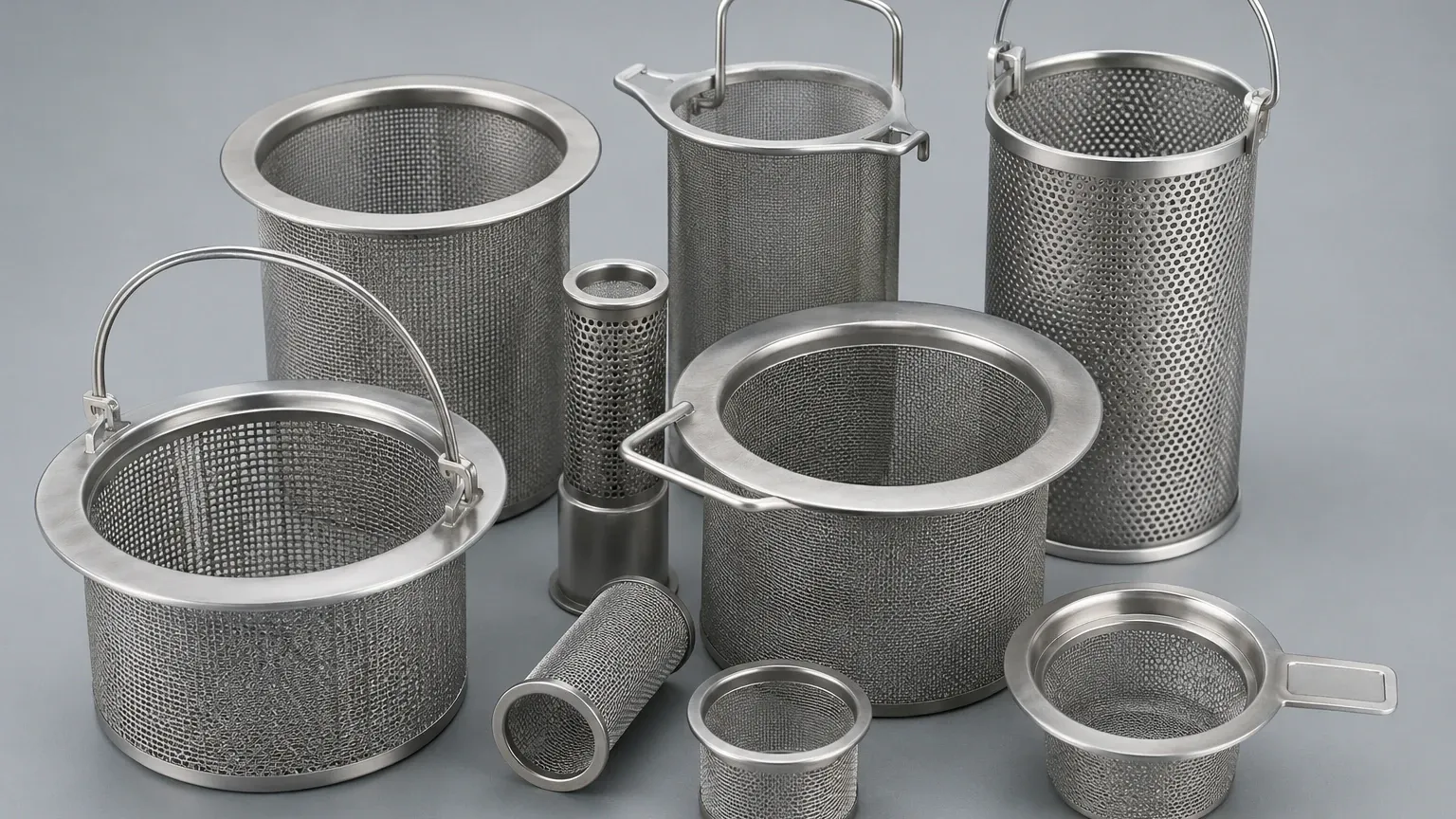
Strainers & Baskets serve as the internal element that performs the actual separation. Because these components are subjected to constant fluid velocity and potential pressure surges, the choice of metal is critical. A strainer basket metal assembly must withstand not only the chemical nature of the fluid but also the physical impact of large particles and the differential pressure that builds as the basket fills with debris.
Material Selection: Beyond Basic Stainless Steel
The most common materials for industrial strainer baskets are 304 and 316L stainless steel. However, the selection must be guided by the specific chemical and thermal environment of the process.
304 Stainless Steel
304 stainless steel is the standard choice for general-purpose applications. It offers excellent strength and good corrosion resistance for water, oils, and mild chemicals. It is widely used in hydraulic systems and general industrial water treatment where the risk of localized pitting is low.
316L Stainless Steel
For applications involving chlorides, acids, or high-salinity environments, 316L stainless steel is the preferred specification. The addition of molybdenum enhances its resistance to pitting and crevice corrosion. In the pharmaceutical and food and beverage industries, 316L is often mandatory due to its superior surface stability and ability to withstand rigorous Clean-in-Place (CIP) chemicals.
Specialty Alloys
In extreme environments, such as petrochemical refining or concentrated chemical processing, standard stainless steels may fail. In these cases, strainer basket metal may be fabricated from specialty alloys like Monel, Hastelloy, or Duplex stainless steel. These materials provide the necessary resistance to highly corrosive media and high-temperature oxidation that would rapidly degrade 304 or 316 grades.
Structural Design and Construction Methods
A high-performance strainer basket is rarely a single layer of material. It is typically a composite structure designed to balance filtration accuracy with mechanical strength.
The Support Cylinder (Perforated Metal)
The outer layer of most baskets is a perforated metal cylinder. This provides the structural skeleton of the basket. The hole size and staggered pattern are engineered to maximize the "open area" percentage while maintaining the rigidity required to prevent the basket from collapsing under high differential pressure. Common perforation sizes range from 1/16" to 1/4", depending on the size of the strainer housing.
The Filtration Media (Wire Mesh)
When finer filtration is required, the perforated cylinder is lined with stainless steel wire mesh. This mesh determines the micron rating of the basket. Wire mesh can range from coarse (20 mesh) to extremely fine (400 mesh or higher). In high-precision applications, multiple layers of mesh may be sintered together or pleated to increase the effective surface area without increasing the outer dimensions of the basket.
Welding and Assembly
The longevity of a strainer basket metal assembly is often determined by the quality of its welds. TIG (Tungsten Inert Gas) welding and spot welding are the standard methods. For sanitary applications, welds must be ground smooth and polished to eliminate crevices where bacteria can proliferate. For heavy-duty industrial use, the seam welds must be robust enough to handle the mechanical stresses of backwashing or manual scraping during cleaning.
Evaluating Filtration Performance: Micron Rating and Pressure Drop
Engineers must navigate the trade-off between filtration efficiency and system performance. A common mistake is over-specifying the filtration level (choosing a micron rating that is too fine), which leads to rapid clogging and excessive pressure drop.
Understanding Micron vs. Mesh
* Mesh Count: Refers to the number of openings per linear inch. A higher mesh count indicates a finer screen.
* Micron Rating: Refers to the actual size of the particles the mesh will retain. For example, a 100-mesh screen typically has an opening of approximately 149 microns.
Pressure Drop (Delta P)
The pressure drop across a clean strainer basket should ideally not exceed 2 PSI (0.14 bar). If the initial pressure drop is too high, it indicates that the basket does not have enough open area for the required flow rate. As the strainer basket metal fills with contaminants, the pressure drop increases. Most systems are designed with a maximum allowable differential pressure (often around 10-15 PSI) at which point the basket must be cleaned or replaced to prevent damage to the pump or the basket itself.
Customization Options for Demanding Applications
Standard off-the-shelf baskets often fail to meet the specific needs of specialized industrial processes. Customization allows for optimized performance in several ways:
1. Reinforced Liners: For high-viscosity fluids like resins or heavy oils, standard mesh can deform. Reinforced liners or heavy-duty support cages prevent mesh migration.
2. Magnetic Inserts: In metalworking or machining applications, magnetic rods can be suspended inside the basket to capture fine ferrous particles that might otherwise pass through the mesh.
3. Handle Configurations: Depending on the housing design, baskets may require overhead handles, side lugs, or slanted bottoms for easy removal and ergonomic handling.
4. Bypass Protection: Precision-engineered flanges and O-ring grooves ensure a tight seal between the basket and the housing, preventing fluid from bypassing the filtration media.
Maintenance, Cleaning, and Replacement Protocols
The durability of a strainer basket metal component is a significant advantage, but it requires a disciplined maintenance schedule. Unlike synthetic filters, metal baskets can be cleaned and reused hundreds of times if handled correctly.
Cleaning Methods
* Manual Cleaning: For coarse debris, rinsing with a high-pressure water hose is often sufficient. If the debris is sticky or oily, chemical degreasers may be required.
* Ultrasonic Cleaning: For fine mesh baskets (100 mesh and finer), manual cleaning may not remove particles lodged deep within the wire intersections. Ultrasonic baths use high-frequency sound waves to cavitate the cleaning fluid, effectively removing microscopic contaminants without damaging the delicate wire structure.
* Backwashing: In automated systems, the flow is periodically reversed to flush debris off the surface of the basket and out through a drain valve.
When to Replace
Despite their robustness, metal baskets are not permanent. They should be inspected regularly for:
* Wire Fraying: Broken wires in the mesh can lead to downstream contamination.
* Structural Distortion: If the perforated support is bowed or dented, it may no longer seal properly in the housing.
* Corrosion: Pitting or discoloration indicates that the material is not chemically compatible with the process fluid, necessitating a move to a higher-grade alloy.
Technical Checklist for Procurement
Before finalizing a specification for a strainer basket metal order, engineers should confirm the following parameters to ensure the solution is fit for purpose:
* Fluid Characteristics: What is the viscosity, temperature, and pH? Are there abrasive particles present?
* Flow Rate: What is the maximum and normal operating flow rate (GPM or m³/h)?
* Maximum Allowable Pressure Drop: What is the system’s tolerance for Delta P before performance is compromised?
* Particle Size Retention: What is the smallest particle that must be removed to protect downstream equipment?
* Housing Dimensions: Are the flange diameter, basket height, and seat configuration accurately measured?
* Regulatory Compliance: Does the application require FDA, 3A, or ASME certification?
By addressing these technical variables, facilities can ensure they select a filtration solution that minimizes downtime and maximizes equipment lifespan. High-quality metal strainer baskets are an investment in the long-term reliability of industrial fluid systems, providing a robust barrier against the unpredictable nature of process contaminants.
