


Strainer Basket Temu
In the modern era of globalized procurement, the search term "strainer basket temu" has become increasingly common among individuals looking for low-cost household solutions. Platforms like Temu have revolutionized the way consumers access everyday items, offering a vast array of kitchen strainers, sink baskets, and domestic filtration tools at highly competitive prices. However, for professionals operating in the industrial sector—ranging from chemical processing to pharmaceutical manufacturing—the distinction between a consumer-grade "strainer basket temu" product and a professional-grade industrial strainer is critical.
While retail platforms serve the domestic market efficiently, industrial applications demand a level of precision, durability, and material traceability that consumer products cannot provide. This article explores the engineering requirements of industrial Strainers & Baskets, the risks of misapplying consumer-grade components in professional environments, and the technical criteria engineers must evaluate when selecting filtration solutions for demanding industrial processes.
The Divergence Between Consumer Platforms and Industrial Requirements
The popularity of searching for a "strainer basket temu" highlights a growing trend in digital sourcing. For a homeowner looking for a simple mesh basket to catch food scraps in a kitchen sink, a retail platform offers an accessible and budget-friendly solution. These products are typically designed for atmospheric pressure, ambient temperatures, and non-corrosive environments.
In contrast, industrial strainers are engineered components designed to protect downstream equipment—such as pumps, valves, and heat exchangers—from particulate contamination. In an industrial setting, a strainer basket must withstand:
* High Differential Pressure: Industrial lines often operate under significant pressure. A basket must maintain its structural integrity even when partially blinded by debris.
* Chemical Aggression: Fluids in chemical or pharmaceutical plants may be highly acidic or alkaline, requiring specific grades of stainless steel or exotic alloys.
* Thermal Extremes: Process fluids may reach temperatures far exceeding the limits of consumer-grade plastics or low-quality metal alloys.
* Regulatory Compliance: Food and beverage or pharmaceutical applications require materials that meet FDA or 3-A sanitary standards, which include specific surface finishes and weld qualities.
Understanding these differences is the first step in ensuring that a procurement decision supports operational safety and efficiency rather than just short-term cost savings.
Material Specifications: Beyond Surface Appearance
When viewing a "strainer basket temu" listing, the product may be described simply as "stainless steel." However, in the industrial world, the specific grade of stainless steel is a fundamental engineering requirement.
Grade 304 vs. Grade 316L
Most consumer-grade strainers are manufactured using 200-series or 304-series stainless steel. While 304 is suitable for general-purpose use, it lacks the molybdenum content found in Grade 316, which provides superior resistance to pitting and crevice corrosion in chloride-rich environments. For industrial applications, especially in marine or chemical processing, 316L (low carbon) is often the standard to prevent sensitization during welding.
Material Traceability
Industrial manufacturers like Kaifil provide material test reports (MTRs) that certify the chemical composition and physical properties of the steel used. This traceability is non-existent in the consumer retail market. For an engineer, knowing the exact alloy composition is essential for calculating the expected lifespan of the component and ensuring it will not contaminate the process fluid.
Structural Integrity and Pressure Loadings
A primary failure mode for low-quality strainer baskets is structural collapse. When a strainer becomes clogged with solids, the pressure on the upstream side increases while the downstream pressure drops. This creates a differential pressure ($ΔP$) that exerts physical force on the basket mesh and frame.
Industrial strainers are designed with a calculated "burst pressure" or "collapse pressure." To achieve this, they often feature:
1. Heavy-Duty Perforated Backing: The fine filtration mesh is supported by a thicker, perforated metal plate that provides the necessary mechanical strength.
2. Reinforced Frames: The top ring and bottom plate are precision-welded to ensure the basket remains seated correctly within the housing under flow stress.
3. Welding Quality: Industrial baskets utilize TIG (Tungsten Inert Gas) or plasma welding to ensure clean, strong joints that do not harbor bacteria or fail under vibration.
In contrast, a "strainer basket temu" style product is often held together by spot welds or mechanical crimping, which are prone to failure in high-flow industrial pipelines.
Micron Ratings and Filtration Precision
Filtration precision is measured in microns (μ). A consumer kitchen strainer might have a "fine mesh," but its actual opening size is rarely specified or controlled. In industrial processes, the micron rating is a critical specification.
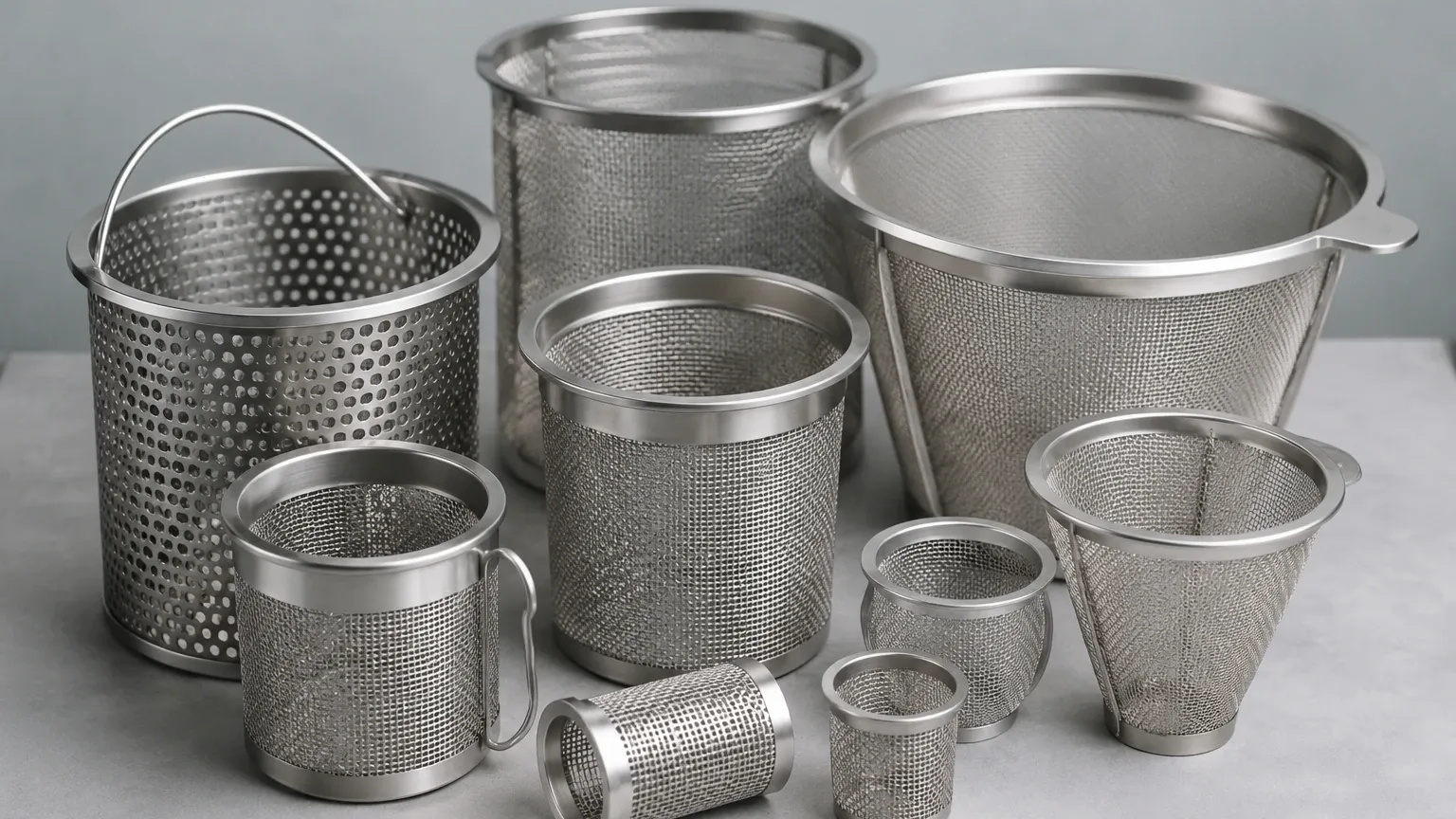
* Coarse Strainers: Used for removing large debris (1/8" to 1/16" perforations).
* Medium Filtration: Utilizing wire mesh to capture particles down to 40-100 microns.
* Fine Filtration: Multi-layered sintered mesh or high-density weaves can capture particles as small as 5-10 microns.
Industrial Strainers & Baskets are manufactured to strict tolerances. The mesh count (the number of wires per linear inch) and the wire diameter are carefully selected to balance filtration efficiency with the available open area. A higher open area percentage reduces the initial pressure drop across the filter, which saves energy and extends the time between cleaning cycles.
Custom Engineering: Why One Size Does Not Fit All
One of the biggest limitations of sourcing through mass-market platforms is the lack of customization. Industrial systems are rarely "standard." Every pipeline has unique flow rates, viscosity profiles, and space constraints.
Professional manufacturers like Kaifil specialize in custom-designed filtration solutions. This includes:
* Bespoke Dimensions: Baskets designed to fit existing housings from various OEMs, ensuring a perfect seal and preventing "bypass" (where fluid escapes around the edges of the filter).
* Handle Variations: Slant handles, heavy-duty lifting lugs, or specialized grips for easy removal in tight spaces.
* Magnetic Inserts: Adding magnetic rods to a strainer basket to capture fine ferrous particles that might pass through a standard mesh.
* Multi-Stage Filtration: Designing baskets with multiple layers of different mesh sizes to provide graduated filtration, which prevents premature clogging of the finest layer.
When an engineer searches for a "strainer basket temu," they are limited to what is in stock. When they work with an industrial partner, they can specify the exact parameters required for their specific application.
Maintenance, Cleaning, and Total Cost of Ownership
While the initial purchase price of a consumer-grade strainer is low, the Total Cost of Ownership (TCO) in an industrial setting can be astronomical if the part fails.
The Cost of Downtime
If a low-quality strainer basket breaks and allows debris to enter a high-speed centrifugal pump, the resulting repair costs and production downtime can reach tens of thousands of dollars. An industrial-grade basket is an insurance policy against such events.
Cleanability
Industrial strainers are designed for repeated cleaning. Whether through manual washing, ultrasonic baths, or Clean-In-Place (CIP) systems, the materials and construction must withstand the cleaning agents and mechanical stresses involved. Consumer products often degrade after a few cycles of rigorous cleaning, leading to rust or mesh detachment.
Longevity
A well-engineered stainless steel strainer basket can last for years in a professional environment. By investing in quality materials and construction up front, procurement teams reduce the frequency of replacements and the associated labor costs.
Key Information to Confirm Before Purchasing
Before moving forward with a filtration solution, engineers and purchasing managers should verify the following technical details with their supplier:
1. Material Grade: Confirm if the application requires SS304, SS316, SS316L, or a specialty alloy like Monel or Hastelloy.
2. Micron/Perforation Size: Define the exact particle size that needs to be removed to protect downstream equipment.
3. Flow Rate and Pressure Drop: Ensure the basket has enough open area to handle the system's flow without causing excessive pressure loss.
4. Operating Temperature: Verify that all components, including seals and gaskets (EPDM, Viton, PTFE), are rated for the process temperature.
5. Connection Type: Ensure the basket flange or ring matches the housing seat to prevent bypass.
Conclusion
The search for a "strainer basket temu" reflects a modern desire for convenience and cost-efficiency. While these platforms are excellent for domestic needs, industrial filtration requires a significantly higher standard of engineering. For professional applications in chemical processing, food production, and water treatment, the reliability of Strainers & Baskets is paramount.
By focusing on material integrity, structural design, and precise filtration ratings, companies can ensure their systems operate safely and efficiently. Partnering with a specialized manufacturer like Kaifil allows for the development of customized solutions that meet the rigorous demands of the industrial landscape, providing long-term value that far outweighs the initial savings of a consumer-grade alternative.
