


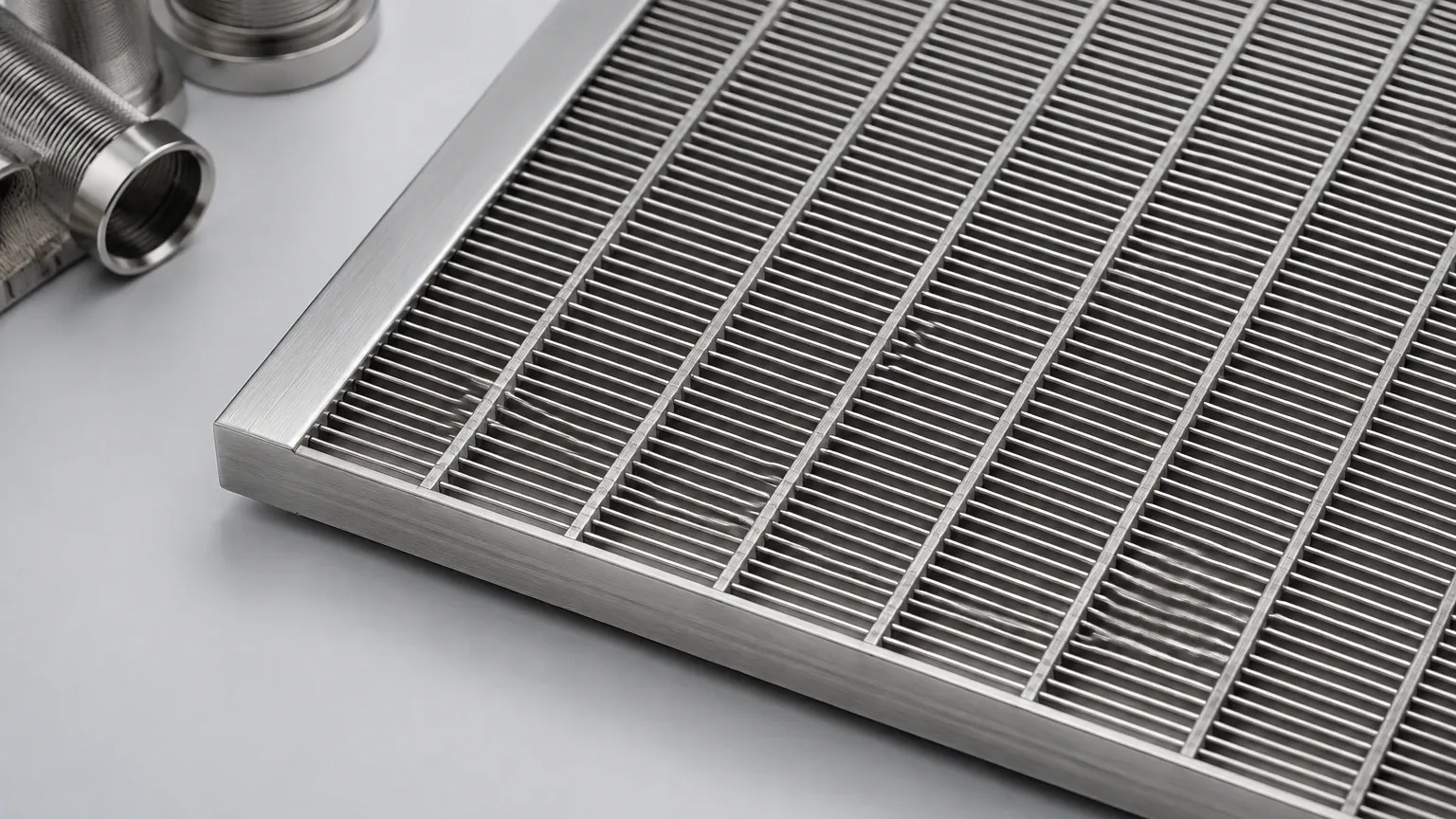
Flat Wedge Wire Screen
In the landscape of industrial filtration and separation, the flat wedge wire screen stands as a cornerstone technology for applications requiring high mechanical strength, precision aperture control, and superior resistance to clogging. Unlike traditional woven wire mesh or perforated plates, wedge wire is an engineered product characterized by its unique V-shaped profile wire and robust support structure. For engineers and procurement specialists, understanding the technical nuances of these components is essential for optimizing process efficiency and extending the service life of filtration equipment.
As a specialized manufacturer, Kaifil provides precision-engineered Wedge Wire Screens designed to meet the rigorous demands of the chemical processing, food and beverage, and pharmaceutical industries. This guide examines the engineering principles, material considerations, and selection criteria necessary for integrating flat wedge wire screens into industrial systems.
Engineering Fundamentals of Wedge Wire Construction
A flat wedge wire screen is fabricated through a sophisticated resistance welding process. The screen consists of two primary components: the surface profile wire (often referred to as the V-wire) and the underlying support rods.
The V-Shaped Profile
The defining characteristic of this technology is the V-shaped cross-section of the surface wire. During the manufacturing process, the wire is positioned with the flat side facing the flow of the medium. This orientation creates a slot that widens inwardly. In a filtration context, this means that any particle small enough to pass through the initial aperture will continue through the screen without becoming wedged or "blinded" within the gap. This self-cleaning property is the primary reason engineers specify a flat wedge wire screen over woven mesh for high-solids or high-viscosity applications.
Resistance Welding and Structural Integrity
Unlike woven products where wires are simply interlaced, wedge wire components are fusion-welded at every intersection between the profile wire and the support rod. This creates a monolithic structure that can withstand significant pressure differentials and mechanical vibrations. The spacing and geometry of the support rods are calculated based on the intended load-bearing requirements of the application, ensuring that the screen maintains its flatness and slot accuracy under operational stress.
Advantages of the Flat Configuration
While wedge wire can be formed into cylinders or cones, the flat wedge wire screen remains one of the most versatile formats in industrial design. Its flat geometry allows for easy integration into existing housings, vibrating equipment, and gravity-fed systems.
1. High Open Area Efficiency: By adjusting the width of the profile wire and the slot size, manufacturers can achieve a high percentage of open area. This minimizes pressure drop across the screen, which is critical for maintaining high flow rates in gravity or low-pressure systems.
2. Mechanical Rigidity: The welded construction provides inherent stiffness. In applications like vibrating shakers or heavy-duty floor drains, the screen acts as a structural element, resisting deformation that would otherwise lead to bypass or mechanical failure.
3. Precision Slot Tolerances: Industrial processes often require exact particle size cut-offs. Modern CNC-controlled welding allows for slot tolerances as tight as ±0.02mm, providing a level of consistency that is difficult to achieve with textile-based filtration media.
4. Ease of Cleaning: The smooth surface profile allows for efficient mechanical cleaning via scrapers or brushes. Furthermore, the lack of wire crossovers (common in woven mesh) eliminates "dead zones" where bacteria or contaminants can accumulate, making it an ideal choice for sanitary applications in the pharmaceutical and food sectors.
Material Selection and Chemical Compatibility
The performance of a flat wedge wire screen is heavily dependent on the alloy selected. Because these screens are often used in corrosive or high-temperature environments, material science plays a pivotal role in the specification process.
* Grade 304 Stainless Steel: The standard choice for general industrial applications, offering good corrosion resistance and cost-effectiveness. It is widely used in water treatment and general food processing.
* Grade 316L Stainless Steel: Containing molybdenum, this alloy provides superior resistance to chlorides and pitting. It is the preferred material for pharmaceutical manufacturing, marine environments, and chemical processing where aggressive cleaning agents are used.
* Duplex and Super Duplex: For extreme environments involving high pressure and highly corrosive media (such as oil and gas or mining), duplex steels offer twice the yield strength of austenitic stainless steels and exceptional resistance to stress corrosion cracking.
* Specialty Alloys: In specific high-temperature or highly acidic environments, materials such as Monel, Hastelloy, or 904L may be specified to ensure the longevity of the filtration component.
Key Performance Metrics: Slot Size and Open Area
When specifying a flat wedge wire screen, engineers must balance the requirement for filtration fineness (slot size) with the need for flow capacity (open area).
Calculating Open Area
The open area percentage is determined by the ratio of the slot width to the total pitch (slot width plus wire width). The formula is expressed as:
Open Area % = [Slot Width / (Slot Width + Wire Width)] × 100
For example, a screen with a 0.5mm slot and a 1.5mm wide profile wire would have an open area of 25%. Increasing the open area reduces the velocity of the fluid passing through the screen, which can help prevent particle impingement and reduce wear on the wire profiles.
Slot Size Selection
The slot size is typically determined by the "minimum particle size" that must be retained. However, in many industrial processes, a "filter cake" of solids builds up on the surface of the screen, which actually performs the fine filtration. In these cases, the wedge wire screen acts as a support medium, and the slot size may be slightly larger than the smallest particles in the feed.
Industrial Applications and Case Use
The versatility of the flat wedge wire screen allows it to be utilized across a broad spectrum of industries, each with unique operational requirements.
Food and Beverage Processing
In the brewing industry, flat screens are used as "false bottoms" in lauter tuns. The screen must support the weight of the grain bed while allowing the wort to drain efficiently. The precision slots ensure that the grain is retained while the liquid passes through clear. Similarly, in sugar processing and fruit juice extraction, these screens provide a durable surface for separating pulp and solids from liquids.
Mining and Mineral Processing
Flat screens are frequently used in vibrating equipment for dewatering and sizing ores. The high impact resistance of the welded stainless steel construction allows the screen to handle heavy abrasive loads without losing slot integrity. The non-blinding characteristics are particularly valuable when dealing with wet, sticky materials that would clog traditional perforated plates.
Chemical and Petrochemical
In catalyst recovery and resin traps, the flat wedge wire screen provides a reliable barrier to prevent the loss of expensive process media. The ability to manufacture these screens in high-nickel alloys ensures compatibility with a wide range of chemical reagents and operating temperatures.
Pulp and Paper
Screens are used in fiber recovery and wastewater treatment within paper mills. The ability to handle high volumes of water while effectively capturing fine wood fibers is essential for both process efficiency and environmental compliance.
Specifying Custom Flat Wedge Wire Screens
To ensure the optimal performance of a filtration system, several technical parameters must be confirmed during the design and procurement phase. Kaifil works closely with engineering teams to customize screens based on the following data points:
1. Dimensions: Length and width, including any required tolerances for fitting into existing frames.
2. Slot Opening: The required gap between wires, typically ranging from 0.05mm to 10mm or more.
3. Wire Profile: Selection of the surface wire shape (e.g., 12S, 22S, 32S) based on the required wear life and flow characteristics.
4. Support Rod Configuration: The spacing and type of support rods (round, rectangular, or triangular) required to meet the calculated collapse pressure or load-bearing requirements.
5. Edge Treatment: Whether the screen requires a simple cut edge, a welded frame, side angles, or reinforcement bars for mounting.
6. Surface Finish: Options include mill finish, pickling and passivation for corrosion resistance, or electropolishing for high-purity pharmaceutical applications.
Maintenance, Cleaning, and Service Life
One of the primary B2B advantages of wedge wire is the low total cost of ownership (TCO). While the initial investment may be higher than woven mesh, the durability and ease of maintenance often lead to a faster ROI.
Cleaning Protocols
Because the slots widen inwardly, most particles that pass the surface will not get stuck. For surface-retained solids, cleaning can be achieved through:
* Backwashing: Reversing the flow of fluid to dislodge the filter cake.
* Mechanical Scraping: Using a blade to move across the flat surface of the wires.
* Ultrasonic Cleaning: For fine-slot screens used in lab or high-precision environments.
Evaluating Replacement Cycles
While stainless steel wedge wire is highly durable, it is not immune to wear. In abrasive applications, the sharp edges of the V-wire will eventually round off, which can alter the filtration characteristics and reduce the self-cleaning efficiency. Regular inspection of the slot widths using feeler gauges or optical comparators is recommended to ensure the screen remains within the specified process tolerances.
Conclusion
The flat wedge wire screen is a high-performance engineering solution that addresses the fundamental challenges of industrial separation: clogging, mechanical failure, and maintenance downtime. By selecting the appropriate wire profiles, materials, and support structures, engineers can create a filtration environment that is both efficient and exceptionally durable.
For organizations seeking reliable OEM or customized filtration components, Kaifil offers the technical expertise and manufacturing precision required to deliver high-performance Wedge Wire Screens tailored to specific industrial environments. From initial material selection to final production, our focus remains on providing dependable solutions that optimize the total cost of ownership and ensure process consistency.
