


V Wire Well Screen
In the realm of groundwater extraction and industrial fluid management, the efficiency of a well is fundamentally dictated by the interface between the aquifer and the pump. The v wire well screen, a specialized configuration of Wedge Wire Screens, serves as this critical interface. Engineered to provide maximum open area while maintaining structural integrity, these screens are the industry standard for high-performance water wells, geothermal systems, and industrial intake applications.
Understanding the technical nuances of the v wire well screen—from its geometric design to material metallurgy—is essential for engineers and procurement teams tasked with ensuring long-term well productivity and minimizing the total cost of ownership. This guide examines the engineering principles, selection criteria, and operational advantages of utilizing advanced wedge wire technology in well construction.
Engineering Principles of V Wire Well Screens
The primary distinction of a v wire well screen lies in its structural geometry. Unlike conventional perforated pipes or bridge slot screens, the v wire design utilizes a cold-rolled, triangular-shaped wire that is helically wrapped around an internal array of longitudinal support rods. Every point where the wire intersects a rod is fused through high-intensity resistance welding.
The V-Shaped Profile Advantage
This construction creates a continuous slot that is narrower at the outer surface and widens inwardly. This "V" profile is engineered to facilitate a "point contact" between the screen and the surrounding filter pack or formation material. In practical terms, any particle that is small enough to pass through the outer width of the slot will easily pass through the widening interior of the screen without becoming wedged. This self-cleaning characteristic significantly reduces the risk of clogging and ensures consistent flow rates over the lifespan of the well.
Continuous Slot Design
The helical wrapping process allows for a continuous slot that extends around the entire circumference of the screen. This design maximizes the available open area compared to punched or slotted pipes. A higher open area translates directly to lower entrance velocities for the fluid, which is a critical factor in preventing sand infiltration and reducing the rate of chemical encrustation and mechanical corrosion.
Material Selection and Durability Factors
Industrial filtration environments, particularly in deep-well applications, subject screens to significant mechanical stress and chemical aggression. Selecting the appropriate material for a v wire well screen is a balance between mechanical strength, corrosion resistance, and project budget.
Stainless Steel Grades
Kaifil utilizes various grades of stainless steel to meet specific environmental demands:
* Grade 304: The standard choice for most freshwater applications. It offers excellent mechanical properties and sufficient corrosion resistance for neutral pH environments.
* Grade 316L: Recommended for brackish water or environments with higher chloride concentrations. The addition of molybdenum enhances resistance to pitting and crevice corrosion.
* Duplex Stainless Steels: For highly aggressive geothermal or deep-sea applications, duplex alloys provide superior yield strength and exceptional resistance to stress corrosion cracking.
Collapse Strength and Tensile Loading
Engineers must calculate the anticipated hydrostatic pressure and the weight of the screen string to ensure structural stability. The collapse strength of a v wire well screen is determined by the size and spacing of the internal support rods and the profile of the V-wire itself. In deep-well scenarios, heavy-duty support rods are utilized to withstand the immense pressures exerted by the surrounding formation and the weight of the pump assembly.
Performance Evaluation: Open Area and Flow Dynamics
The performance of a well is often measured by its specific capacity—the yield per unit of drawdown. The v wire well screen optimizes this metric through superior hydraulic efficiency.
Calculating Open Area
The open area is the percentage of the screen surface that allows fluid passage. It is calculated based on the slot width and the wire width. For example, a screen with a 0.5mm slot and a 2mm wire width provides significantly more open area than a perforated pipe with 10mm holes spaced 20mm apart.
Entrance Velocity and Head Loss
High entrance velocities (the speed at which water enters the screen) can lead to several failures:
1. Sand Pumping: High-velocity water can carry fine formation particles through the filter pack and into the well, damaging pumps and clogging downstream equipment.
2. Encrustation: Rapid pressure drops at the screen interface can cause dissolved minerals (like calcium carbonate) to precipitate, blocking the slots.
3. Frictional Head Loss: Efficient screens minimize the energy required to pull water into the well, reducing the electrical costs associated with pumping.
By maximizing the open area, the v wire well screen maintains low entrance velocities, typically recommended to be below 0.03 meters per second (0.1 feet per second) for optimal longevity.
Customization Options for Industrial Applications
Every geological formation and industrial process presents unique challenges. A "one-size-fits-all" approach rarely yields optimal results. Customization of Wedge Wire Screens allows engineers to tailor the screen to the specific grain size distribution of the aquifer.
Slot Size Precision
Slot sizes can be customized with tolerances as tight as ±0.05mm. The selection of the slot size is usually based on a sieve analysis of the formation material. Generally, the slot size is chosen to retain 90% to 100% of the filter pack material, or 40% to 60% of the natural formation in a naturally developed well.
End Fittings and Integration
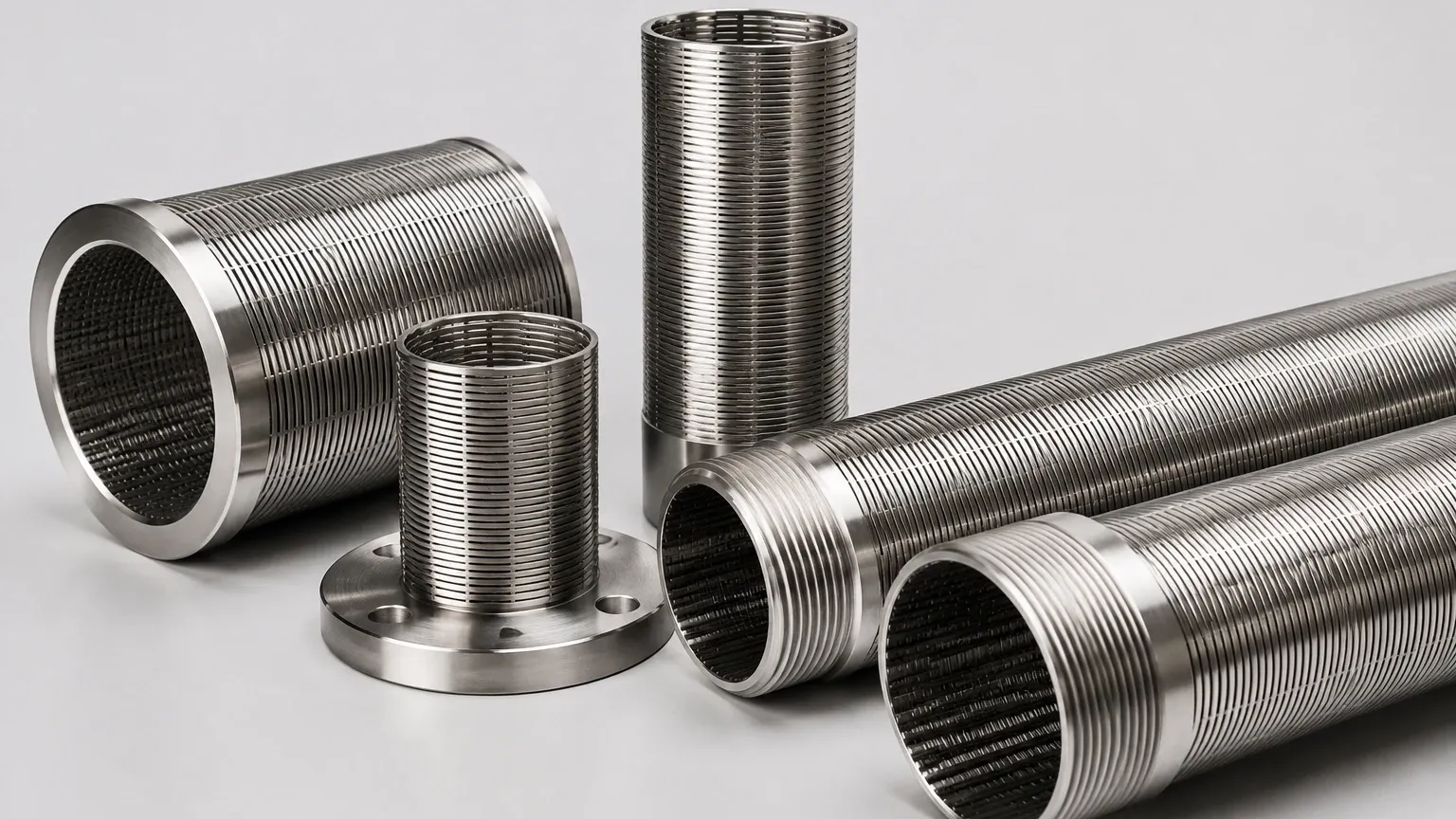
To ensure seamless integration into the well casing string, v wire well screens can be manufactured with various end connections:
* Threaded Couplings: API or NPT threads for easy assembly on-site.
* Weld Rings: Beveled edges for permanent, high-strength welding to the casing.
* Flange Connections: Often used in industrial intake systems or large-diameter water treatment vessels.
Reinforcement and Diameter Variations
Screens can be produced in diameters ranging from 1 inch to over 40 inches. For high-pressure applications, the internal support rods can be reinforced or the wire profile can be thickened to increase the moment of inertia, providing higher resistance to deformation.
Installation and Maintenance Considerations
The longevity of a v wire well screen is not only dependent on its manufacture but also on proper installation and subsequent maintenance.
Well Development
After the screen is placed, the well must be "developed." This process involves surging or jetting water through the screen to remove fine silts and clays from the formation. The v wire design is particularly robust during this phase, as its smooth internal surface allows for the effective use of development tools like surge blocks or high-pressure jetting nozzles without damaging the screen.
Cleaning and Rehabilitation
Over years of operation, even the most efficient screens may experience some degree of fouling from bio-growth or mineral scaling. Because v wire well screens are typically made from high-grade stainless steel, they can withstand aggressive rehabilitation techniques. This includes chemical acidizing to dissolve mineral deposits or mechanical brushing and jetting. The structural integrity of the welded wedge wire ensures that the screen remains intact during these high-stress maintenance procedures.
Total Cost of Ownership and Selection Strategy
When evaluating the procurement of a v wire well screen, it is vital to look beyond the initial purchase price. The total cost of ownership (TCO) includes installation costs, energy consumption for pumping, maintenance frequency, and the anticipated lifespan of the well.
Operational Efficiency
A high-quality wedge wire screen reduces drawdown, which in turn reduces the vertical lift required by the pump. This leads to significant energy savings over the life of the well. Furthermore, the reduction in sand infiltration extends the life of the submersible pump, which is often one of the most expensive components to replace in a well system.
Risk Mitigation
Choosing a screen with insufficient collapse strength or poor corrosion resistance can lead to catastrophic well failure. A collapsed screen often necessitates the abandonment of the entire well and the drilling of a replacement, costing hundreds of thousands of dollars. Investing in a precision-engineered v wire well screen from a specialized manufacturer like Kaifil mitigates these risks by providing a component designed for the specific pressures and chemistries of the site.
Conclusion for Engineers and Purchasing Teams
Selecting the right v wire well screen requires a deep understanding of the site-specific geological and chemical conditions. By focusing on the precision of the slot width, the quality of the stainless steel alloy, and the structural design of the support rods, technical professionals can ensure their filtration systems operate at peak efficiency. As a manufacturer specializing in custom stainless steel filtration solutions, Kaifil provides the engineering expertise and manufacturing precision necessary to deliver high-performance Wedge Wire Screens tailored to the most demanding industrial environments.
