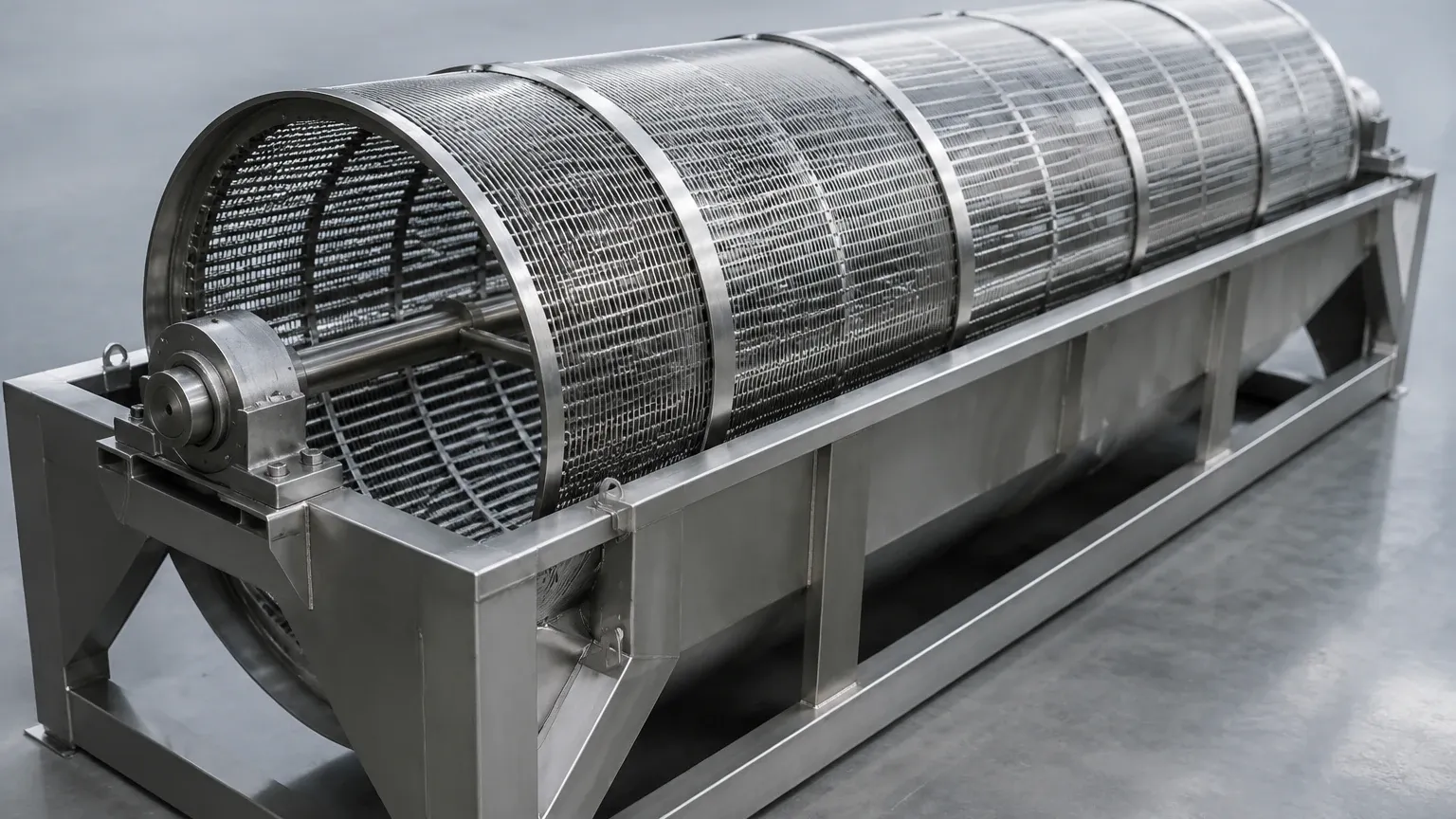
Wedge Wire Rotary Drum Screen
In industrial solid-liquid separation, the efficiency of a filtration system is often determined by its ability to handle continuous high-volume throughput without frequent downtime for cleaning or maintenance. The wedge wire rotary drum screen stands as a critical component in many process industries, offering a mechanical self-cleaning solution that utilizes the unique geometric properties of profile wire. By integrating Wedge Wire Screens into a rotating drum assembly, engineers can achieve precise separation, high flow rates, and exceptional durability in demanding environments.
The Engineering Principles of Wedge Wire Screens
To understand the performance of a wedge wire rotary drum screen, one must first examine the fundamental design of the filtration media itself. Unlike traditional woven wire mesh or perforated plates, wedge wire is constructed from V-shaped profile wires that are resistance-welded onto support rods at each intersection.
This V-shaped profile creates a slot that widens inwardly. In a filtration context, this means that any particle small enough to pass through the surface opening will continue through the screen without becoming wedged or trapped. This "two-point contact" design is what gives wedge wire its non-clogging characteristic, which is essential for the continuous operation of a rotary drum.
For engineers, the selection of the wire profile and the support rod spacing is a balancing act between mechanical strength and open area. A larger wire profile increases the drum's resistance to hydraulic pressure and physical wear but reduces the total open area, which can limit throughput. Conversely, a finer wire increases the open area and filtration precision but may require more frequent support rods to maintain structural integrity under heavy loads.
Structural Design of the Wedge Wire Rotary Drum Screen
A wedge wire rotary drum screen is typically composed of a cylindrical screen, a drive system, a distribution weir or inlet pipe, and a discharge mechanism for the separated solids. The drum itself is the heart of the machine. It is manufactured by wrapping the profile wire around a cage of support rods, creating a continuous slot that remains uniform across the entire circumference of the cylinder.
Internal vs. External Feed Systems
There are two primary configurations for these systems, each suited to different industrial requirements:
1. Internally Fed Rotary Screens: In this design, the influent enters the center of the drum. As the drum rotates, the liquid passes through the wedge wire slots to a collection tank below, while the solids are retained on the inner surface. Internal flights or a slight inclination of the drum transport the solids toward the discharge end. This configuration is often preferred for applications with high solid concentrations or where the solids are particularly abrasive.
2. Externally Fed Rotary Screens: Here, the liquid is distributed over the outer surface of the rotating drum. The filtrate passes through the slots into the drum's interior and is discharged through the end, while the solids remain on the outside and are removed by a fixed doctor blade or scraper. This design is highly efficient for large-scale wastewater treatment and applications where high hydraulic loading is required.
Material Selection and Chemical Compatibility
Because these screens are frequently exposed to corrosive chemicals, high temperatures, and abrasive materials, material selection is paramount. Stainless steel is the industry standard due to its mechanical properties and resistance to oxidation.
* Grade 304 Stainless Steel: Suitable for general industrial applications, including municipal wastewater and some food processing environments where corrosion risks are moderate.
* Grade 316/316L Stainless Steel: Recommended for chemical processing, pharmaceutical production, and marine environments. The addition of molybdenum provides enhanced resistance to chlorides and pitting corrosion.
* Duplex Stainless Steels: For extreme environments involving high pressure or highly aggressive chemical slurries, duplex grades offer superior yield strength and corrosion resistance compared to standard austenitic steels.
When specifying a wedge wire rotary drum screen, engineers must also consider the pH levels and temperature of the process fluid. High temperatures can affect the structural stability of the drum, while extreme pH levels can lead to rapid degradation of the welds if the incorrect alloy is chosen.
Performance Evaluation and Slot Precision
The primary performance metric for a rotary drum screen is its filtration accuracy, defined by the slot width. Slot openings can range from as small as 20 microns to several millimeters.
Precision in slot manufacturing is critical. If the slot width varies across the drum, the filtration efficiency will be compromised, allowing oversized particles to pass through or causing localized clogging in narrower sections. High-quality manufacturing processes ensure that the slot tolerances are kept within strict limits, providing a predictable and repeatable separation process.
Another key factor is the Percentage of Open Area. This is calculated by the ratio of the slot width to the total pitch (slot width plus wire width). A higher percentage of open area results in lower entrance velocities and reduced pressure drops, which in turn extends the life of the screen by reducing the abrasive impact of particles on the wire edges.
Maintenance and Operational Efficiency
One of the most significant advantages of using a wedge wire rotary drum screen is the reduction in total cost of ownership (TCO). While the initial capital expenditure may be higher than that of a mesh-based system, the long-term savings in maintenance and replacement parts are substantial.
Self-Cleaning Mechanisms
The rotation of the drum naturally assists in the removal of solids. However, many systems incorporate additional cleaning features to maintain optimal flow:
* Backwash Sprays: High-pressure nozzles located inside or outside the drum can periodically or continuously flush the slots to remove any adhering particles.
* Scraper Blades: In externally fed systems, a precision-aligned scraper (often made of brass or high-density polymers) removes the "filter cake" from the surface, ensuring the slots remain open for the next rotation cycle.
Wear and Replacement Cycles
Because wedge wire is a rigid, welded structure, it does not suffer from the stretching, tearing, or fraying common with woven wire mesh. In typical municipal applications, a well-maintained wedge wire drum can last for several years. In more abrasive mining or pulp and paper applications, the wire profiles may eventually wear down, increasing the slot width. Regular inspection of the slot dimensions is recommended to ensure the system continues to meet the required filtration specifications.
Industry-Specific Applications
The versatility of the wedge wire rotary drum screen makes it a staple in numerous sectors:
* Wastewater Treatment: Used as a fine screen for the removal of hair, plastics, and organic solids in the primary treatment stage. This protects downstream equipment like pumps and membranes from damage and clogging.
* Food and Beverage Processing: Essential for fruit juice clarification, vegetable washing water recovery, and the separation of spent grains in breweries. The hygienic properties of stainless steel ensure compliance with food safety standards.
* Pulp and Paper: Used for fiber recovery and white water filtration. The ability to handle high flow rates and recover valuable fibers makes it an economically vital component in paper mills.
* Mining and Mineral Processing: Used for dewatering slurries and recovering process water. The heavy-duty construction of the wedge wire allows it to withstand the impact of heavy mineral particles.
* Chemical and Pharmaceutical: Provides precise separation of catalysts or crystalline products from mother liquors, where chemical purity and containment are required.
Engineering Checklist for Customization
When sourcing a wedge wire rotary drum screen for a specific project, engineers should confirm the following technical parameters with the manufacturer:
1. Hydraulic Loading Rate: What is the maximum flow rate the drum can handle without overflowing?
2. Solids Concentration: What is the percentage of solids in the influent, and what is the desired dryness of the discharged solids?
3. Particle Size Distribution: What is the smallest particle that must be retained, and what is the largest particle expected in the feed?
4. Mechanical Drive Requirements: Does the application require a variable frequency drive (VFD) to adjust drum speed based on fluctuating flow rates?
5. Installation Footprint: Are there space constraints that dictate a specific drum diameter-to-length ratio?
By addressing these factors during the design phase, the resulting filtration solution will be optimized for the specific nuances of the application, ensuring reliable performance and minimal operational intervention.
Conclusion
The wedge wire rotary drum screen represents a sophisticated marriage of mechanical engineering and material science. By leveraging the non-clogging properties of Wedge Wire Screens, industrial facilities can achieve a level of filtration efficiency that is difficult to match with other technologies. Whether the goal is to protect downstream equipment, recover valuable materials, or meet environmental discharge regulations, the rotary drum screen provides a robust, durable, and low-maintenance solution for modern industrial challenges.