


Wedge Wire Screen Hsn Code
In the landscape of industrial filtration and mechanical separation, the classification of components for international trade and domestic taxation is as critical as the engineering specifications themselves. For procurement managers and engineers, identifying the correct wedge wire screen hsn code is essential for ensuring regulatory compliance, accurate duty assessment, and seamless logistics. Wedge wire screens, known for their high strength and non-clogging characteristics, are utilized across diverse sectors, including chemical processing, water treatment, and food production.
Understanding the Harmonized System of Nomenclature (HSN) code requires a technical grasp of the product's function and material composition. As a specialized manufacturer of stainless steel filtration solutions, Kaifil provides high-precision Wedge Wire Screens designed to meet rigorous industrial standards. This guide examines the technical nuances of wedge wire screens, their classification logic, and the engineering factors that influence both performance and procurement.
Understanding HSN Classification for Wedge Wire Screens
The HSN code system is an internationally standardized names and numbers for classifying traded products. For wedge wire screens, classification typically falls under two primary chapters of the HSN system, depending on the product's state of fabrication and its intended application.
Chapter 73: Articles of Iron or Steel
Most stainless steel wedge wire components are classified under Chapter 73, specifically within the 7314 heading. This heading covers "Cloth (including endless bands), grill, netting and fencing, of iron or steel wire; expanded metal of iron or steel."
* HSN 7314.14: This sub-heading is often used for other woven cloth of stainless steel. However, since wedge wire is a welded structure rather than a woven one, it may be categorized under 7314.41 (other grill, netting, and fencing, welded at the intersection) or 7314.49 (other).
* HSN 7326: If the wedge wire screen is further fabricated into a specific finished article not elsewhere specified, it may fall under 7326.90, which covers "Other articles of iron or steel."
Chapter 84: Machinery and Mechanical Appliances
If the wedge wire screen is designed and supplied as a dedicated part of a specific filtering or purifying machine, it may be classified under Chapter 84.
* HSN 8421: This heading covers "Centrifuges, including centrifugal dryers; filtering or purifying machinery and apparatus, for liquids or gases." Parts of these machines are classified under HSN 8421.99. When a wedge wire screen is custom-engineered as a replacement part for a specific industrial filter or centrifuge, this code is frequently utilized to reflect its role as a machine component rather than a generic steel article.
Selecting the correct wedge wire screen hsn code requires coordination between the engineering team (who understands the application) and the logistics team (who understands customs regulations). Misclassification can lead to delays or incorrect tax liabilities, particularly in regions like India where the Goods and Services Tax (GST) is tied directly to these codes.
Engineering Principles of Wedge Wire Screens
Beyond classification, the performance of a wedge wire screen is dictated by its geometric precision and material integrity. Unlike traditional woven wire mesh, wedge wire is constructed by welding V-shaped profile wires onto support rods at each intersection. This creates a continuous slot that widens inwardly, a feature that is fundamental to its self-cleaning properties.
The V-Wire Advantage
The "wedge" or "V" shape of the profile wire ensures that particles only have two points of contact at the surface of the screen. If a particle passes through the initial slot opening, it enters an expanding area, significantly reducing the risk of blinding or pegging. This is a critical consideration for engineers designing systems for high-solids loading or viscous fluids.
Slot Opening Precision
The slot opening, or aperture, is the most critical dimension in a wedge wire screen. It determines the filtration rating. Precision manufacturing allows for slot widths as small as 20 microns with extremely tight tolerances. Engineers must balance the slot width with the required flow rate and the mechanical strength necessary to withstand differential pressures.
Material Selection and Corrosion Resistance
Since wedge wire screens are frequently exposed to aggressive chemicals, high temperatures, and abrasive slurries, material selection is a primary engineering concern. Kaifil utilizes various grades of stainless steel to match specific environmental demands.
1. Grade 304/304L: The standard choice for general industrial applications, offering good corrosion resistance and excellent fabrication characteristics. It is widely used in food and beverage processing where hygiene is paramount.
2. Grade 316/316L: Contains molybdenum, which provides superior resistance to chlorides and pitting. This is the preferred material for pharmaceutical applications, chemical processing, and marine environments.
3. Duplex Stainless Steels: For applications involving extreme mechanical stress and highly corrosive media (such as desalination or petrochemical refining), duplex grades offer higher yield strength and enhanced resistance to stress corrosion cracking.
When determining the wedge wire screen hsn code, the material composition (specifically the nickel and chromium content) must be accurately documented, as some customs jurisdictions have specific sub-codes for high-alloy steels.
Structural Integrity and Mechanical Loading
Industrial wedge wire screens are often subjected to significant hydraulic forces, backwashing pressures, and mechanical loads from scrapers or internal agitators. The structural design involves two main components:
* Profile Wires: These define the filtration surface. Their size (width and height) determines the wear life and the open area of the screen.
* Support Rods: These provide the structural skeleton. They can be round, rectangular, or teardrop-shaped. The spacing between support rods is a key variable in calculating the collapse strength and burst pressure of the screen.
Engineers must perform stress analysis to ensure the screen can handle the maximum expected differential pressure (ΔP). In heavy-duty applications, such as mining or intake screens, additional reinforcement rings or outer cages may be integrated into the design.
Customization and OEM Solutions
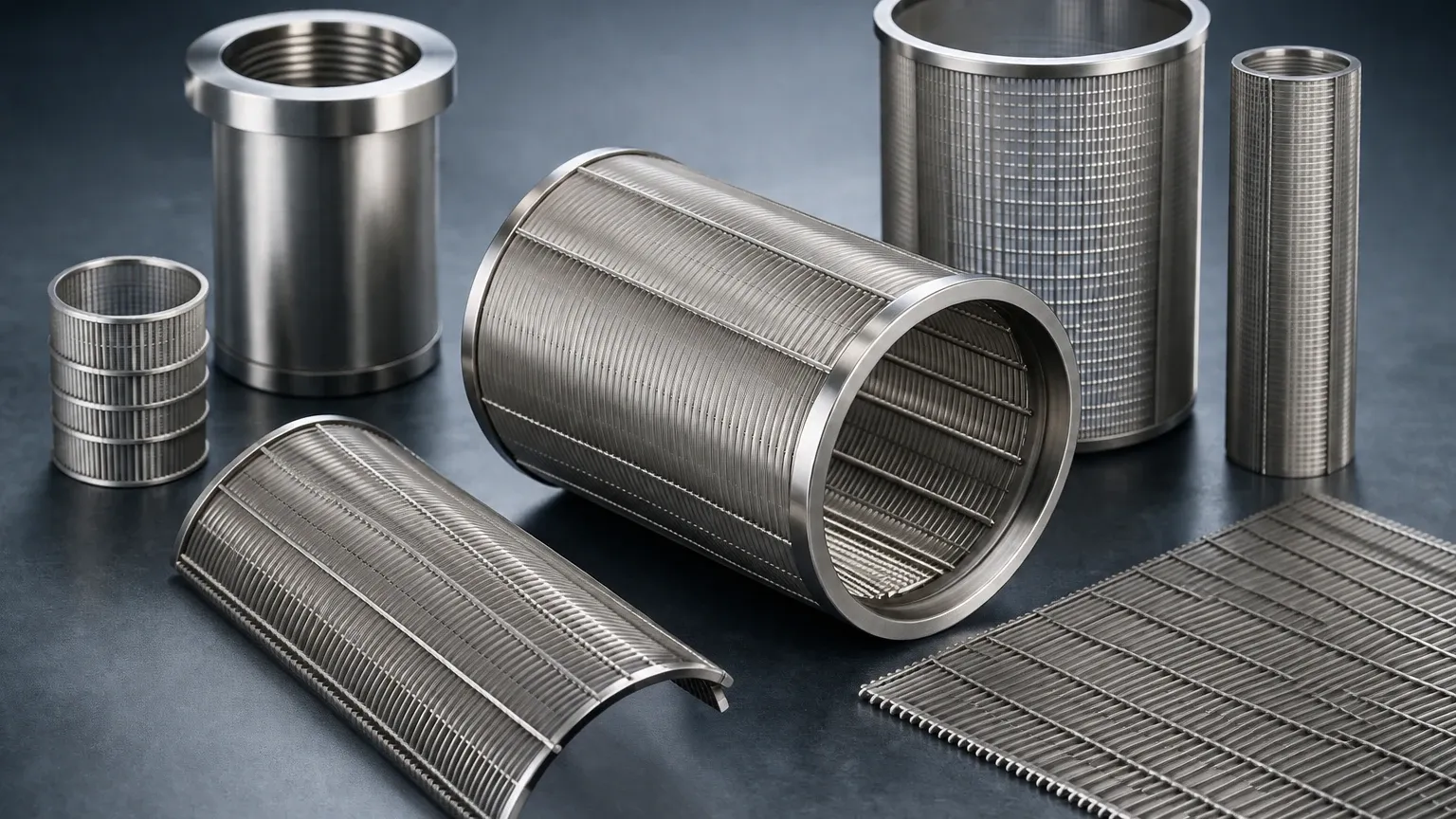
One of the primary reasons for the widespread use of wedge wire is its versatility in form. Unlike standard mesh, which is usually limited to flat or simple cylindrical shapes, wedge wire can be engineered into complex geometries to fit specific equipment. Kaifil specializes in providing OEM solutions that include:
* Cylindrical Filter Elements: Used in internally or externally fed rotary screens, screw presses, and automatic backwash filters. These can be designed for flow from "out-to-in" or "in-to-out."
* Flat Panels and Sieve Bends: Essential for dewatering and sizing in mineral processing and wastewater treatment. The curved profile of a sieve bend utilizes the Coanda effect to increase separation efficiency.
* Support Grids: Used in ion exchange vessels, sand filters, and carbon towers to support the media bed while ensuring uniform flow distribution.
When ordering a customized component, providing the manufacturer with the exact equipment model and the intended function helps in confirming whether the wedge wire screen hsn code should reflect a general steel article or a specific machinery part.
Evaluating Total Cost of Ownership (TCO)
While the initial purchase price of a wedge wire screen may be higher than that of a disposable filter or a simple woven mesh, the total cost of ownership is often lower due to several factors:
* Longevity: The robust welded construction offers a significantly longer service life, reducing the frequency of replacements.
* Operational Efficiency: The non-clogging nature of the V-wire reduces downtime for cleaning and maintenance. It also allows for more effective automated cleaning cycles (backpulsing or mechanical scraping).
* Energy Savings: A well-designed wedge wire screen maintains a lower pressure drop over time compared to media that tends to blind, resulting in lower pumping costs.
Engineers should evaluate these factors during the selection process, moving beyond the "unit cost" to consider the long-term impact on plant productivity.
Conclusion for Procurement and Engineering Teams
Selecting the right filtration component involves a intersection of engineering precision and regulatory awareness. Identifying the appropriate wedge wire screen hsn code is a necessary step in the procurement process to ensure that the transition from manufacturer to site is handled without administrative friction.
For technical professionals, the focus remains on the structural and material specifications that ensure the screen performs reliably in demanding environments. Whether it is a high-pressure hydraulic system or a sensitive food processing line, the choice of profile wire, slot width, and alloy grade will dictate the success of the filtration process.
Kaifil continues to support global industries by manufacturing high-performance stainless steel filtration components tailored to specific application requirements. By combining advanced manufacturing capabilities with deep technical expertise, we help our partners achieve optimal filtration efficiency and durable performance. For those seeking detailed specifications or custom design assistance, we invite you to review product options and application support to find the ideal solution for your industrial challenges.
