


Wedge Wire Screen Used
In the landscape of industrial filtration and separation, the efficiency of a system often hinges on the mechanical integrity and precision of its primary screening media. Among the various options available to engineers, wedge wire screens stand out due to their unique construction and hydraulic performance. Understanding how and why a wedge wire screen used in specific industrial contexts can significantly impact the operational lifespan and maintenance costs of a filtration system.
At its core, a wedge wire screen is a precision-engineered metal structure composed of V-shaped profile wires that are resistance-welded onto support rods at each intersection. This design creates a continuous slot that widens inwardly, a feature that is fundamental to its non-clogging characteristics. For technical professionals and purchasing teams, selecting the right filtration component requires a deep dive into the engineering principles that govern these screens.
The Engineering Principles of Wedge Wire Construction
The performance of a wedge wire screen is derived from its geometry. Unlike woven wire mesh, which can suffer from wire shifting or "blinding" as particles become trapped in the intersections, wedge wire maintains a rigid and consistent slot opening.
The V-Shaped Profile
The defining characteristic of the wedge wire is its triangular or V-shaped profile. When the wedge wire screen used in a process, the narrowest part of the slot is at the surface where the fluid enters. As particles pass through the slot, the opening immediately widens. This means that any particle that can fit through the initial opening will pass through the screen without becoming wedged, a phenomenon known as self-cleaning or non-blinding. This is critical for applications involving sticky materials or particles of varying sizes.
Structural Integrity and Welding
The manufacturing process involves high-precision resistance welding. The profile wires are wrapped around support rods (which can be round, rectangular, or teardrop-shaped) and welded at every contact point. This creates a high-strength, single-unit structure capable of withstanding significant pressure differentials and mechanical stresses. Engineers must evaluate the ratio between the profile wire size and the support rod spacing to ensure the screen can handle the required burst or collapse pressure of the specific application.
Industrial Applications: Where is Wedge Wire Screen Used?
The versatility of this technology allows it to be integrated into a wide array of industrial processes. Each industry utilizes the screen differently based on the physical properties of the media being filtered.
Water Treatment and Management
In municipal and industrial water treatment, Wedge Wire Screens are frequently employed as intake screens for rivers or lakes. Their high open area allows for large volumes of water to be drawn in at low velocities, which protects aquatic life and prevents debris from entering the system. Additionally, they are used in ion exchange units as resin traps, ensuring that expensive resin beads remain within the vessel while allowing the treated water to pass through freely.
Food and Beverage Processing
In the brewing industry, wedge wire is the standard material for lauter tun bottoms. The precision slots allow for the efficient separation of wort from the grain bed. Because the screens are typically made from food-grade stainless steel (such as SS304 or SS316L), they meet strict hygiene standards and can withstand the rigorous Clean-In-Place (CIP) cycles required in food production. They are also used in sugar refining, fruit juice extraction, and vegetable processing for dewatering and solids recovery.
Petrochemical and Chemical Industries
Chemical processing environments often involve corrosive fluids and high temperatures. Wedge wire screens are used as catalyst bed supports in reactors and as internal components in separators. The choice of material is paramount here; while SS316L is common, more exotic alloys like Duplex stainless steel or Monel may be specified for high-chloride or acidic environments. The mechanical rigidity of the screen ensures that it does not deform under the weight of the catalyst or the force of high-pressure gas flows.
Mining and Mineral Processing
In the mining sector, the wedge wire screen used primarily for dewatering, sizing, and media recovery. Vibratory screens and centrifugal dryers utilize wedge wire panels because they can handle the abrasive nature of ores and coal. The durability of the welded structure means fewer replacements and less downtime in high-throughput operations.
Technical Criteria for Selecting Wedge Wire Screens
When specifying a wedge wire component, engineers must move beyond basic dimensions and consider the technical parameters that dictate performance.
Slot Size and Tolerance
The slot size (the gap between profile wires) determines the filtration rating. Wedge wire can be manufactured with slots as small as 20 microns or as large as several millimeters. However, the precision of these slots is what determines the effectiveness of the separation. A high-quality manufacturer ensures that the slot tolerance is tight across the entire surface of the screen to prevent bypass of oversized particles.
Open Area Calculation
The open area is the percentage of the total screen surface that is available for fluid flow. It is calculated based on the slot width and the width of the profile wire. A higher open area results in a lower pressure drop and higher flow capacity. Engineers must balance the need for a high open area with the requirement for mechanical strength; using a thinner profile wire increases the open area but reduces the overall durability of the screen.
Flow Direction
Wedge wire screens can be designed for flow from the outside-in (FOTI) or inside-out (FITO). The orientation of the V-shape relative to the flow direction is critical. For external filtration, the flat side of the V-wire faces outward. For internal filtration, such as in a rotary drum screen, the flat side faces inward. Incorrect orientation will lead to immediate clogging and potential structural failure.
Material Selection and Corrosion Resistance
Material choice is the first line of defense against premature failure. Kaifil specializes in stainless steel solutions because of the material's inherent strength and resistance to oxidation.
* Grade 304: Suitable for general industrial use, water filtration, and standard atmospheric conditions.
* Grade 316L: Contains molybdenum, providing superior resistance to pitting and crevice corrosion in chloride-rich environments. This is the preferred choice for marine applications and many chemical processes.
* Duplex Stainless Steel: Offers even higher mechanical strength and enhanced resistance to stress corrosion cracking, often used in heavy-duty mining or high-pressure oil and gas applications.
Engineers should also consider the surface finish. Electropolishing can be applied to stainless steel wedge wire to further improve corrosion resistance and create an ultra-smooth surface that reduces particle adhesion, which is particularly beneficial in the pharmaceutical and food industries.
Maintenance, Cleaning, and Longevity
One of the primary reasons a wedge wire screen used in automated systems is its compatibility with backwashing and mechanical cleaning.
Backwashing Efficiency
Because the slots widen inwardly, a reverse flow of fluid (backwashing) can easily dislodge particles trapped on the surface. This allows for continuous operation without the need to disassemble the filter housing for manual cleaning. The smooth surface of the profile wires also facilitates the use of scrapers or brushes in rotary screen applications.
Total Cost of Ownership (TCO)
While the initial purchase price of a wedge wire screen may be higher than that of a disposable cartridge or a woven mesh screen, the TCO is often significantly lower. The durability of the welded stainless steel construction means that the screen can often last for years, if not decades, with proper maintenance. The reduction in downtime, labor costs for replacement, and the elimination of consumable filter waste contribute to a more sustainable and cost-effective operation.
Customization and OEM Integration
Every industrial process has unique spatial and performance requirements. Wedge wire technology is highly customizable, allowing it to be integrated into existing equipment or designed into new systems.
1. Flat Panels: Used for vibratory sieves, flooring, and architectural grilles.
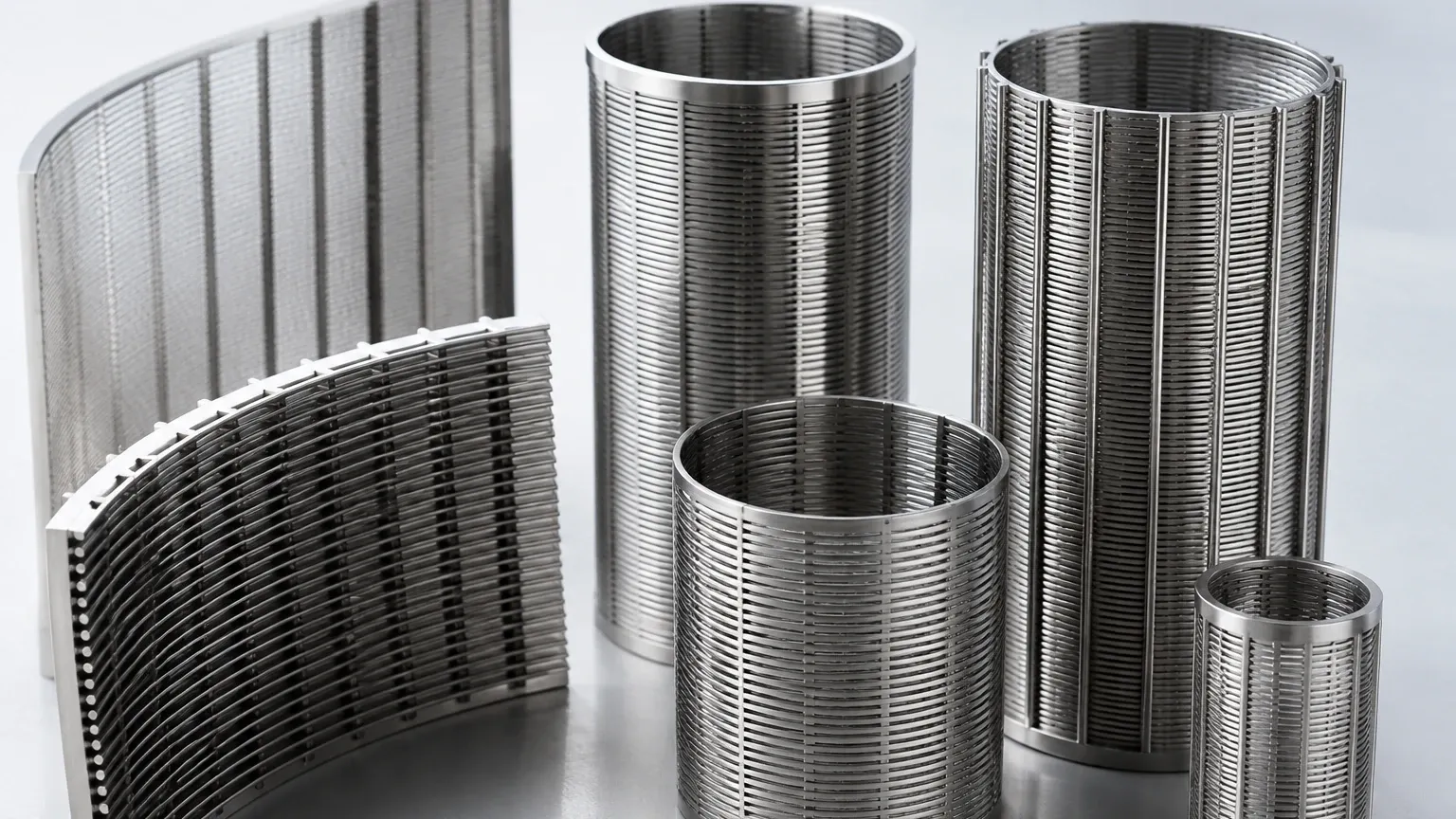
2. Cylinders and Tubes: Used in candle filters, rotary screens, and pipe strainers. These can be fabricated with various end fittings, such as flanges, threaded connectors, or plain ends for welding.
3. Baskets: Custom-shaped baskets are used in centrifugal separators and batch filtration processes.
4. Curved Sieve Bends: Specifically designed for gravity-fed dewatering and sizing applications in the mineral and food industries.
When working with a manufacturer like Kaifil, engineers can specify the exact wire profile, support rod spacing, and overall dimensions to optimize the screen for their specific flow rates and particle loads.
Conclusion: Making Informed Purchasing Decisions
Selecting a wedge wire screen is an engineering decision that requires a thorough understanding of the fluid dynamics and mechanical requirements of the application. By focusing on slot precision, material grade, and the specific V-wire geometry, technical professionals can ensure they are implementing a solution that provides reliable, long-term performance.
Before finalizing a specification, it is recommended to confirm the maximum operating pressure, the chemical composition of the process fluid, and the required flow rate. This information allows for the optimization of the screen design, ensuring that the wedge wire screen used in your facility contributes to maximum efficiency and minimal operational disruption.
