


4 Cup Filter Packs
In the landscape of industrial filtration, the geometry of a filter component is as critical as the material from which it is constructed. While flat filtration media are common, specific applications in polymer processing, chemical manufacturing, and high-pressure hydraulic systems require three-dimensional configurations. Among these, cup-shaped filter packs—often referred to in technical procurement as 4 cup filter packs or deep-drawn filter cups—provide a unique balance of surface area, structural integrity, and flow dynamics.
For engineers and procurement specialists, selecting the correct Filter Discs & Packs involves understanding the interplay between mesh weave, material grade, and the mechanical stresses of the operating environment. This guide examines the technical specifications and engineering considerations for cup-shaped filter packs in industrial B2B applications.
The Engineering Behind Cup-Shaped Filter Packs
Unlike standard flat discs, cup-shaped filter packs are engineered through a process of deep drawing or precision stamping. This transformation of flat wire mesh into a cylindrical or conical "cup" shape significantly increases the available filtration surface area within a fixed diameter. In industrial systems where housing space is limited but high flow rates are required, this geometry is indispensable.
Structural Integrity under Pressure
The "cup" design inherently offers better resistance to axial pressure than a single-layer flat disc. In applications like plastic extrusion or fiber spinning, the melt pressure can reach significant levels. A cup-shaped pack distributes this pressure more evenly across its curved surfaces, reducing the risk of mesh distortion or "blow-through."
Depth vs. Surface Filtration
While many filter packs act as surface filters, multi-layered cup packs can be designed to provide depth filtration. By nesting different mesh counts—coarse on the outside for structural support and fine on the inside for particle retention—engineers can create a gradient that captures particles of varying sizes, thereby extending the service life of the pack and reducing the frequency of system downtime for filter changes.
Material Selection for High-Performance Industrial Filtration
The performance of 4 cup filter packs is fundamentally limited by the metallurgy of the wire mesh. In industrial environments characterized by corrosive chemicals or extreme temperatures, material selection is the primary factor in determining the total cost of ownership.
1. Stainless Steel 304: The standard choice for general industrial applications. It offers excellent strength and basic corrosion resistance, making it suitable for food and beverage processing or standard hydraulic systems.
2. Stainless Steel 316L: For more demanding environments, 316L (low carbon) is preferred. The addition of molybdenum enhances resistance to pitting and crevice corrosion, particularly in chloride-rich environments or pharmaceutical processing where high-purity standards are mandatory.
3. Specialty Alloys: In cases involving extreme acidity or temperatures exceeding 800°C, alloys such as Inconel or Monel may be utilized. These materials maintain their mechanical properties under conditions where standard stainless steels would oxidize or lose structural rigidity.
Structural Design and Mesh Weave Options
The efficiency of a filter pack is defined by its weave. When specifying 4 cup filter packs, engineers must choose a weave that balances filtration fineness with permeability.
Plain Weave
This is the most common and cost-effective weave, where each warp wire crosses over and under each weft wire. It provides high permeability and is easy to clean, making it ideal for low-to-medium viscosity fluids.
Dutch Weave (Plain and Twilled)
Dutch weaves utilize a heavier warp wire and a finer weft wire, resulting in a dense, firm filter cloth. This weave is specifically designed for high-pressure filtration. Plain Dutch weave offers high strength and fine filtration ratings, while Twilled Dutch weave allows for the finest micron ratings (down to 5-10 microns) by layering wires more tightly.
Multi-Layer Sintering and Binding
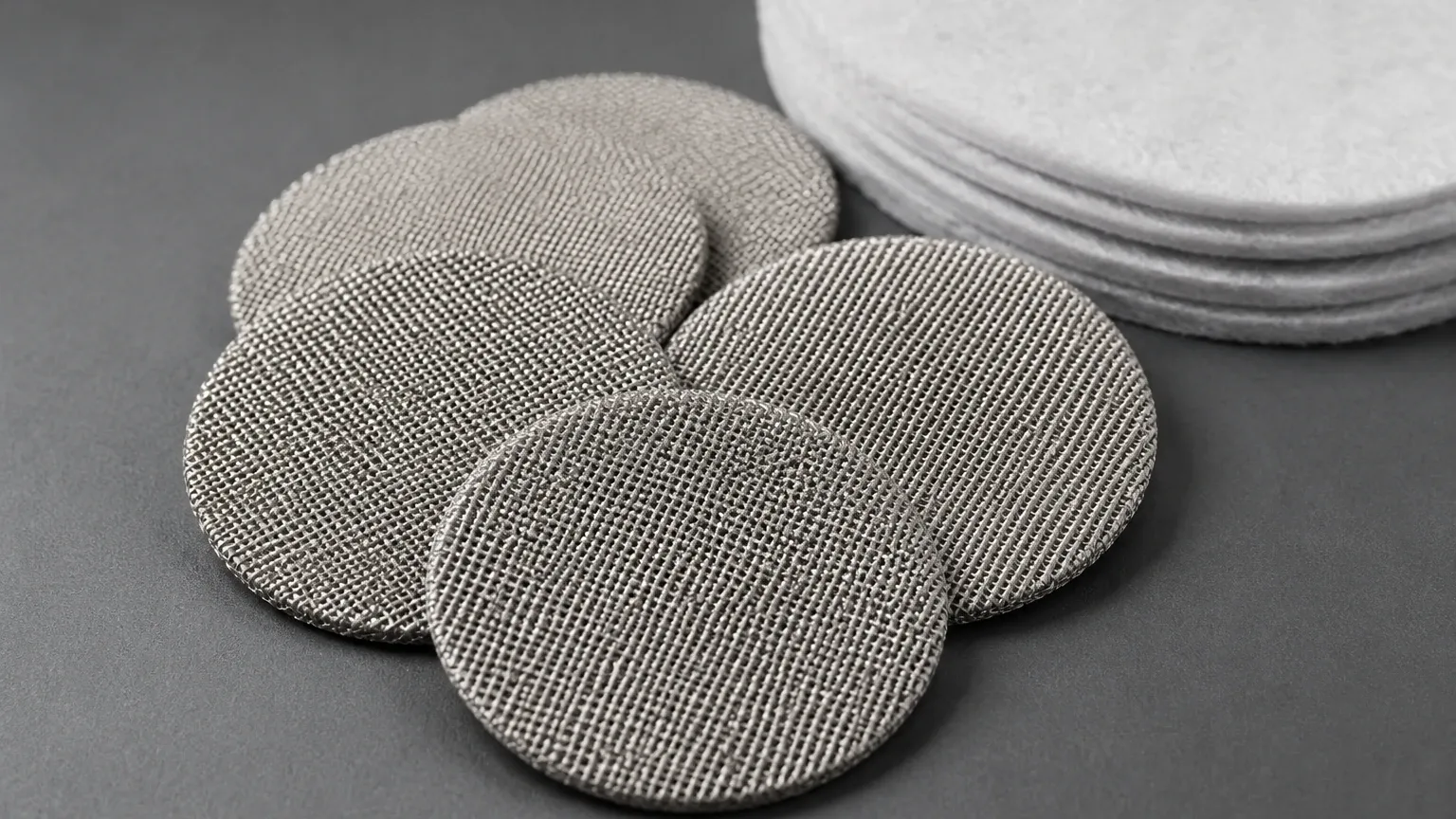
To prevent the edges of the mesh from fraying and to ensure a leak-proof seal within the filter housing, cup packs are often finished with specific edging techniques:
* Spot Welding: Used to bond multiple layers of mesh together at strategic points.
* Aluminum or Copper Rims: A soft metal binding is compressed around the edge of the cup, acting as a gasket to ensure a tight seal against the housing wall.
* Sintering: For the most demanding applications, the mesh layers are diffusion-bonded (sintered) to create a monolithic structure that cannot delaminate under high pressure.
Critical Applications in Polymer and Chemical Processing
The unique geometry of cup-shaped filter packs makes them the preferred choice for several high-stakes industrial processes.
Polymer Melt Filtration
In the production of plastic films, bottles, and synthetic fibers, the polymer melt must be free of degraded gels and foreign contaminants. 4 cup filter packs are installed in the extruder head. The cup shape allows for a larger volume of contaminant buildup before the differential pressure reaches the limit for a screen change, which is vital for continuous production cycles.
Chemical and Petrochemical Processing
Refining processes often involve aggressive solvents and high temperatures. Stainless steel cup filters are used to protect downstream valves and instrumentation from particulate matter. Their ability to be cleaned and reused (via ultrasonic cleaning or chemical burn-off) provides a significant economic advantage over disposable synthetic filters.
Pharmaceutical and Food Production
In these industries, the focus is on hygiene and precision. Stainless steel 316L cup filters ensure that no media migration occurs (common with fiber filters) and that the filtration process remains sterile. The smooth surface of the wire mesh prevents bacterial growth and allows for thorough CIP (Clean-In-Place) procedures.
Selection Criteria: What Engineers Need to Confirm
Before finalizing a purchase order for 4 cup filter packs, technical teams should evaluate the following parameters to ensure application compatibility:
* Micron Rating: Is the requirement for absolute or nominal filtration? Engineers must define the maximum allowable particle size that can pass through the mesh.
* Differential Pressure ($ΔP$): What is the maximum pressure drop the system can tolerate before the filter is considered "blinded"? This determines the required mesh open area.
* Flow Velocity: High-velocity flows can cause wire vibration or erosion. The pack must be engineered to withstand the kinetic energy of the fluid.
* Housing Dimensions: Precision in the deep-drawing process is essential. Even a millimeter of variance in the cup diameter can lead to bypass, where unfiltered fluid escapes around the edges of the pack.
* Chemical Compatibility: Beyond the primary fluid, consider cleaning agents or potential trace contaminants that could cause stress corrosion cracking in the mesh.
Maintenance, Durability, and Cost Considerations
One of the primary B2B advantages of stainless steel Filter Discs & Packs is their longevity. While the initial capital expenditure for a high-quality metal cup pack is higher than for a polymer or paper equivalent, the total cost of ownership is often lower due to several factors:
Cleanability and Reuse
Unlike disposable filters, stainless steel mesh can be cleaned multiple times. Methods such as backwashing, ultrasonic cleaning, or solvent soaking can restore the filter to near-original permeability. This reduces waste disposal costs and the logistical burden of maintaining high inventory levels of disposable units.
Replacement Cycles
The replacement cycle for industrial cup filters is typically governed by the differential pressure. Once the $ΔP$ reaches a predetermined threshold, the pack is removed. In high-volume extrusion lines, the use of a "continuous screen changer" allows for the replacement of these packs without stopping the production line, but the quality of the pack itself determines how often this cycle must occur.
Common Risks in Procurement
Low-quality filter packs often suffer from inconsistent mesh counts or poor welding at the seams. For an engineer, a failure in a $50 filter pack can lead to $50,000 in lost production time or damaged downstream equipment. It is essential to partner with a manufacturer that provides material certifications (MTRs) and performs rigorous quality control, such as bubble point testing, to ensure that every pack meets the specified micron rating.
In conclusion, 4 cup filter packs are high-precision components that require a deep understanding of material science and fluid dynamics. By focusing on the specific needs of the application—whether it is the high-pressure environment of a polymer extruder or the sterile requirements of a pharmaceutical lab—purchasing teams can select filtration solutions that optimize performance and minimize long-term operational costs.
