


Engineering Guide to Sintered Wire Mesh Filter Technology
In high-pressure and high-temperature industrial environments, traditional filtration media often fail due to structural instability or chemical degradation. The sintered wire mesh filter has emerged as a critical component for engineers requiring a balance of high mechanical strength, precise filtration accuracy, and long-term durability. Unlike standard wire cloth, which can shift under pressure, sintered mesh undergoes a thermal diffusion bonding process that fuses the contact points of multiple layers of wire mesh into a single, integrated structure.
For technical procurement teams and system designers, understanding the nuances of sintered laminates is essential for optimizing fluid systems in chemical processing, pharmaceuticals, and hydraulic applications. This guide examines the engineering principles, selection criteria, and operational considerations for integrating these components into industrial workflows.
The Sintering Process and Structural Integrity
Sintering is a metallurgical process where multiple layers of stainless steel wire mesh are placed in a high-temperature vacuum furnace. Under controlled pressure and heat, the individual wires bond at every intersection point through molecular diffusion. This occurs without the use of binders or filler metals, ensuring the material remains 100% stainless steel (typically Grade 304 or 316L).
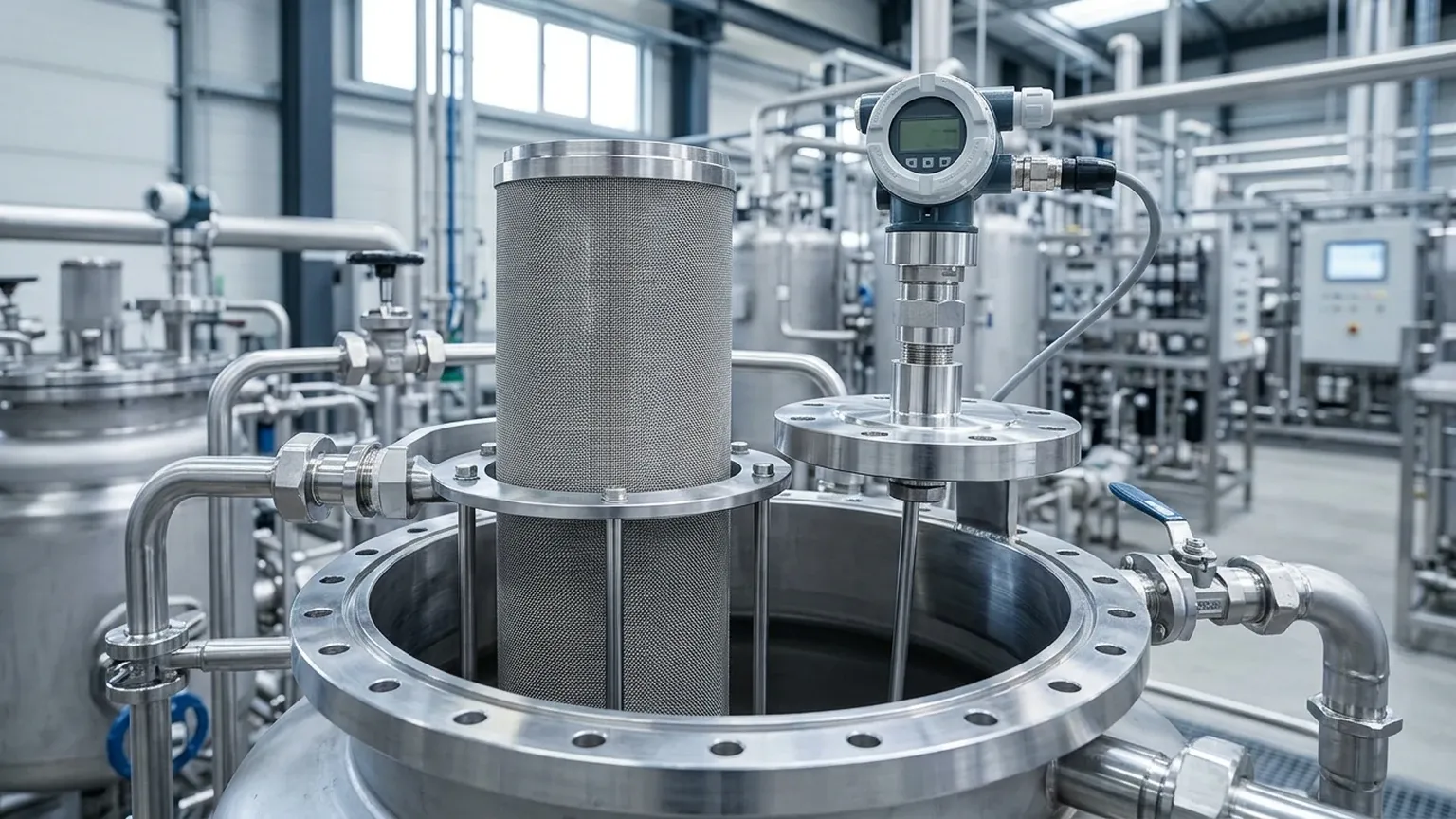
The resulting material retains the permeability of the original mesh but gains the structural rigidity of a solid plate. This is particularly important for Wire Mesh Filter Cylinders & Tubes, where the cylindrical geometry must withstand significant differential pressures without collapsing or deforming the pore structure.
Multi-Layer Laminate Construction
A standard sintered wire mesh filter is often constructed from five distinct layers, each serving a specific mechanical or hydraulic function:
1. Protective Layer: The outermost layer that shields the finer filtration mesh from mechanical damage during handling and installation.
2. Control Layer: The precision-woven mesh that determines the micron rating of the filter. This layer defines the "absolute" filtration threshold.
3. Drainage Layer: A coarser mesh that facilitates the flow of filtrate away from the control layer, reducing localized pressure buildup.
4. Support Layers (2 Layers): Heavy-duty meshes that provide the overall structural backbone, allowing the filter to operate under high-pressure differentials.
Operating Principles: Surface vs. Depth Filtration
While many sintered filters are categorized as surface filters, the multi-layer laminate actually provides a degree of depth filtration. As fluid passes through the tortuous paths created by the overlapping wire patterns, particles are trapped not just on the surface but within the interstitial spaces of the control layer.
This mechanism offers several engineering advantages:
* Pore Stability: Because the wires are fused, the pore size remains constant even under fluctuating flow rates or high-pressure pulses. This prevents "unloading," where trapped contaminants are forced through the filter due to mesh deformation.
* High Permeability: Despite the multi-layer construction, the open area remains high, resulting in a lower initial pressure drop ($ΔP$) compared to sintered metal powders or ceramic filters.
* Uniformity: The vacuum sintering process ensures a highly uniform distribution of pores across the entire surface area, preventing channeling and ensuring consistent flow distribution.
Key Selection Criteria for Industrial Applications
When specifying a sintered wire mesh filter, engineers must move beyond simple micron ratings. A comprehensive selection process involves evaluating the following technical parameters:
1. Micron Rating: Absolute vs. Nominal
In industrial filtration, the distinction between absolute and nominal ratings is critical. A nominal rating refers to an approximate pore size with a specific efficiency (e.g., 90% of particles trapped). An absolute rating, verified through bubble point testing, ensures that no particle larger than the specified micron size can pass through the mesh. For critical applications like pharmaceutical API recovery or catalyst protection, absolute-rated sintered mesh is mandatory.
2. Chemical Compatibility and Material Grades
While Type 304 stainless steel is suitable for many water treatment applications, Type 316L is the industry standard for chemical and marine environments due to its higher molybdenum content, which provides superior resistance to pitting and crevice corrosion. For highly aggressive environments involving concentrated acids or high-temperature oxidation, specialized alloys like Hastelloy C-276 or Monel may be required.
3. Temperature and Pressure Thresholds
Sintered stainless steel filters can typically operate at temperatures ranging from -200°C to 600°C in inert atmospheres. However, the maximum operating pressure is determined by the thickness of the laminate and the support structure of the filter housing. Engineers must calculate the maximum allowable differential pressure ($ΔP_{max}$) to determine when the filter requires cleaning or replacement.
Customization and Geometric Configurations
Industrial systems rarely accommodate off-the-shelf components without modification. Customization of Wire Mesh Filter Cylinders & Tubes allows for seamless integration into existing pipelines and vessels. Fabrication techniques such as plasma welding or TIG welding are used to join the sintered sheets into cylindrical forms, ensuring the seams are as strong as the base material.
Common customization options include:
* End Fittings: Options include Double Open End (DOE), Single Open End (SOE) with 222 or 226 O-rings, NPT/BSPT threaded connections, or flanged ends.
* Reinforcement: For high-viscosity fluids or extreme pressure drops, internal perforated cores or external shrouds can be added to the sintered tube to prevent buckling.
* Pleating: To increase the effective filtration area within a confined footprint, sintered mesh can be pleated before being formed into a cartridge, significantly extending the service life between cleaning cycles.
Installation Constraints and Application Risks
Successful implementation of a sintered wire mesh filter requires attention to the physical constraints of the system. Improper installation can lead to bypass—where fluid flows around the filter rather than through it—rendering the filtration process ineffective.
Installation Best Practices
* Seal Integrity: Ensure that O-rings or gaskets are compatible with the process fluid. A failure in the seal is the most common cause of downstream contamination.
* Flow Direction: Most sintered cylinders are designed for outside-to-inside flow. Reversing the flow without adequate internal support can cause the mesh to burst outwards.
* Vibration Mitigation: In hydraulic systems, high-frequency vibrations can lead to fatigue at the weld points. Proper mounting and the use of dampeners are recommended.
Risk Factors
* Scaling and Fouling: In water treatment, calcium carbonate or biological growth can blind the mesh. If the $ΔP$ rises too rapidly, it may indicate that the chosen micron rating is too fine for the incoming contaminant load.
* Cleaning Stress: While sintered mesh is highly cleanable, aggressive chemical cleaning or excessive ultrasonic power can eventually degrade the diffusion bonds, leading to wire shedding.
Maintenance: Cleaning and Longevity
One of the primary B2B value propositions of the sintered wire mesh filter is its cleanability. Unlike disposable polymer cartridges, sintered metal filters are a long-term capital investment. Effective cleaning methods include:
* Backpulsing/Backwashing: Using clean filtrate or compressed gas to force contaminants out of the mesh in the reverse direction of the flow.
* Ultrasonic Cleaning: Immersing the filter in an ultrasonic bath with a suitable detergent to dislodge fine particulates trapped deep within the mesh layers.
* Chemical Cleaning: Using acids, alkalis, or solvents to dissolve organic or inorganic scaling. This must be done with strict adherence to material compatibility charts.
* Burn-off (Pyrolysis): For polymer or organic heavy fouling, controlled heating in a vacuum oven can carbonize the contaminants, which are then removed via ultrasonic cleaning.
Technical Checklist for International Buyers
Before finalizing a purchase order for sintered filtration components, technical buyers should confirm the following specifications with the manufacturer:
1. Laminate Specification: Confirm the number of layers and the specific mesh counts of each layer.
2. Certification: Request Material Test Reports (MTRs) to verify the alloy grade and Bubble Point Test results to verify the absolute micron rating.
3. Welding Standards: Ensure that all longitudinal and circumferential welds are performed by certified technicians to prevent bypass risks.
4. Cleaning Protocol: Ask for recommended cleaning procedures tailored to the specific contaminants in your process.
5. Total Cost of Ownership (TCO): Evaluate the higher initial cost of sintered mesh against the savings in replacement filters, downtime, and waste disposal costs over a 3-to-5-year period.
By focusing on these technical boundaries, engineers can ensure that their choice of a sintered wire mesh filter provides the necessary reliability for demanding industrial applications. Whether utilized in a high-pressure hydraulic circuit or a sterile pharmaceutical line, the structural integrity of a properly engineered sintered filter remains the benchmark for precision metal filtration.
