


Filters 5
In the landscape of industrial filtration, the term "filters 5" often serves as a shorthand for two of the most critical specifications in precision engineering: 5-micron filtration accuracy and 5-layer sintered wire mesh structures. For engineers and procurement specialists, achieving consistent performance at this level requires a deep understanding of material science, structural integrity, and fluid dynamics.
As a professional manufacturer, Kaifil specializes in translating these technical requirements into high-performance Filter Discs & Packs that withstand the rigors of chemical processing, pharmaceutical production, and heavy industrial applications. This guide explores the engineering considerations behind 5-micron and 5-layer filtration systems, providing the technical foundation necessary for informed selection.
The Engineering of 5-Layer Sintered Mesh
When discussing "filters 5" in the context of high-pressure or high-viscosity environments, the 5-layer sintered wire mesh is the industry standard. Sintering is a metallurgical process where multiple layers of stainless steel wire cloth are bonded together using heat and pressure in a vacuum furnace. This process creates a monolithic structure that retains the precise pore size of the filter layer while gaining immense mechanical strength.
The Functional Anatomy of 5 Layers
A standard 5-layer sintered laminate is engineered with a specific hierarchy of functionality:
1. Protective Layer: The outermost layer protects the fine filter mesh from mechanical damage during handling and installation.
2. Filter Layer: This is the core of the "filters 5" specification, typically a fine weave (such as Dutch weave) designed to capture particles down to 5 microns.
3. Dispersion Layer: This layer helps distribute the fluid flow evenly across the filter layer, preventing localized blinding and extending the service life.
4. Support Layer: Provides the necessary rigidity to prevent the filter layer from deforming under high differential pressure.
5. Reinforcing Layer: The thickest layer, usually a coarse square mesh, which provides the overall structural integrity of the disc or pack.
By combining these layers, manufacturers create a filter medium that offers the precision of thin wire cloth with the durability of a thick plate. This is particularly vital in applications involving backwashing or high-pressure surges where single-layer mesh would fail.
Understanding 5-Micron Filtration Efficiency
Selecting a 5-micron filter requires more than just looking at a datasheet. Engineers must distinguish between nominal and absolute filtration ratings to ensure the "filters 5" requirement meets the process safety standards.
Nominal vs. Absolute Ratings
In many commercial applications, a 5-micron nominal rating implies that the filter will catch a majority of particles at that size, but perhaps only 60% to 80%. In contrast, for critical B2B industrial processes—such as protecting high-pressure hydraulic valves or ensuring the purity of pharmaceutical APIs—an absolute rating is required. An absolute 5-micron filter disc ensures that 99.9% (Beta ratio of 1000) of particles 5 microns or larger are retained.
Pore Geometry and Flow Resistance
The geometry of the pores in a 5-micron stainless steel mesh is determined by the weave type. Plain Dutch Weave (PDW) and Twill Dutch Weave (TDW) are frequently used for 5-micron applications because they offer a tortuous path that enhances particle capture while maintaining a manageable pressure drop ($ΔP$). Engineers must balance the need for fine filtration with the energy costs associated with pushing fluid through a dense 5-micron barrier.
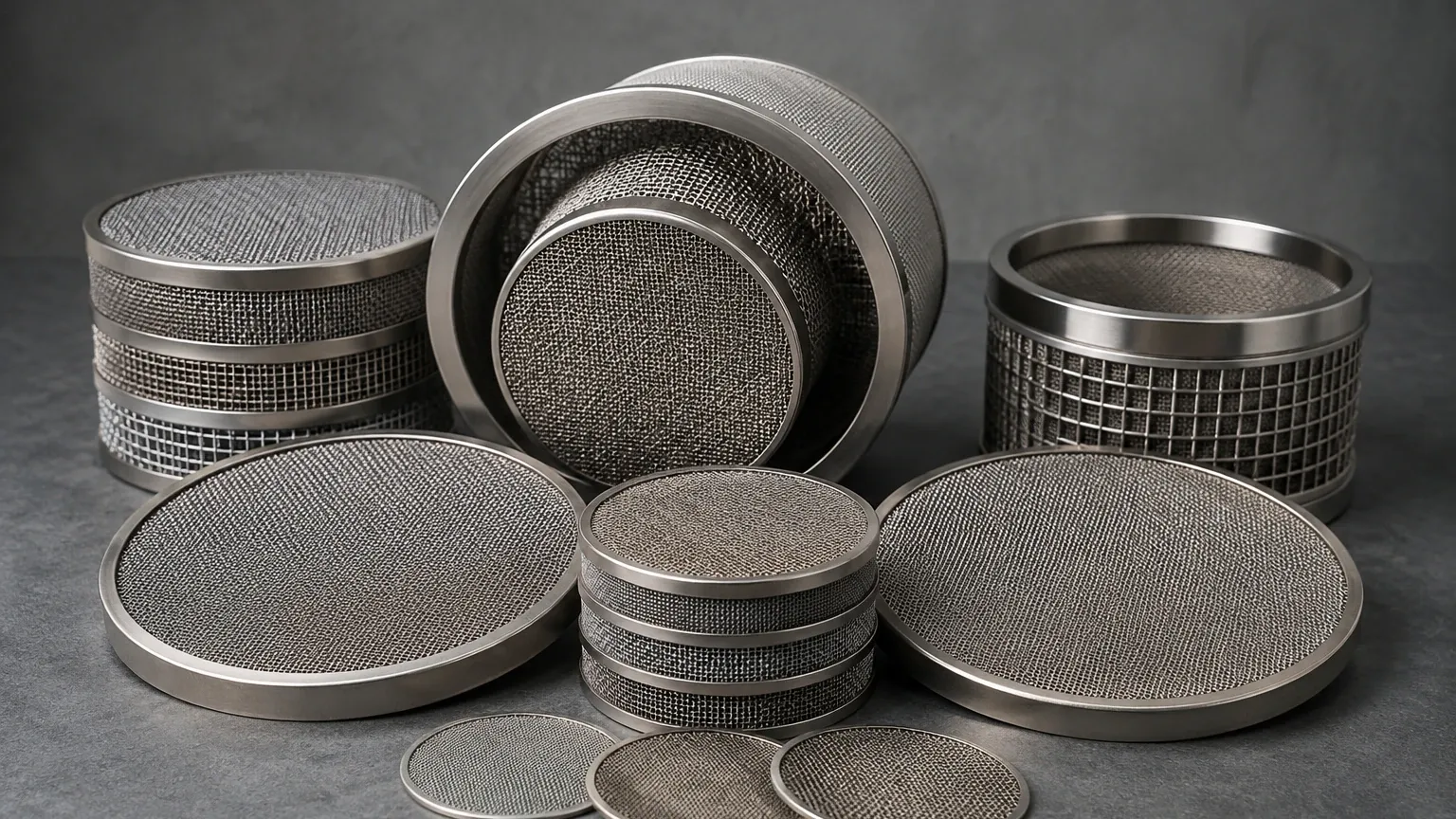
Construction and Design of Filter Discs & Packs
Filter discs and packs are rarely used as simple cut pieces of mesh. Their construction significantly impacts their integration into industrial machinery, such as plastic extruders, polymer melt filters, and centrifugal separators.
Single-Layer vs. Multi-Layer Packs
* Single-Layer Discs: Used primarily in low-pressure applications or as pre-filters. These are often made from plain weave stainless steel mesh.
* Multi-Layer Packs: These consist of several layers of different mesh counts, often spot-welded together or bound by an aluminum or stainless steel rim. A "filters 5" pack might include a 100-mesh outer layer for coarse debris, a 5-micron sintered layer for precision, and a 20-mesh layer for structural support.
Bordering and Sealing
To prevent bypass—where unfiltered fluid escapes around the edges of the disc—precision bordering is essential. Kaifil provides various bordering options, including:
* Aluminum Rim: Cost-effective and provides a good seal for polymer extrusion.
* Stainless Steel Rim: Offers superior chemical resistance and can be reused or cleaned multiple times.
* Spot Welding: Ideal for keeping multi-layer packs aligned without adding significant thickness to the edge.
Material Selection: 304 vs. 316L Stainless Steel
The performance of "filters 5" components is heavily dependent on the alloy used. While both 304 and 316L are common, the choice is dictated by the chemical environment and temperature.
304 Stainless Steel
304 is the workhorse of the filtration industry. It offers excellent strength and good corrosion resistance for standard water treatment, hydraulic oils, and food-grade applications. However, it is susceptible to chloride-induced pitting.
316L Stainless Steel
For more demanding environments, 316L is the preferred choice. The addition of molybdenum provides enhanced resistance to phosphoric acid, sulfuric acid, and chloride environments. The "L" stands for low carbon, which is critical if the filter discs or packs require welding, as it prevents carbide precipitation and maintains corrosion resistance in the heat-affected zones.
Specialty Alloys
In extreme cases involving highly corrosive chemicals or temperatures exceeding 500°C, specialty alloys like Hastelloy, Monel, or Inconel may be used to manufacture 5-micron filter discs. These materials ensure that the pore structure remains stable even under thermal expansion and chemical attack.
Industrial Applications for 5-Micron Filtration
Where exactly do "filters 5" solutions provide the most value? The applications span across several high-stakes industries where particulate contamination is not an option.
Chemical and Petrochemical Processing
In the chemical industry, 5-micron filter discs are used to protect catalysts and ensure the purity of downstream products. The ability of sintered stainless steel to withstand aggressive solvents and high temperatures makes it superior to polymer-based filters.
Polymer and Plastic Extrusion
In the production of fine films and fibers, even a 10-micron particle can cause a "break" in the production line. Multi-layer filter packs with a 5-micron core are used in screen changers to remove gels and degraded polymer, ensuring a smooth, high-quality output.
Pharmaceutical and Biotechnology
Sterility and purity are paramount in pharma. 5-micron filters are often used as a pre-filtration stage before 0.22-micron sterilizing filters. They remove larger aggregates and precipitates, preventing the more expensive sub-micron filters from clogging prematurely.
Hydraulic and Lubrication Systems
Modern hydraulic systems operate at extremely tight tolerances. Particles in the 5-micron range can cause abrasive wear on pumps and valves. Stainless steel Filter Discs & Packs are used in high-pressure lines to maintain fluid cleanliness and extend the life of the entire system.
Maintenance, Cleaning, and Total Cost of Ownership (TCO)
One of the primary advantages of stainless steel "filters 5" components over disposable alternatives is their cleanability. While the initial investment in a sintered 5-layer disc is higher than a paper or felt filter, the TCO is often much lower.
Cleaning Methods
* Ultrasonic Cleaning: Uses high-frequency sound waves to dislodge particles trapped deep within the 5-layer structure.
* Backwashing: Reversing the flow of fluid to push contaminants out of the mesh.
* Chemical Cleaning: Using specialized solvents to dissolve organic or inorganic deposits without damaging the stainless steel.
* Burn-off/Pyrolysis: For polymer applications, the filters can be heated in a controlled environment to carbonize the plastic, which is then removed via ultrasonic cleaning.
Determining Replacement Cycles
Engineers should monitor the differential pressure ($ΔP$) across the filter. Once the $ΔP$ reaches a predetermined "terminal pressure drop," the filter must be cleaned or replaced. Repeated cleaning cycles will eventually lead to a slight increase in the clean pressure drop due to entrained particles that cannot be removed, at which point the disc or pack should be retired.
Technical Selection Criteria for Engineers
When requesting a quote or designing a system around "filters 5" specifications, engineers should confirm the following data points to ensure application compatibility:
1. Fluid Characteristics: Viscosity, density, and chemical composition.
2. Operating Conditions: Maximum operating temperature and normal/peak pressure.
3. Flow Rate: Required liters per minute (LPM) or gallons per minute (GPM) at a specific $ΔP$.
4. Contaminant Profile: Type of particles (hard, soft, fibrous) and expected loading.
5. Mechanical Interface: Dimensions (diameter, thickness), housing type, and sealing requirements (gaskets or metal-to-metal).
Conclusion
Whether you are looking for the extreme durability of a 5-layer sintered mesh or the precision of a 5-micron absolute rating, the "filters 5" category represents a pinnacle of industrial filtration technology. By selecting high-quality stainless steel Filter Discs & Packs, industrial operators can achieve a balance of precision, strength, and long-term cost-efficiency.
Kaifil continues to support global engineering teams by providing customized filtration solutions that meet these exacting standards. From material selection to final production, our focus remains on delivering reliable components that perform in the most demanding industrial environments. When the success of your process depends on the integrity of your filtration, understanding the technical nuances of mesh construction and micron ratings is the first step toward optimized performance.
