


25 Micron Stainless Steel Woven Wire Mesh Filter: An Engineering Guide to Selection and Application
In industrial filtration, the 25-micron threshold represents a critical transition point between coarse straining and fine particulate separation. A 25 micron stainless steel woven wire mesh filter is a precision-engineered component designed to remove microscopic contaminants while maintaining the structural integrity required for high-pressure and high-temperature environments. Unlike polymer-based filters, stainless steel mesh offers a unique combination of mechanical strength, chemical resistance, and cleanability, making it a staple in chemical processing, hydraulic systems, and food production.
Selecting the right filtration media involves more than simply choosing a micron rating. Engineers must evaluate the weave geometry, material grade, and the structural configuration—often resulting in the specification of Wire Mesh Filter Cylinders & Tubes to ensure the filter can withstand operational stresses without bypassing or collapsing.
Understanding the 25 Micron Filtration Level
To put the 25-micron rating in perspective, a human hair is approximately 70 microns in diameter, while the lower limit of visibility for the human eye is roughly 40 microns. Therefore, a 25-micron filter is capturing particles that are invisible to the naked eye.
In the context of woven wire mesh, "25 micron" typically refers to the pore size or the aperture of the weave. However, it is essential to distinguish between nominal and absolute ratings. A nominal rating indicates the filter's ability to retain the majority of particles of a specific size, whereas an absolute rating (often achieved through high-precision Dutch weaves) ensures that 99.9% of particles larger than 25 microns are captured. For critical applications like protecting sensitive hydraulic valves or pharmaceutical batch processing, understanding the efficiency of the weave is paramount.
Material Science: Choosing the Right Stainless Steel Grade
The performance of a 25 micron stainless steel woven wire mesh filter is heavily dictated by the alloy used in its construction. While several grades exist, two dominate the industrial landscape:
1. Grade 304 Stainless Steel
This is the standard "18-8" stainless steel. It provides excellent strength and good corrosion resistance for general industrial use. It is suitable for water filtration, light chemical applications, and environments where high-intensity corrosive agents are not present.
2. Grade 316 and 316L Stainless Steel
For more demanding environments, Grade 316 is the preferred choice due to the addition of molybdenum, which enhances resistance to pitting and crevice corrosion, particularly in chloride-rich environments (such as marine or brine applications). Grade 316L (low carbon) is specifically utilized when welding is required in the fabrication of Wire Mesh Filter Cylinders & Tubes, as it prevents carbide precipitation that can lead to intergranular corrosion at the weld seams.
Weave Types for Fine Filtration
For a 25-micron rating, the choice of weave pattern significantly impacts flow resistance and mechanical durability.
* Plain Weave: The simplest pattern where wires cross over and under each other. While common for coarser mesh, achieving a stable 25-micron aperture in plain weave requires very fine wires, which may lack the necessary strength for high-pressure differentials.
* Twill Weave: Each shute wire passes successively over and under two warp wires. This allows for a heavier wire diameter for a given micron rating, providing better durability than plain weave for fine filtration.
* Plain Dutch Weave (PDW): This weave uses a larger diameter warp wire and a smaller diameter shute wire driven closely together. This creates a "tortuous path" for the fluid, offering superior strength and an absolute filtration rating. Most high-performance 25-micron cylinders utilize a variation of the Dutch weave to balance flow rate with particle retention.
Engineering Design: Wire Mesh Filter Cylinders & Tubes
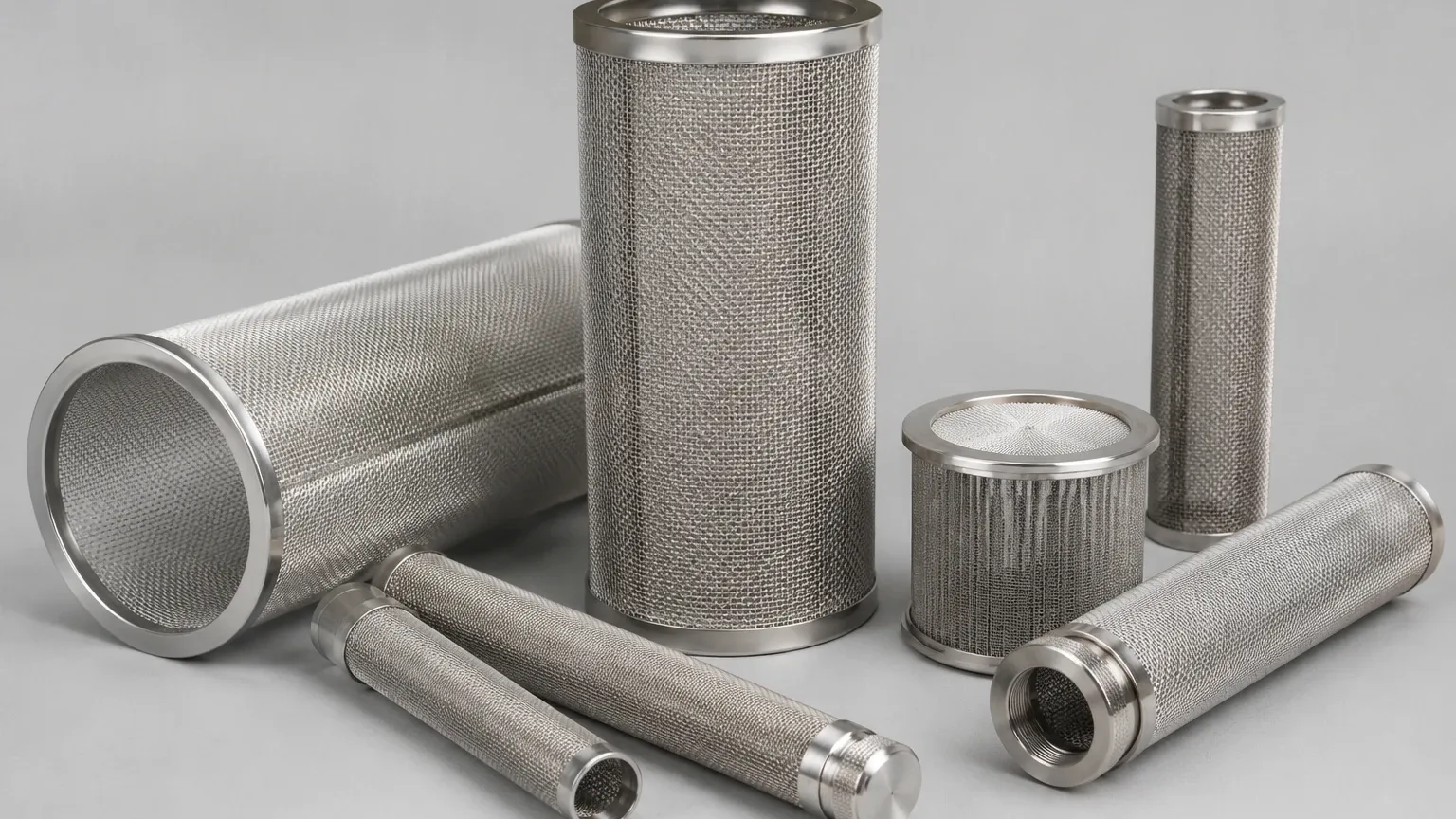
A 25-micron mesh is inherently delicate. On its own, the mesh may deform under the pressure of the fluid flow. To solve this, industrial filters are typically fabricated as Wire Mesh Filter Cylinders & Tubes. These components are engineered with a multi-layered approach:
1. The Filtration Layer: The 25-micron woven wire mesh that performs the actual separation.
2. The Support Layer: A coarser, heavier mesh (such as 10 or 20 mesh) placed behind the filtration layer to provide mechanical backing.
3. The Perforated Core: In high-pressure applications, the mesh layers are wrapped around a perforated stainless steel tube. This core provides the ultimate structural rigidity, preventing the filter from collapsing under high differential pressure (Delta P).
This cylindrical geometry is preferred in B2B industrial settings because it maximizes the surface area within a compact footprint, allowing for higher flow rates and longer service intervals between cleanings.
Performance Evaluation: Flow Rate and Pressure Drop
When integrating a 25 micron stainless steel woven wire mesh filter into a system, engineers must calculate the clean pressure drop. Every filter media introduces resistance to the flow. As the 25-micron pores begin to capture contaminants, the effective open area decreases, and the pressure drop increases.
Key factors influencing performance include:
* Viscosity of the Fluid: Higher viscosity fluids (like heavy oils) require a larger surface area to maintain the same flow rate through 25-micron openings compared to water.
* Face Velocity: The speed at which the fluid hits the mesh surface. Lower face velocities generally result in better filtration efficiency and longer filter life.
* Contaminant Loading: The nature of the solids (hard particles vs. soft, deformable gels) affects how quickly the mesh will blind or clog.
Maintenance, Cleaning, and Total Cost of Ownership (TCO)
One of the primary advantages of stainless steel filters over disposable cartridges is their cleanability. A 25-micron mesh can be restored to near-original performance through several methods:
* Backwashing: Reversing the flow of the fluid to dislodge particles from the surface of the mesh.
* Ultrasonic Cleaning: Using high-frequency sound waves in a cleaning solvent to vibrate trapped particles out of the intricate weave of a Dutch weave mesh.
* Chemical Cleaning: Using mild acids or caustic solutions to dissolve organic or mineral buildup, provided the chemical is compatible with the 304 or 316 stainless steel grade.
While the initial capital expenditure for a stainless steel filter cylinder is higher than a plastic disposable, the TCO is often significantly lower. The longevity of the metal, combined with the elimination of frequent replacement costs and disposal fees, makes it the more sustainable and cost-effective choice for long-term industrial operations.
Buyer’s Checklist: Information Required for Custom Solutions
When sourcing Wire Mesh Filter Cylinders & Tubes for a specific project, providing comprehensive technical data to the manufacturer ensures the final product meets the application's demands. International buyers and engineers should confirm the following parameters:
1. Micron Rating and Efficiency: Is 25 micron a nominal or absolute requirement?
2. Operating Environment: What is the chemical composition of the fluid? What are the minimum and maximum operating temperatures?
3. Pressure Parameters: What is the normal operating pressure, and what is the maximum allowable differential pressure before cleaning is required?
4. Mechanical Dimensions: Specify the outer diameter (OD), inner diameter (ID), and overall length. Include details on end fittings (e.g., threaded, flanged, or open-ended).
5. Flow Direction: Will the fluid flow from the outside-in (standard for most cylinders) or inside-out?
Conclusion
The 25 micron stainless steel woven wire mesh filter is a versatile and robust solution for precision industrial filtration. By understanding the nuances of weave types, material grades, and the structural benefits of Wire Mesh Filter Cylinders & Tubes, engineering teams can optimize their processes for maximum efficiency and durability. Whether protecting high-value downstream equipment or ensuring the purity of a final product, these stainless steel components provide the reliability that modern industrial environments demand.
Download 25 Micron Stainless Steel Woven Wire Mesh Filter as a PDF
