


How Long Does a Merv 8 Filter Last
In industrial and commercial filtration environments, the longevity of a filter is not merely a matter of maintenance schedules; it is a critical variable in operational efficiency, energy consumption, and equipment protection. When engineers and facility managers ask, "how long does a merv 8 filter last," the answer involves a complex interplay between the filter’s physical properties, the environmental contaminant load, and the specific requirements of the downstream processes.
Minimum Efficiency Reporting Value (MERV) 8 filters are widely utilized as primary filters in commercial HVAC systems and as pre-filters in industrial air handling units. While they are effective at capturing particles between 3.0 and 10.0 microns—such as dust mites, lint, and large pollen—their service life is finite. Understanding the technical boundaries of these filters helps in planning replacement cycles and evaluating when a transition to more robust solutions, such as custom Filter Discs & Packs, is necessary for demanding industrial applications.
Understanding the MERV 8 Rating and Performance Standards
The MERV scale, developed by ASHRAE (American Society of Heating, Refrigerating and Air-Conditioning Engineers), provides a standardized measurement of a filter's ability to capture particles of varying sizes. A MERV 8 filter is designed to achieve a dust spot efficiency of approximately 30% to 35% and must capture at least 70% of particles in the 3.0 to 10.0-micron range.
In an industrial context, MERV 8 filters are often pleated, which increases the surface area of the media (typically synthetic fibers or cotton-polyester blends) relative to the face area of the filter frame. This design allows for a higher dust-holding capacity compared to flat-panel fiberglass filters. However, because these materials are often disposable and susceptible to moisture or high-pressure differentials, their lifespan is significantly shorter than that of precision-engineered metal filtration components.
Factors Influencing the Lifespan of a MERV 8 Filter
Determining how long a MERV 8 filter lasts requires an analysis of the operating environment. While a standard recommendation for commercial buildings might be 90 days, industrial applications often demand more frequent intervals or more durable materials.
1. Contaminant Concentration and Particle Size Distribution
The primary factor is the volume of particulate matter the filter encounters. In a cleanroom pre-filtration stage, a MERV 8 filter might last the full 90 days. Conversely, in a metalworking facility or a food processing plant where airborne particulates are dense, the filter may reach its terminal pressure drop in as little as 30 days. The nature of the particles—whether they are dry, oily, or abrasive—also dictates how quickly the media pores become occluded.
2. System Airflow and Velocity
Industrial HVAC systems often move air at higher velocities than residential units. Higher airflow increases the rate at which particles are impinged upon the filter media. If the system operates 24/7, the cumulative exposure to contaminants is quadrupled compared to a system that runs only during standard business hours. Engineers must calculate the total "run-time hours" rather than calendar days to accurately predict filter failure.
3. Humidity and Environmental Moisture
Standard MERV 8 pleated filters are often sensitive to humidity. High moisture levels can cause the filter media to sag or promote the growth of microbial colonies if the dust load contains organic matter. In environments with high humidity or chemical vapors, disposable media can degrade structurally, leading to "blow-through" or bypass, where unfiltered air escapes around the edges of the filter.
Monitoring Pressure Drop: The Technical Indicator for Replacement
From an engineering perspective, the most reliable way to determine how long a MERV 8 filter lasts is to monitor the pressure drop (ΔP) across the filter bank using a manometer or differential pressure gauge.
Every filter has an initial resistance (clean pressure drop) and a recommended final resistance (terminal pressure drop). For most MERV 8 filters, the initial resistance is typically between 0.2 and 0.3 inches of water gauge (w.g.). Manufacturers generally recommend replacement when the pressure drop reaches 0.5 to 1.0 inches w.g.
Operating a filter beyond its terminal pressure drop leads to several negative outcomes:
* Increased Energy Consumption: The system’s fan must work harder to pull air through the clogged media, leading to higher utility costs.
* Reduced Airflow: Decreased CFM (Cubic Feet per Minute) can compromise the temperature and humidity control of the facility.
* Media Breach: Excessive pressure can cause the filter media to tear or the frame to collapse, allowing contaminants to foul downstream coils or high-efficiency HEPA filters.
MERV 8 in Industrial Pre-Filtration vs. Specialized Metal Filters
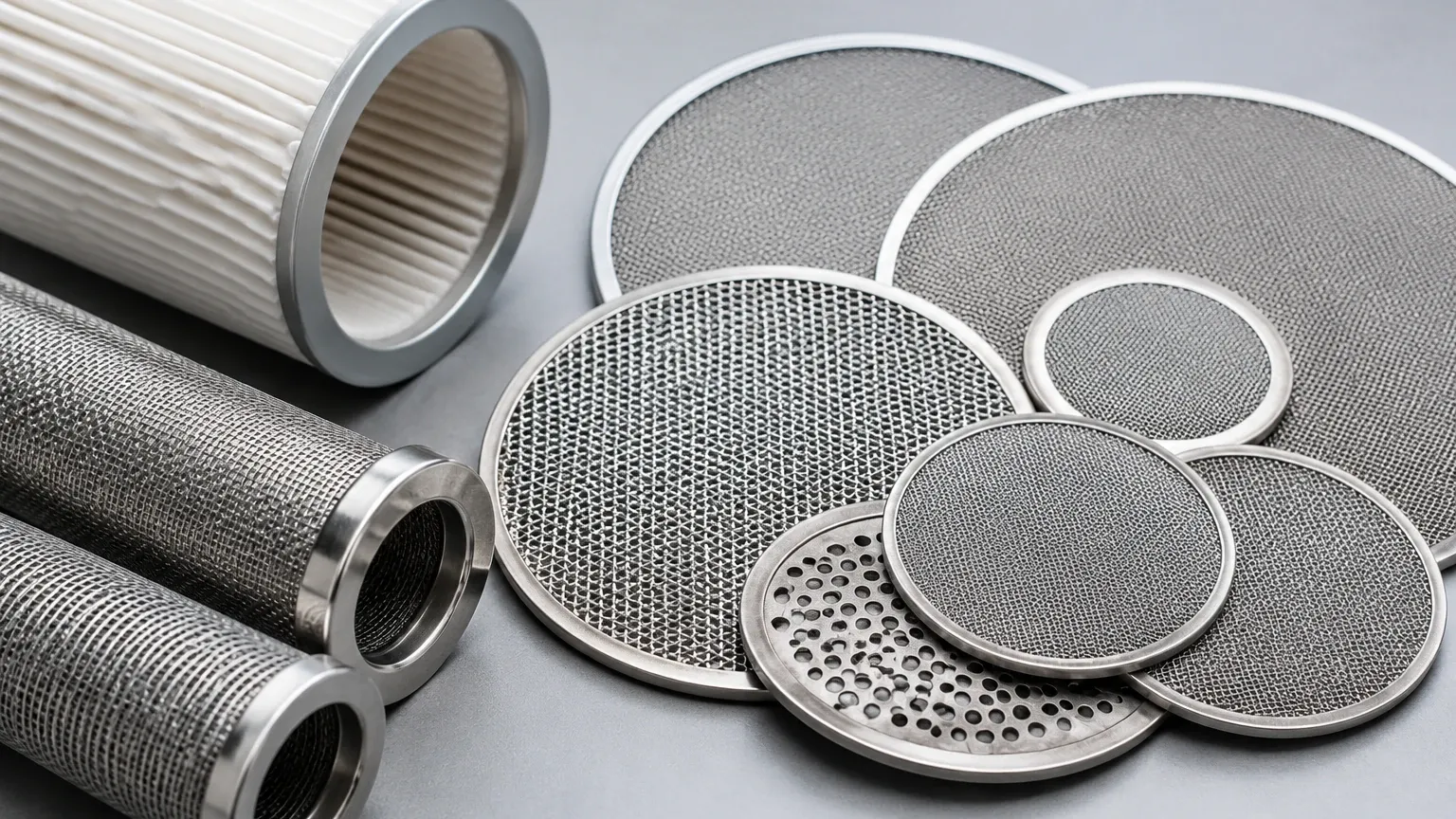
While MERV 8 filters are excellent for general air quality, many industrial processes involving liquids, high temperatures, or corrosive chemicals require a different approach. In these scenarios, disposable pleated media is insufficient. This is where Filter Discs & Packs manufactured from stainless steel wire mesh become essential.
Unlike disposable MERV 8 filters, stainless steel filter discs are designed for:
* Extreme Temperatures: Where synthetic fibers would melt or degrade, stainless steel maintains structural integrity.
* Chemical Compatibility: Resistance to solvents, acids, and alkaline solutions that would dissolve standard filter adhesives.
* Reusability: Many metal filter packs can be cleaned (via ultrasonic cleaning or backwashing) and returned to service, offering a lower total cost of ownership in specific process-filtration roles.
For engineers designing systems that require precise micron ratings and high mechanical strength, comparing the lifecycle of a disposable MERV 8 air filter to a permanent metal mesh filter is a vital part of the specification process.
Risks of Overextending Filter Service Life
Attempting to extend the life of a MERV 8 filter beyond its rated capacity is a common but costly mistake. In industrial settings, the risks include:
Downstream Equipment Damage
If a MERV 8 filter is used as a pre-filter for a more expensive MERV 14 or HEPA filter, its failure will cause the secondary filters to clog prematurely. Replacing a HEPA filter is significantly more expensive than replacing a MERV 8 pre-filter.
Product Contamination
In industries like pharmaceutical manufacturing or food processing, a bypassed filter can introduce contaminants into the production line. This can result in batch rejection, regulatory fines, and significant financial loss.
Health and Safety Compliance
Accumulated dust on a filter can become a fire hazard in certain industrial environments. Furthermore, poor air filtration can lead to violations of occupational health standards regarding indoor air quality (IAQ).
Optimizing Filtration Efficiency and Cost-to-Performance Ratios
To optimize how long a MERV 8 filter lasts, engineers should consider the following best practices:
1. Gasket Integrity: Ensure that the filter frames are properly sealed. Air bypass is often mistaken for a long-lasting filter, when in reality, the air is simply flowing around the media rather than through it.
2. Staged Filtration: Use a low-cost MERV 4 fiberglass filter as a "sacrificial" pre-filter to catch the largest debris, thereby extending the life of the MERV 8 unit.
3. Scheduled Inspections: In the first year of a new process, inspect filters monthly to establish a baseline for dust loading and pressure drop.
4. Material Upgrades: If a MERV 8 filter is failing due to physical stress rather than particle loading, consider moving to a reinforced mesh or a custom-designed metal filter component.
The Role of Custom Filtration Solutions
In many B2B applications, standard off-the-shelf MERV 8 filters are only one part of a larger filtration strategy. For specialized machinery, hydraulic systems, or high-pressure gas lines, standard HVAC-style filters cannot provide the necessary performance.
Custom manufacturers like Kaifil provide precision-engineered Filter Discs & Packs that offer exact filtration accuracy and durability that disposable media cannot match. When the question is no longer about air quality but about process purity and component protection, shifting from disposable MERV-rated media to stainless steel wire mesh provides a more reliable and predictable service life.
Conclusion
So, how long does a MERV 8 filter last? In a standard, low-load environment, 90 days is a reasonable expectation. However, in the rigorous world of industrial manufacturing, that window can shrink to 30 days or less. The key to successful filtration management lies in moving beyond guesswork and utilizing technical data—specifically pressure drop readings and environmental analysis—to dictate replacement cycles. By understanding the limitations of MERV 8 media and knowing when to integrate high-performance metal filtration components, engineers can ensure system longevity, maintain product quality, and optimize the total cost of filtration operations.
