


Are All Merv 8 Filters the Same
In the landscape of industrial filtration, the Minimum Efficiency Reporting Value (MERV) serves as a standardized yardstick for evaluating the performance of air and fluid filtration media. Among these ratings, MERV 8 is one of the most frequently specified levels for general-purpose filtration. However, for engineers and procurement specialists, a critical question often arises: are all MERV 8 filters the same?
While the rating itself implies a specific level of efficiency in capturing particles between 3.0 and 10.0 microns, the mechanical construction, material composition, and operational longevity of these filters vary significantly between manufacturers and applications. In heavy-duty industrial environments—such as chemical processing, food and beverage production, and hydraulic systems—relying solely on the MERV 8 label without considering the underlying engineering can lead to premature system failure, increased pressure drops, and higher total cost of ownership.
Understanding the MERV 8 Performance Standard
The MERV rating system, developed by the American Society of Heating, Refrigerating and Air-Conditioning Engineers (ASHRAE) under Standard 52.2, classifies filters based on their ability to capture particles of varying sizes. A MERV 8 rating specifically indicates that a filter must capture at least 70% of particles in the 3.0 to 10.0-micron range (E3 particles).
However, the rating only describes the *minimum* efficiency during a controlled test. It does not account for how that efficiency is maintained over time or how the filter performs under fluctuating temperatures, high humidity, or exposure to corrosive chemicals. In industrial settings, a "MERV 8 equivalent" might be achieved through different filtration mechanisms, such as mechanical sieving in stainless steel wire mesh or electrostatic attraction in synthetic fibers. While both may meet the 70% threshold in a lab, their real-world performance in a processing plant will differ vastly.
Material Composition: Why Media Type Matters
The most significant differentiator between MERV 8 filters is the material used for the filtration media. In commercial HVAC applications, polyester or cotton-polyester blends are common. In industrial filtration, however, the choice of material is dictated by the environment.
Synthetic and Glass Fiber Media
Many standard MERV 8 filters use synthetic pleated media. These are cost-effective for air handling but often lack the structural integrity required for high-pressure fluid filtration or high-temperature air streams. Glass fiber media can offer higher temperature resistance but may be prone to fiber shedding, which is unacceptable in pharmaceutical or food-grade applications.
Metal Wire Mesh and Precision Components
For demanding industrial processes, stainless steel wire mesh is often the preferred choice. While the MERV scale is predominantly used for air filters, the micron-rating equivalent of MERV 8 (approximately 25-30 microns for absolute filtration) is a common specification for Filter Discs & Packs. Stainless steel 304 or 316L wire mesh provides a level of durability and chemical compatibility that synthetic MERV 8 filters cannot match. These metal components are engineered to withstand high differential pressures and can be cleaned and reused, whereas synthetic filters are almost exclusively disposable.
Airflow Efficiency and Initial Pressure Drop
One of the most critical engineering considerations when selecting a filter is the initial pressure drop (ΔP). This is the resistance the filter poses to the air or fluid stream when it is clean. Not all MERV 8 filters are designed with the same aerodynamic or hydrodynamic efficiency.
A filter with a high pleat count generally offers more surface area, which reduces the face velocity of the fluid passing through the media. This results in a lower initial pressure drop and a longer service life. Conversely, cheaper MERV 8 filters may use fewer pleats or a denser, lower-quality media to achieve the same efficiency rating, leading to higher energy consumption as pumps or fans must work harder to overcome the resistance. In industrial scales, even a small difference in ΔP can translate into thousands of dollars in annual energy costs.
Industrial vs. Commercial Grade: Structural Integrity
The environment in which a filter operates determines whether a standard MERV 8 filter will suffice or if a reinforced industrial version is required. Structural integrity involves the frame, the bonding agents, and the support backing of the media.
1. Frame Construction: Commercial filters often use moisture-resistant beverage board frames. In industrial settings where high humidity or oil mist is present, these frames can soften and collapse. Industrial-grade filters utilize galvanized steel, aluminum, or stainless steel frames to ensure the filter remains seated in the housing under high load.
2. Media Backing: To prevent the media from fluttering or collapsing under high flow rates, industrial filters often incorporate an expanded metal backing. This is particularly important for filters that must handle variable frequency drive (VFD) systems where airflow or fluid pressure fluctuates.
3. Adhesives and Sealants: In chemical processing, the adhesives used to bond the media to the frame must be resistant to solvents and high temperatures. Standard MERV 8 filters may use hot-melt glues that fail at temperatures exceeding 150°F, whereas industrial versions use specialized epoxies or mechanical seals.
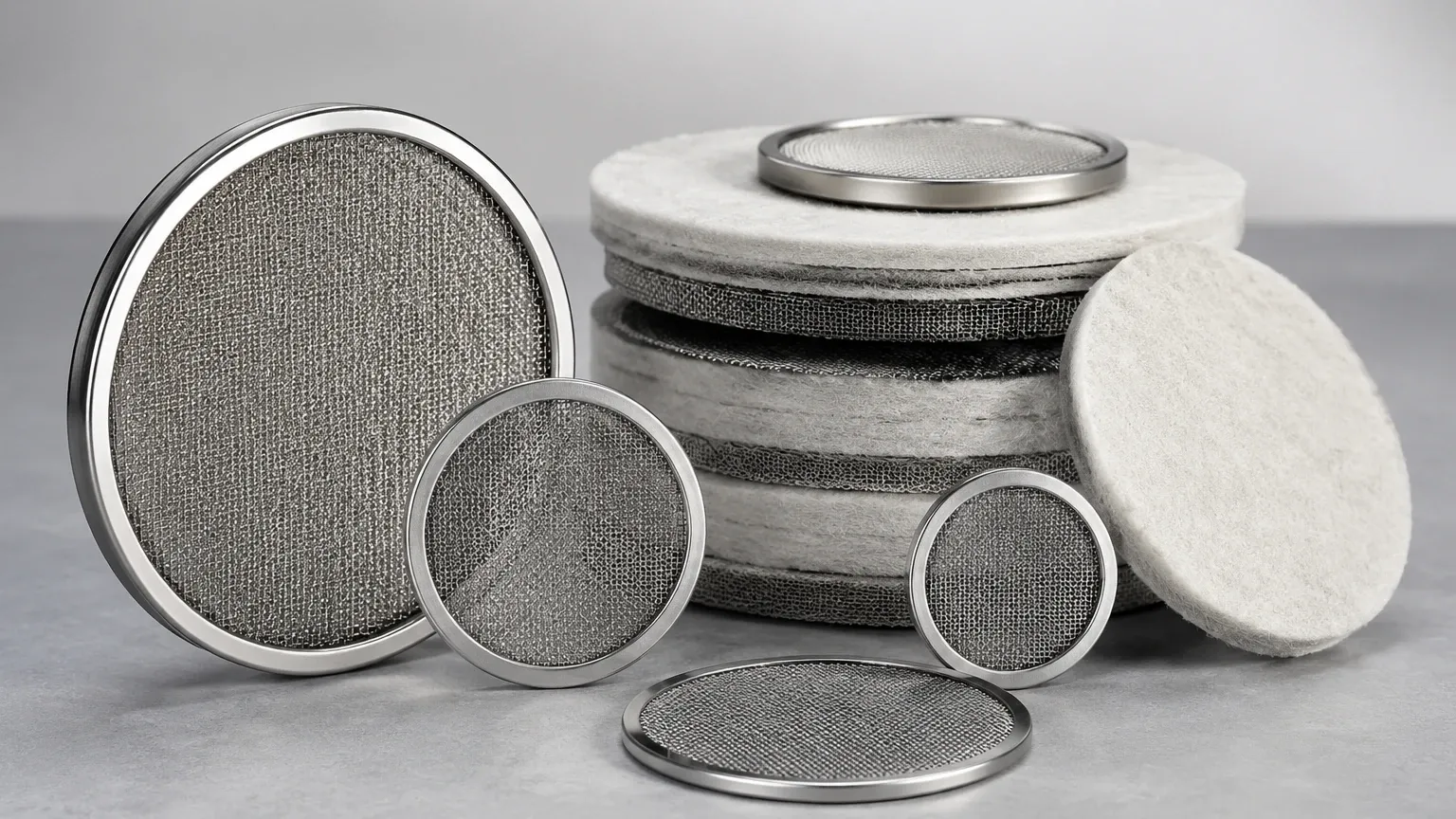
Selecting the Right Filter Discs & Packs for Precision Applications
In many liquid filtration and polymer extrusion processes, the concept of a MERV rating is translated into specific micron ratings. When engineers look for the performance characteristics of a MERV 8 filter in a compact, high-pressure format, they often turn to specialized Filter Discs & Packs.
These components are manufactured by layering different grades of stainless steel wire mesh to achieve a specific filtration fineness while maintaining high flow rates. Unlike a standard pleated HVAC filter, these packs are designed for:
* High-Pressure Resistance: Capable of withstanding hundreds of PSI without deformation.
* Precise Micron Retention: Ensuring that particles above a specific size are consistently removed from the process stream.
* Thermal Stability: Operating effectively in temperatures ranging from cryogenic levels to over 800°F.
When evaluating these products, engineers must confirm the weave type (plain, twilled, or Dutch weave) and the layering strategy, as these factors influence the dirt-holding capacity and the ease of backwashing.
Total Cost of Ownership: Disposable vs. Cleanable Solutions
When asking if all MERV 8 filters are the same, one must look beyond the purchase price. The total cost of ownership (TCO) includes the initial cost, maintenance labor, disposal fees, and energy impact.
* Disposable Filters: Standard synthetic MERV 8 filters have a low upfront cost but require frequent replacement. In a large-scale facility, the labor cost of changing hundreds of filters and the environmental impact of sending used filters to a landfill can be substantial.
* Cleanable Metal Filters: While the initial investment in stainless steel filter components is higher, their ability to be cleaned (via ultrasonic cleaning, chemical baths, or backflushing) allows them to remain in service for years. This is particularly advantageous in closed-loop systems where process purity is essential and downtime for filter changes must be minimized.
Common Risks of Using Substandard MERV 8 Filters
Choosing a filter based solely on the MERV 8 label without verifying technical specifications can introduce several risks into an industrial process:
* Bypass: Poorly constructed frames or inconsistent media density can allow unfiltered air or fluid to bypass the media, contaminating downstream equipment.
* Media Migration: Low-quality synthetic or fiberglass media may shed fibers into the process stream, leading to product contamination.
* Premature Loading: Filters with insufficient surface area will "blind" or clog rapidly, leading to frequent system shutdowns and increased maintenance cycles.
* Inaccurate Ratings: Not all manufacturers adhere strictly to ASHRAE 52.2 testing protocols. Some may claim "MERV 8 performance" based on internal tests that do not reflect actual operating conditions.
Conclusion: Technical Verification is Key
In conclusion, all MERV 8 filters are certainly not the same. The rating provides a baseline for efficiency, but it does not define the quality, durability, or suitability of the filter for a specific industrial application. Engineers must look deeper into the technical data sheets, examining the pressure drop curves, material compatibility, and structural design.
For those working in specialized sectors like chemical manufacturing or high-precision engineering, moving away from standard disposable filters toward customized Filter Discs & Packs often provides a more reliable and cost-effective solution. By prioritizing material integrity and engineering precision over nominal ratings, facilities can ensure optimal performance, protect sensitive equipment, and reduce long-term operational costs. Always consult with a filtration specialist to match the specific requirements of your process with the appropriate filtration technology, ensuring that the "MERV 8" performance you expect is the performance you actually receive.
