


Metal Mesh Filter Nearby: An Engineering Guide to Sourcing and Selection
In industrial operations, the sudden failure of a filtration component often triggers an immediate search for a "metal mesh filter nearby." While local availability is critical for minimizing downtime, engineers and procurement specialists must balance the urgency of replacement with the technical requirements of the application. Industrial filtration is rarely a one-size-fits-all solution; the performance of Wire Mesh Filter Cylinders & Tubes depends heavily on precise material selection, weave patterns, and structural integrity.
This guide examines the technical considerations involved in selecting metal mesh filters, comparing the trade-offs between local off-the-shelf sourcing and specialized manufacturing, and outlining the performance metrics essential for demanding industrial environments.
Sourcing Considerations: Finding a Metal Mesh Filter Nearby vs. Specialized Manufacturing
When a maintenance emergency occurs, the instinctual search for a metal mesh filter nearby is driven by the need to restore production. Local industrial distributors often carry standard sizes and common mesh grades. However, for specialized processes in the chemical, pharmaceutical, or food and beverage sectors, a standard component may not meet the necessary specifications for chemical compatibility or filtration accuracy.
The Limitations of Local Stock
Standard stock items are typically designed for general-purpose applications. They may use lower-grade stainless steel or simplified construction methods that cannot withstand high pressure or aggressive cleaning cycles. For engineers, the risk of using an incompatible "nearby" filter includes:
* Bypass Risks: Poorly fitted seams or end caps can allow unfiltered media to pass through.
* Material Degradation: If the local stock is SS304 but the process requires SS316L, premature corrosion and media contamination are inevitable.
* Inaccurate Micron Ratings: General-purpose mesh often lacks the certified absolute micron rating required for precision filtration.
The Value of Specialized OEM Support
Working with a manufacturer like Kaifil allows for the customization of filtration components to exact process parameters. While shipping from a specialized facility may take longer than a local pickup, the resulting component is engineered for longevity and specific performance targets, ultimately reducing the total cost of ownership (TCO).
Technical Specifications of Wire Mesh Filter Cylinders & Tubes
Wire mesh filters are foundational components in liquid and gas filtration. Understanding their construction is vital for making an informed purchasing decision. These filters are typically fabricated by forming woven wire cloth into cylindrical shapes, which are then secured via advanced welding techniques.
Weave Types and Their Impact
The method by which the wires are woven determines the filter's strength, flow rate, and particle retention capabilities:
1. Plain Weave: The simplest pattern where wires cross over and under each other. It offers high flow rates but is generally limited to coarser filtration tasks.
2. Twill Weave: Each shute wire passes successively over and under two warp wires. This allows for a heavier wire diameter and finer mesh counts, providing increased strength for high-pressure applications.
3. Dutch Weave (Plain and Twill): This weave uses a larger diameter for warp wires and a smaller diameter for shute wires. The result is a dense, high-strength mesh with very fine openings, ideal for high-pressure filtration and precise particle separation.
Structural Reinforcement
In many industrial settings, a single layer of mesh is insufficient to withstand the differential pressure across the filter. Wire Mesh Filter Cylinders & Tubes are often designed with multiple layers. A common configuration includes a fine filtration layer protected by coarser drainage and support layers. This "multi-layer" approach prevents the fine mesh from deforming or collapsing under load.
Material Engineering for Corrosive and High-Temperature Environments
The choice of alloy is perhaps the most critical factor in filter longevity. When searching for a metal mesh filter nearby, it is essential to verify the specific grade of stainless steel provided.
Stainless Steel 304 vs. 316L
* Grade 304: Suitable for basic water treatment and general industrial use where corrosion risk is minimal. It is cost-effective but susceptible to chloride-induced pitting.
* Grade 316/316L: The industry standard for chemical processing and marine environments. The addition of molybdenum provides significantly better resistance to acids and salts. The "L" (low carbon) variant is preferred for welded components to prevent carbide precipitation at the weld seams.
Specialized Alloys
For extreme environments, standard stainless steel may fail. Specialized applications may require:
* Hastelloy: For highly acidic or alkaline environments.
* Monel: Specifically for applications involving hydrofluoric acid or seawater.
* Inconel: Best suited for high-temperature gas filtration where oxidation resistance is paramount.
Evaluating Filtration Efficiency: Micron Ratings and Flow Dynamics
Engineers must distinguish between nominal and absolute micron ratings when evaluating filters. A nominal rating refers to the ability of the filter to retain a certain percentage of particles of a specific size. An absolute rating, however, indicates that 99.9% of particles above that size will be captured. For critical pharmaceutical or hydraulic applications, only absolute-rated Wire Mesh Filter Cylinders & Tubes should be utilized.
Pressure Drop (ΔP) Considerations
Every filter introduces a resistance to flow, known as pressure drop. An improperly selected filter can lead to excessive energy consumption by pumps or even system failure. Factors influencing pressure drop include:
* Open Area Percentage: A higher open area reduces initial pressure drop but may compromise the structural integrity of the mesh.
* Fluid Viscosity: Higher viscosity fluids require larger surface areas or coarser mesh to maintain acceptable flow rates.
* Contaminant Loading: As the filter captures particles, the pressure drop increases. Engineering the filter with sufficient surface area ensures a longer service life before the terminal pressure drop is reached.
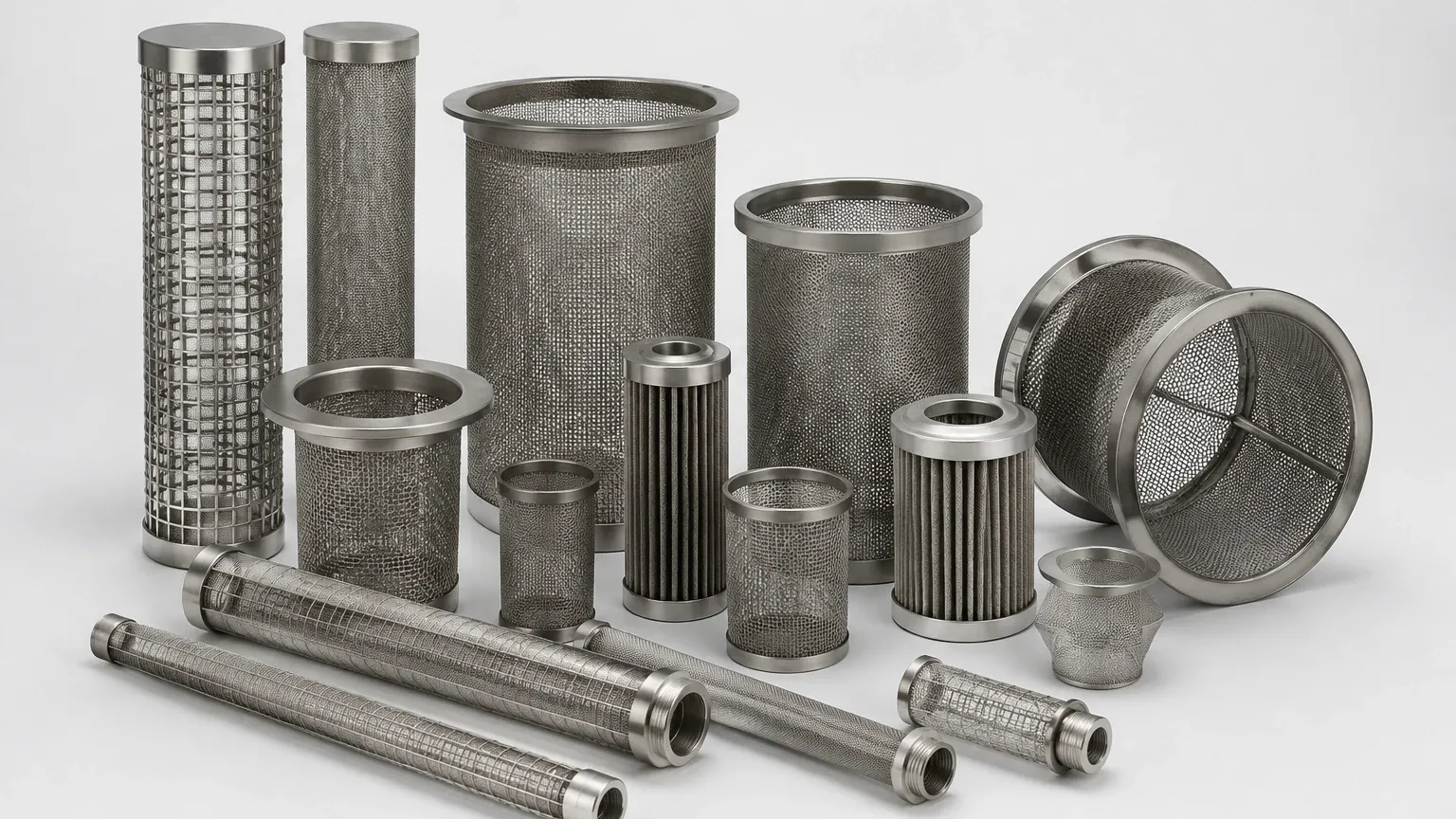
Custom Fabrication and OEM Integration for Industrial Systems
One of the primary advantages of sourcing from a specialized manufacturer is the ability to customize the mechanical interface of the filter. Standard components found "nearby" may require adapters or modifications that introduce potential leak points.
Custom End Fittings
Filters can be manufactured with various end-cap configurations to match existing housing requirements:
* Threaded Connections (NPT/BSP): For secure, high-pressure liquid lines.
* Flanged Ends: For large-scale industrial piping.
* O-Ring Seals (222/226): Common in the food and beverage industry to ensure a sanitary, bypass-free seal.
* Plain Ends: For use with compression fittings or internal support structures.
Precision Welding
The integrity of a wire mesh filter depends on the quality of its seams. In high-purity industries, plasma or TIG welding is used to create smooth, burr-free joints that do not harbor bacteria or contribute to metallic shedding. This level of precision is rarely found in generic, mass-produced filters.
Operational Longevity: Maintenance and Cleaning Protocols
Unlike disposable polymer filters, stainless steel wire mesh filters are designed for reuse. This sustainability is a major driver for their use in large-scale industrial processes. However, the effectiveness of the cleaning process determines the filter's ultimate lifespan.
Cleaning Methods
1. Backwashing: Reversing the flow of fluid to dislodge particles trapped on the surface. This is most effective for surface-loading mesh.
2. Ultrasonic Cleaning: Using high-frequency sound waves in a cleaning solution to remove deeply embedded particles. This is the preferred method for fine Dutch weave meshes.
3. Chemical Cleaning: Using solvents or acids to dissolve organic or mineral scaling. Compatibility between the cleaning agent and the filter material must be verified.
Replacement Cycles
While metal filters are durable, they are not infinite. Factors such as fatigue from pressure pulsations, erosion from abrasive particles, and eventual blinding (permanent clogging) will necessitate replacement. Establishing a regular inspection schedule helps engineers identify signs of mesh deformation or seam failure before a catastrophic breakdown occurs.
Conclusion: Making the Informed Choice
While the search for a "metal mesh filter nearby" provides a solution for immediate needs, the long-term efficiency and safety of an industrial system depend on precision engineering. Selecting the correct Wire Mesh Filter Cylinders & Tubes requires a deep understanding of weave patterns, material science, and fluid dynamics.
By partnering with a specialized manufacturer like Kaifil, engineers gain access to technical expertise that ensures every filtration component is optimized for its specific environment. Whether you are designing a new system or upgrading an existing process, prioritizing technical specifications over mere proximity will result in higher filtration accuracy, reduced maintenance costs, and a more reliable production line.
